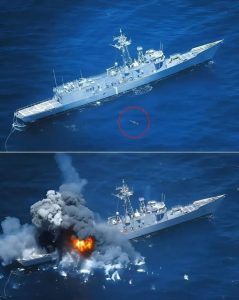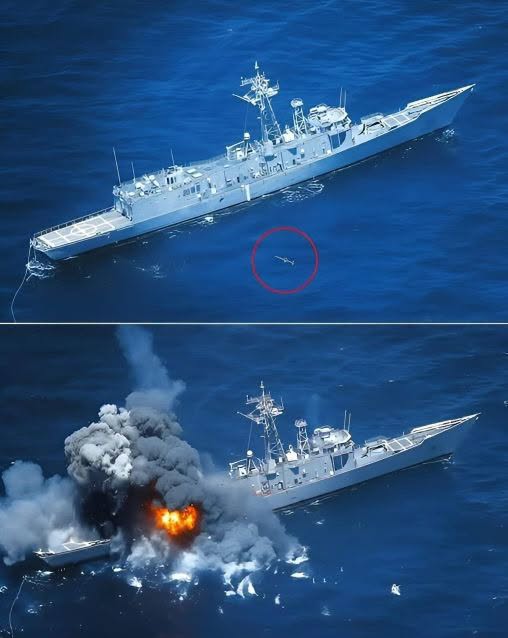
USS Rodney M. Davis (FFG-60) Sinks After Being Hit? Here’s What You Should Know
Headlines claiming that “USS Rodney M. Davis (FFG-60) sank after being hit” often spread rapidly across social media, especially during periods of international tension. Such posts are typically written to provoke curiosity and encourage clicks, but they should not be accepted as fact without confirmation from reliable sources.
The USS Rodney M. Davis (FFG-60) was an Oliver Hazard Perry-class guided-missile frigate commissioned into the U.S. Navy in 1987. Throughout its active service, the ship participated in numerous exercises, maritime security operations, and international deployments. Named after Marine Sergeant Rodney Maxwell Davis, a Medal of Honor recipient during the Vietnam War, the frigate earned a respected place in U.S. naval history.
After more than two decades of service, the ship was officially decommissioned in 2015. Following decommissioning, it was no longer part of the active U.S. fleet. In 2022, the vessel was intentionally sunk during the U.S.-led Rim of the Pacific (RIMPAC) military exercise as part of a planned live-fire training event known as a SINKEX (Sinking Exercise). During such exercises, retired ships are used as targets to help naval forces train under realistic conditions while evaluating the performance of modern weapons systems.
Because of this history, sensational posts claiming the USS Rodney M. Davis was recently “hit” in combat can easily mislead readers if they omit the important context that the ship had already been retired and later deliberately sunk during a military exercise.
Modern naval warfare is highly complex. Warships operate within carefully coordinated fleets that include destroyers, submarines, surveillance aircraft, and logistical support vessels. Advanced radar systems, electronic warfare equipment, missile defenses, and intelligence networks work together to detect and respond to threats. As a result, verified reports of a naval vessel being attacked are major international news events that receive immediate attention from governments and established media organizations.
If an active U.S. Navy warship were actually sunk during combat today, the consequences would be enormous. Military leaders would hold emergency briefings, government officials would issue statements, and allies would closely monitor the situation. News organizations worldwide would provide continuous coverage while analysts assessed the strategic implications. Such an event would not remain confined to a single viral social media post.
Unfortunately, social media platforms often reward sensational content. Dramatic headlines frequently include phrases such as “Breaking News,” “Just Minutes Ago,” or “See More” to encourage readers to click before verifying the information. Images accompanying these posts are sometimes taken from unrelated military exercises, historical events, or even video games, creating a misleading impression that a recent attack has occurred.
One reason misinformation spreads so quickly is that military operations naturally involve uncertainty. During periods of heightened international tension, rumors often circulate before official information becomes available. Some posts combine genuine photographs with false captions, while others recycle years-old footage and present it as current events.
Responsible journalism follows a different approach. Before reporting a major military incident, reputable news organizations seek confirmation from multiple independent sources, including official military statements, satellite imagery when available, eyewitness accounts, and expert analysis. This verification process reduces the risk of publishing inaccurate or misleading information.
Readers can also evaluate extraordinary claims by asking several simple questions. Is the event being reported by multiple well-established news organizations? Have government agencies or military officials released statements? Does the story provide evidence beyond anonymous social media posts? Are the accompanying photographs or videos verified as recent?
The intentional sinking of retired naval vessels during training exercises is not unusual. Many nations conduct similar exercises to improve operational readiness, test weapons, and train sailors under realistic conditions. These exercises are carefully planned and monitored to minimize environmental impact while providing valuable experience for participating forces.
Understanding the history of ships like the USS Rodney M. Davis helps place viral claims into proper context. While the frigate did indeed sink, it did so as part of a scheduled military training exercise years after leaving active service—not because of a recent combat attack.
The rapid growth of artificial intelligence and digital editing tools has made it increasingly easy to create convincing but false content. Fabricated headlines, manipulated images, and edited videos can spread globally within minutes, making critical thinking more important than ever. Taking a few moments to verify extraordinary claims before sharing them helps reduce the spread of misinformation.
In summary, any headline suggesting that the USS Rodney M. Davis (FFG-60) was recently sunk after being hit should be viewed with skepticism unless supported by credible, independently verified reporting. The ship was decommissioned in 2015 and intentionally sunk during a planned military exercise in 2022. Understanding this distinction is essential for separating historical facts from sensational online rumors and ensuring that information shared about military events is accurate and reliable.