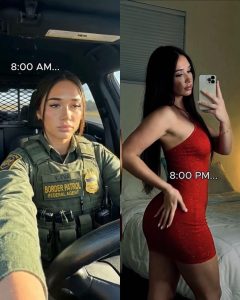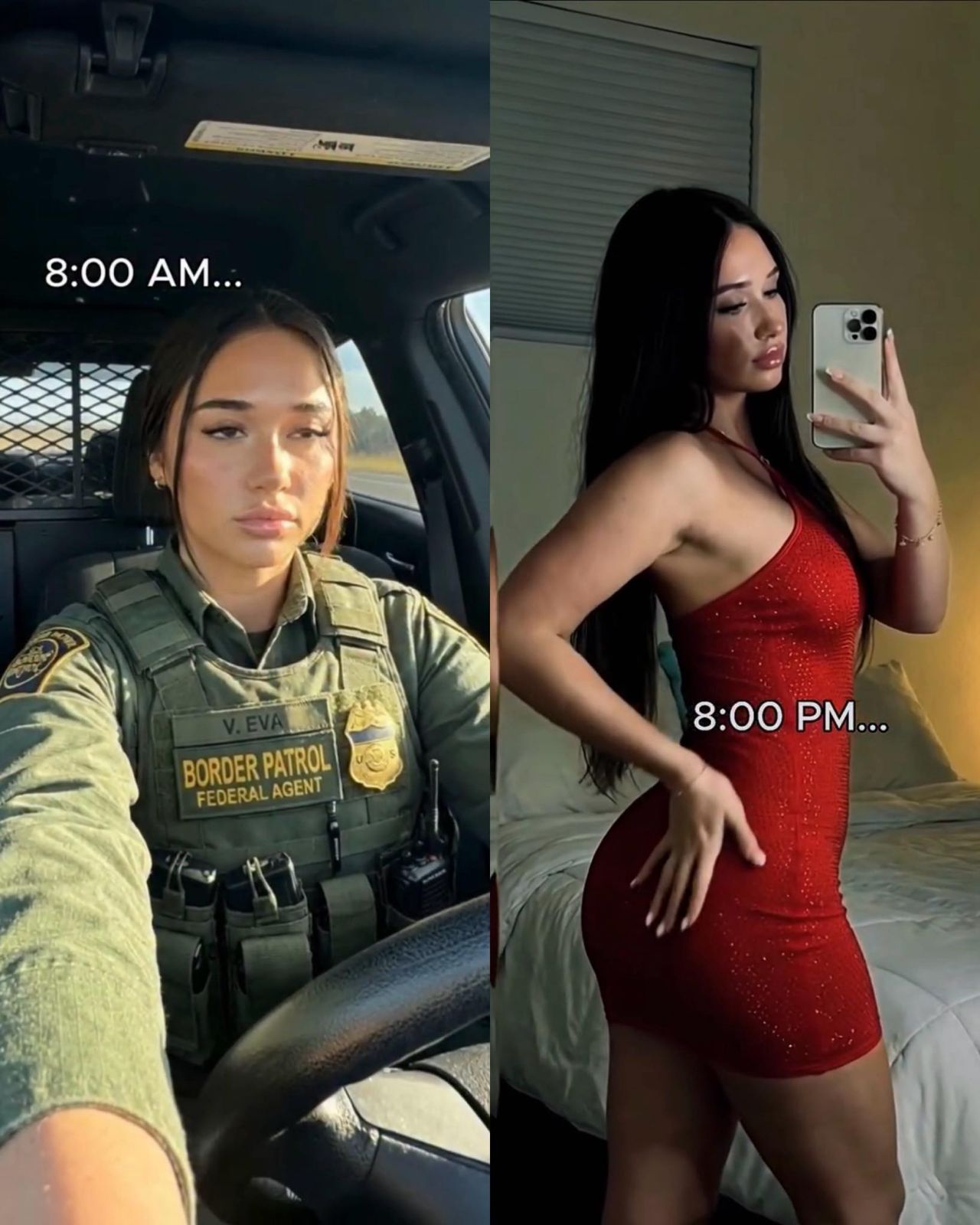
An ICE agent is going viral after posting a video showing what she looks like after work — and the internet has a lot to say about it.
The short clip, shared on social media, follows a now-familiar format: uniform on, uniform off. It begins with the agent in full professional attire — badge visible, hair pulled back, posture firm. The setting appears serious and work-focused. Then comes the transition. The screen cuts, music shifts, and she reappears in casual clothes, relaxed, smiling, presenting a very different side of herself.
Within hours, the video gained traction. Some viewers praised her confidence and transparency. Others criticized the post, arguing that law enforcement — particularly officers affiliated with immigration enforcement — shouldn’t be engaging in “trend” culture online. The comments quickly split into admiration, skepticism, political debate, and heated arguments.
To understand why the video sparked such strong reactions, it helps to understand the agency she works for. The agent identified herself as an employee of U.S. Immigration and Customs Enforcement, commonly known as ICE. The agency operates under the Department of Homeland Security and is responsible for enforcing immigration laws, investigating customs violations, and addressing cross-border criminal activity.
ICE has long been a lightning rod in national political debates. Supporters argue the agency enforces existing laws and plays a critical role in border security and public safety. Critics contend that some enforcement practices are overly aggressive or harmful to immigrant communities. Because of that tension, ICE agents often find themselves at the center of broader discussions about immigration policy.
So when an ICE agent posts a viral, personality-driven video, it doesn’t exist in a vacuum.
For many viewers, the video humanizes someone they may otherwise see only through headlines or political discourse. It reminds audiences that behind a uniform is an individual — someone with hobbies, fashion preferences, a sense of humor, and a life beyond work. In an era where “day in the life” and “get ready with me” videos dominate social media, law enforcement officers are increasingly participating in the same digital storytelling style as teachers, nurses, and military personnel.
For others, however, the video feels jarring. Immigration enforcement is a deeply emotional and often painful topic for many families and communities. Seeing an agent present a lighthearted or glamorous after-work persona can be perceived as tone-deaf or insensitive, depending on one’s perspective. Critics argue that the work ICE performs has serious consequences, and they question whether social media trends are appropriate for such roles.
This divide reflects a broader cultural shift. Social media has blurred the lines between professional identity and personal branding. Police officers, firefighters, attorneys, and even judges now maintain TikTok and Instagram accounts. Some use them for recruitment, others for public relations, and some simply to participate in trends like anyone else.
The ICE agent’s video also highlights how visual storytelling shapes perception. The transformation format plays on contrast — authority versus relatability. It invites viewers to reconsider assumptions. But in highly polarized topics, even a simple outfit change can become symbolic.
Supporters flooded the comments with messages like “You’re more than the uniform” and “Thank you for your service.” Others expressed appreciation for seeing a woman in a law enforcement role embracing both professionalism and individuality. Representation matters in many fields, and female agents in federal enforcement roles are still less common than their male counterparts. For some viewers, the video signaled empowerment and confidence.
On the other hand, critics questioned the intent. Was it an attempt to soften the image of the agency? Was it a personal branding move? Or simply participation in a viral trend? In today’s algorithm-driven landscape, motivations are often interpreted through political lenses.
There’s also the question of workplace boundaries. Federal agencies typically maintain social media policies governing what employees can post, especially when identifying themselves as government officials. The balance between free expression and institutional neutrality is delicate. Employees are private citizens, but they are also representatives of federal authority.
The virality of the clip underscores how law enforcement visibility has changed over the past decade. Previously, most public interaction with federal agents occurred through press conferences or official statements. Now, agents can speak directly to millions of followers with a smartphone and a trending audio track.
Some communication experts argue that transparency and approachability can build trust. Showing the human side of public servants may reduce stigma and encourage dialogue. Others caution that viral culture rewards oversimplification — and complex policy issues rarely fit into 30-second transitions.
Interestingly, the conversation around the video often drifted beyond the agent herself. Comment threads turned into debates about immigration policy, border control, due process, humanitarian concerns, and national security. In that sense, the clip became a digital Rorschach test. Viewers projected broader beliefs onto a brief moment of self-expression.
There’s also a generational element at play. Younger audiences are accustomed to authenticity online. They expect even serious professionals to have multidimensional identities. Older viewers may see the blending of professional authority and social media trends as inappropriate or distracting.
Ultimately, the video’s impact may say more about the online environment than about the agent herself. Social media rewards contrast, emotion, and shareability. A uniform-to-casual transition checks all those boxes. Add a controversial federal agency to the mix, and virality becomes almost inevitable.
The larger takeaway is this: in the digital age, no profession exists solely within its official walls anymore. Public servants navigate the same platforms as influencers and entertainers. The challenge is managing perception while honoring the seriousness of the role.
For the ICE agent at the center of the viral clip, what may have begun as a simple post turned into a national conversation about identity, professionalism, and public trust. Whether viewers saw empowerment, controversy, relatability, or distraction depended largely on their preexisting beliefs.
And that may be the most telling part of all.
In today’s climate, even a quick after-work outfit reveal can ignite debates far beyond fashion.