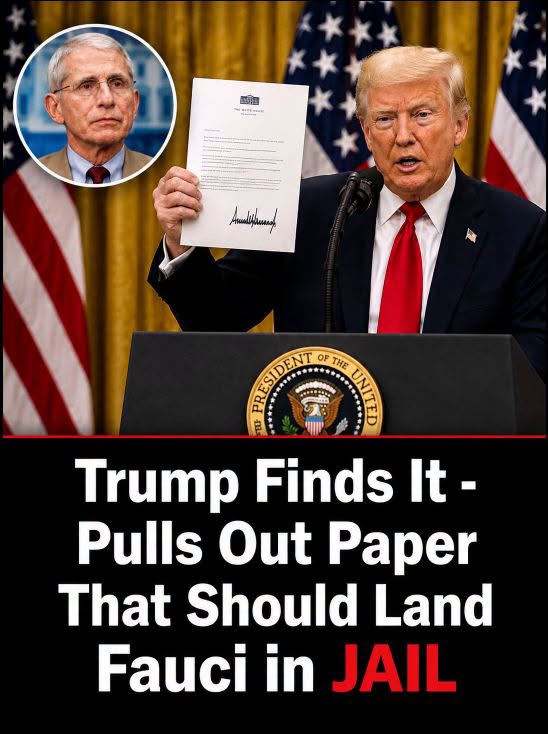
Trump Reacts After Fauci Invokes the Fifth Amendment 111 Times
The long-running political battle over the COVID-19 pandemic erupted again this week after Dr. Anthony Fauci repeatedly invoked the Fifth Amendment during a contentious Senate hearing. Fauci reportedly declined to answer questions 111 times, turning what was expected to be another congressional examination of the pandemic response into a dramatic confrontation over constitutional rights, accountability and the origins of COVID-19.
The hearing took place on July 29 before the Senate Homeland Security and Governmental Affairs Committee and was led by Republican Sen. Rand Paul, one of Fauci’s most persistent critics. Paul has spent years questioning Fauci about the government’s handling of COVID-19 and whether U.S. government-funded research in China may have contributed to the pandemic. Fauci, now retired, appeared under subpoena and quickly made clear that he intended to rely on his constitutional protections.
Fauci said his decision was based on the advice of his attorneys and concerns that his testimony could potentially expose him to legal jeopardy. Rather than answering many of the committee’s questions, he repeatedly declined to respond by invoking the Fifth Amendment’s protection against self-incrimination. His decision immediately became the central story of the hearing.
The reaction was fierce.
Republican lawmakers argued that the repeated refusals prevented Congress from obtaining answers to questions that they believe the American public deserves to hear. Paul has indicated that the committee may move toward a contempt-of-Congress vote against Fauci. The Senate’s consideration of that step could keep the controversy alive well beyond the original hearing.
At the same time, Fauci’s defenders argued that exercising a constitutional right should not automatically be interpreted as evidence of wrongdoing. Legal experts cited in recent reporting have emphasized that the Fifth Amendment remains a constitutional protection and that invoking it does not, by itself, establish guilt.
That distinction is important because the political rhetoric surrounding Fauci has become increasingly intense.
During the hearing, the central subjects included the origins of COVID-19, U.S. funding for research involving coronaviruses, Fauci’s communications during the pandemic and questions raised by personal diary entries recently released by Sen. Paul. Those diary entries have become another source of political controversy, particularly because they provide a glimpse into Fauci’s private thoughts about the pandemic and his interactions with political officials.
The Trump connection adds another layer to the controversy.
Fauci worked with Donald Trump during the first year of the COVID-19 pandemic, when the two became some of the most recognizable figures in America’s response to the crisis. Their relationship was complicated, and Fauci’s recently released diary entries contain sharply critical private observations about Trump. Reports on the diary say Fauci described Trump’s behavior in highly negative terms as the pandemic progressed.
Trump’s broader political movement has frequently criticized Fauci’s pandemic-era decisions, including policies involving masks, lockdowns, schools and public-health restrictions. Fauci, meanwhile, has defended his record and argued that his decisions were based on the information available to public-health officials at the time.
The latest Senate hearing therefore represents more than a disagreement between one senator and one retired scientist. It is part of a much larger argument over who should be held responsible for America’s response to one of the most disruptive public-health emergencies in modern history.
One of the most controversial issues is the laboratory-leak theory.
Republican lawmakers have continued to investigate whether research connected to the Wuhan Institute of Virology played a role in the emergence of COVID-19. Fauci has rejected accusations that he knowingly participated in concealing the origins of the virus or improperly funded dangerous research. Supporters of Fauci argue that the evidence remains disputed and that political investigations have sometimes presented allegations as established facts before they have been proven.
The hearing also revived an uncomfortable question surrounding presidential pardons.
Former President Joe Biden granted Fauci a preemptive pardon covering federal offenses that may have occurred between January 1, 2014, and January 19, 2025. Critics have argued that the pardon should eliminate any reason for Fauci to fear criminal prosecution for actions within that period. However, legal experts have explained that the relationship between a presidential pardon and Fifth Amendment protections is more complicated than simply saying that a pardon removes the constitutional right.
There is also an important historical irony that has entered the political debate.
Trump himself invoked the Fifth Amendment hundreds of times during a 2022 deposition connected to a New York civil investigation into his business practices. Contemporary reporting placed the number at more than 400, with some accounts putting it above 440. Trump argued at the time that he was exercising a constitutional protection because he believed the investigation was politically motivated.
That history has prompted critics of the current criticism of Fauci to accuse Trump’s supporters of applying a double standard. Their argument is straightforward: if invoking the Fifth Amendment was legitimate for Trump, they say, it should also be legitimate for Fauci.
Supporters of the investigation respond that the circumstances are different and that Congress has a legitimate responsibility to investigate the federal government’s COVID-19 policies.
That disagreement is unlikely to disappear.
What happens next could be more important than the dramatic exchanges inside the hearing room. Sen. Paul has indicated that the committee is considering contempt proceedings against Fauci. If lawmakers move forward, the dispute could become a broader legal battle over the limits of congressional investigative power and the circumstances under which a witness can refuse to answer questions.
Meanwhile, Fauci’s refusal to answer has created a political paradox. His decision may have protected him from potentially dangerous testimony, but it has also allowed his critics to argue that he is hiding something. Fauci and his defenders counter that exercising a constitutional right should never be treated as proof of guilt.
That tension lies at the heart of the controversy.
For millions of Americans, COVID-19 remains an intensely personal memory. Families lost loved ones, businesses closed, schools were disrupted and governments made extraordinary decisions under enormous pressure. Many people still want a complete accounting of what happened, why certain decisions were made and whether officials made mistakes that could have been avoided.
Those questions deserve serious investigation.
But serious investigation also requires separating evidence from accusation. The fact that Fauci invoked the Fifth Amendment 111 times is a striking development, but it does not by itself prove that he committed a crime. Likewise, political accusations about the origins of COVID-19 or government-funded research must ultimately be evaluated on evidence rather than partisan loyalty.
The latest confrontation has therefore reopened an old national argument: how should America examine the mistakes of the pandemic without turning the search for accountability into another political battle?
For now, the answer remains unsettled. Fauci has chosen silence on many questions. Republican lawmakers are demanding answers. Democrats are warning against what they describe as a politically motivated prosecution campaign. And Trump’s long-standing conflict with Fauci continues to influence how millions of Americans interpret the story.
The Senate’s next steps could determine whether this becomes another headline that fades within days—or the beginning of a much larger legal and political reckoning over America’s COVID-19 response.