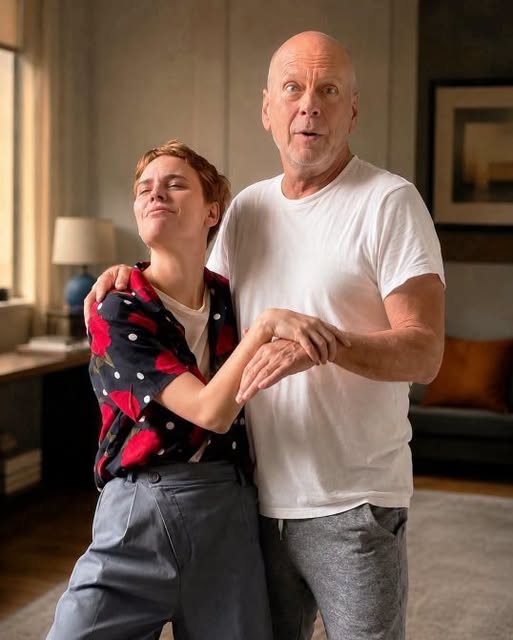
Bruce Willis and His Journey After Losing the Ability to Speak
Bruce Willis has spent decades as one of Hollywood’s most recognizable actors. Known around the world for his tough-guy roles, quick wit, and unforgettable performances, he became a symbol of action cinema through movies such as Die Hard, The Fifth Element, Armageddon, and Pulp Fiction. But in recent years, the public has come to know a very different side of his life—one shaped not by movie sets or red carpets, but by a serious medical condition that has affected his ability to communicate.
In 2022, Willis’s family announced that he had been diagnosed with aphasia, a condition that can affect a person’s ability to speak, understand language, read, or write. The announcement led to his retirement from acting. Later, his family revealed that his condition had progressed, and in 2023 they announced that he had been diagnosed with frontotemporal dementia, commonly known as FTD.
The news was heartbreaking for millions of people who had watched Willis entertain audiences for generations.
Frontotemporal dementia is a neurological disorder that primarily affects the frontal and temporal lobes of the brain. These areas are strongly involved in personality, behavior, language, and communication. Unlike some other forms of dementia, FTD can appear at a younger age and may initially cause significant changes in language or behavior.
For Willis, one of the most difficult aspects of his illness has reportedly been communication.
There have been public reports that his ability to speak has become severely limited. However, it is important to distinguish between confirmed information from his family and speculation circulating online. Headlines claiming that he has completely lost the ability to communicate verbally should be treated carefully unless they are supported by a direct statement from his family or representatives.
Even when someone can no longer communicate in the same way they once did, that does not necessarily mean they have lost the ability to understand, feel, recognize loved ones, or experience emotions.
That distinction is especially important when discussing dementia.
Language is something many people take for granted. We speak to our families, tell jokes, ask questions, share memories, and express affection without thinking about the complicated neurological processes that make communication possible. When a disease begins interfering with those processes, everyday conversations can become extraordinarily difficult.
For a person like Willis, whose career depended heavily on dialogue and performance, losing some of that ability can be particularly poignant.
His famous characters were often defined by their voices. John McClane in Die Hard became famous not only because of his physical courage but also because of his sarcastic comments and memorable one-liners. Willis’s voice became part of his identity as an actor.
Today, however, his family’s focus is understandably much more personal.
Instead of discussing upcoming movies, fans have increasingly heard about Willis through updates from his wife, former wife, children, and other loved ones. They have emphasized the importance of family, compassion, and being present with him.
Willis has a large blended family, and his loved ones have remained publicly supportive throughout his illness. His wife, Emma Heming Willis, has spoken openly about the challenges of caring for someone living with dementia and about the importance of raising awareness.
She has also encouraged people to understand that dementia does not affect only the person who receives the diagnosis. It affects entire families.
Caregiving can be emotionally and physically demanding. Families may have to adapt to changes in communication, routines, independence, and personality. They may also experience grief while their loved one is still alive—a complicated emotional experience sometimes described as anticipatory grief.
For Willis’s family, maintaining his dignity has been an important part of navigating the situation.
The actor’s story has also helped draw attention to frontotemporal dementia, a condition that is less widely understood than Alzheimer’s disease. Increased public awareness can encourage people to learn about symptoms, seek medical advice when concerning changes appear, and support research into treatments.
There is currently no simple cure that reverses frontotemporal dementia. Treatment generally focuses on managing symptoms, supporting communication and daily functioning, and helping families cope with the progression of the disease.
Communication strategies can change as the illness progresses. Some people may benefit from gestures, facial expressions, writing, photographs, communication boards, or other assistive methods. Family members may also learn to speak more slowly, ask simple questions, provide choices, and give the person extra time to respond.
Perhaps most importantly, communication is about much more than words.
A smile can communicate affection. A touch can communicate reassurance. A look can communicate recognition. Sitting beside someone can communicate love even when a conversation is no longer possible.
That is one of the most meaningful lessons that can be taken from Willis’s journey.
Fans may remember him as the charismatic star who walked through explosions, delivered jokes under pressure, and played characters who refused to give up. But his life today is not a movie. There is no script and no guaranteed happy ending. His family is dealing with a real neurological disease, and their priority is his comfort and dignity.
It is natural for fans to feel sadness when they hear that an actor they admired is no longer able to work or communicate as he once did. Yet Willis’s legacy extends far beyond his present medical circumstances.
He has already left an enormous mark on cinema.
From action films to comedies and dramas, his performances entertained audiences across generations. His work helped define an era of Hollywood filmmaking, and his characters remain recognizable long after their original releases.
Now, the focus is on the person behind those characters.
Bruce Willis is more than the tough hero seen on screen. He is a father, husband, family member, and human being facing an extraordinarily difficult illness. His story reminds us that illness can affect anyone, regardless of fame, wealth, or success.
It also reminds us to be cautious with sensational headlines.
When discussing someone’s health, especially a public figure living with dementia, accuracy and compassion matter. A dramatic headline may attract attention, but the reality is much more complex than a few words on a screen.
What matters most is that Willis continues to be surrounded by people who care about him.
Although he may not be able to communicate as he once did, his life, relationships, and decades of work continue to speak for him. Millions of people remember the laughter, excitement, and unforgettable characters he brought to the screen.
And perhaps that is the most fitting way to remember Bruce Willis—not simply through what his illness has taken away, but through everything he has given to the world.
His voice may have changed. His career may have ended. His circumstances may be profoundly different from the days when he stood in front of cameras as one of Hollywood’s biggest stars.
But his legacy remains.
For his family and his fans, that legacy is something worth holding onto with love, respect, and dignity.