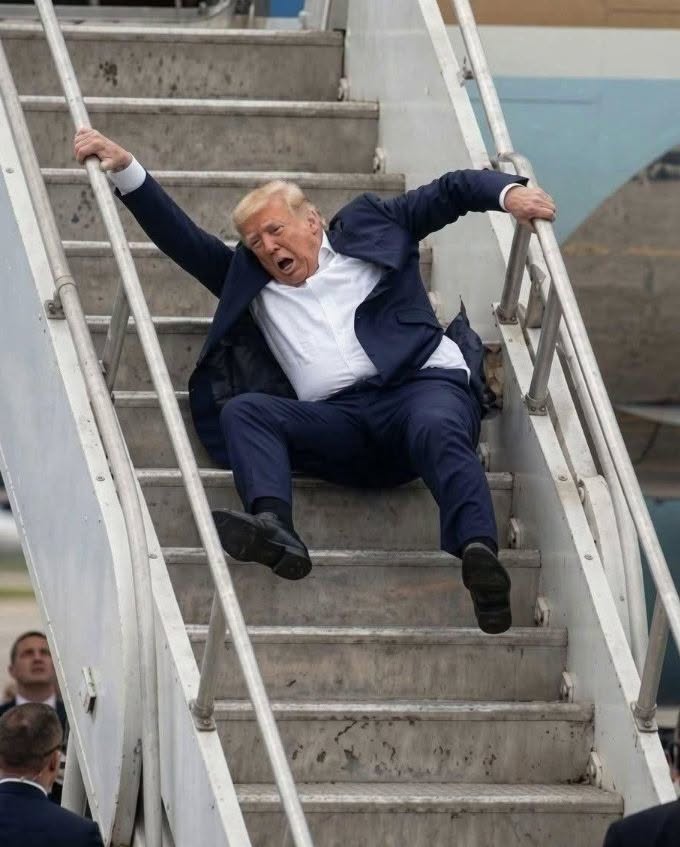
Trump FALLS AGAIN! — Questions Swirl After Viral Claims About the President’s Health
A dramatic headline claiming that President Donald Trump has “fallen again” and that the White House doctor has revealed a shocking development is spreading rapidly online.
The wording is designed to create immediate concern: “Trump FALLS AGAIN! — White House Doctor Breaks S…”
But before accepting such a headline as fact, there is an important question that every reader should ask: What has actually been confirmed?
At the time of writing, there is no reliable confirmation establishing that President Trump has suffered a new fall matching the claim circulating online, nor should a supposed statement from a White House physician be treated as genuine without an identifiable official source.
That does not mean questions about the president’s health are unimportant. Quite the opposite. The health and physical condition of a sitting president are matters of legitimate public interest. However, responsible reporting requires separating verified information from rumors, speculation, recycled footage, and sensational social-media headlines.
Why a headline like this spreads so quickly
President Trump is one of the most closely watched political figures in the world. Every public appearance can generate thousands of photographs and videos, and even a small stumble, awkward movement, or moment of hesitation can become the subject of intense online discussion.
A short clip can be removed from its original context and reposted with a completely different caption.
For example, an older video of Trump walking down stairs could be presented as though it happened today. A photograph showing him reaching for a railing could be described as a “fall.” A moment in which he loses his balance briefly could be exaggerated into a major medical emergency.
Once a dramatic caption is attached to the image, the original context can disappear.
That is why readers should always look for the date, location, and original source of any video or photograph.
The phrase “White House doctor reveals…”
Another common feature of viral political stories is the phrase “White House doctor reveals.”
Those words immediately suggest that confidential or shocking medical information has been released.
But medical information involving a president should not be assumed to be authentic simply because a headline mentions a doctor.
A genuine medical update would normally be attributable to a specific physician, official statement, medical report, or other verifiable source. If a story does not identify where the supposed information came from, readers should be cautious.
There is also an important difference between an official medical report and commentary from someone claiming to have knowledge of the president’s condition.
The difference may seem small, but it is crucial.
Trump’s health has been a public subject before
Because Trump is an older president, questions about his physical condition have repeatedly attracted attention.
Throughout his political career, cameras have recorded his movements at rallies, airports, golf courses, military ceremonies, diplomatic events, and other public appearances.
Supporters may interpret an awkward moment as insignificant, while critics may interpret the same moment as evidence of a serious problem.
That political divide can make objective reporting more difficult.
A short video may become a political argument before anyone has established exactly what happened.
A fall does not automatically mean a medical emergency
Even if a public figure does stumble or fall, the event itself does not automatically establish that the person has suffered a serious medical problem.
People can lose their balance for many ordinary reasons. Uneven surfaces, stairs, footwear, weather, fatigue, distractions, or simply an unexpected movement can cause someone to stumble.
Of course, a fall can sometimes result in serious injury, particularly for older adults. That is why medical professionals take falls seriously.
But determining whether an individual has suffered an injury requires medical evaluation. It cannot reliably be diagnosed from a few seconds of video.
This is particularly important when discussing a president.
A viewer watching footage on social media does not have access to the person’s medical examination, vital signs, neurological assessment, imaging, or medical history.
Why sensational health stories can be harmful
False health reports can have consequences far beyond social-media arguments.
They can cause unnecessary anxiety among members of the public. They can also encourage people to believe that political leaders are hiding information, even when there is no evidence of wrongdoing.
For the individual involved, repeated false claims about illness or injury can also be deeply invasive.
A president is a public official, but that does not mean every rumor about their body or health becomes fact simply because it attracts attention.
Responsible journalism requires evidence.
What should readers look for?
If you see a headline claiming that Trump has fallen again, start by checking the source.
Ask:
When did the event supposedly happen?
Where did it happen?
Who reported it first?
Is there an official statement?
Are reputable news organizations reporting the same event independently?
Does the video actually show what the headline claims?
These questions can quickly reveal whether a story is credible or simply designed to generate clicks.
Readers should also be suspicious of headlines that use excessive capitalization, multiple exclamation points, phrases such as “THE TRUTH IS OUT,” or claims that a doctor has “finally revealed” a secret without providing evidence.
Such wording is often used to create emotional urgency.
The importance of waiting for verified information
In breaking news situations, information can change.
An initial report may contain incomplete details. Officials may still be investigating an incident. A person may stumble but remain completely unharmed. A video may turn out to be several months old.
That is why responsible outlets often use careful language when details remain unclear.
Instead of immediately declaring that someone has suffered a serious medical emergency, credible reporting waits for confirmation.
That approach may be less dramatic, but it is far more trustworthy.
Trump’s public appearances will continue to attract attention
As president, Trump will continue appearing in front of cameras at events across the country and around the world.
Every gesture, step, facial expression, and pause can potentially become part of the news cycle.
That level of scrutiny is unlikely to disappear.
For that reason, the public should become increasingly skilled at recognizing the difference between genuine reporting and engagement-driven content.
A headline can be compelling without being accurate.
A photograph can be real while the caption attached to it is false.
A video can be authentic while the story surrounding it is completely misleading.
What the viral headline really tells us
The headline claiming that Trump “falls again” may tell us more about the modern information environment than about Trump’s actual health.
Social media rewards content that generates strong emotional reactions.
Fear, anger, surprise, and curiosity can all drive clicks.
A headline suggesting that a president has suffered a sudden medical problem is therefore almost guaranteed to attract attention.
But readers should not allow the emotional power of a headline to replace evidence.
The responsible approach is to remain curious without becoming credulous.
Final thoughts
The claim that “Trump FALLS AGAIN” and that a White House doctor has made a shocking revelation should not be treated as established fact without reliable confirmation.
President Trump’s health is an important public matter, but it deserves serious reporting rather than sensational speculation.
If a genuine medical emergency occurs, official statements and reputable news organizations will provide verified information as it becomes available.
Until then, the best response is to pause before sharing.
In today’s fast-moving media environment, being first is not always the same as being right.
The most responsible readers are not necessarily those who react fastest. They are the ones who stop, investigate, compare sources, and wait for evidence.
Because when the subject is the health of a sitting president, accuracy matters far more than a shocking headline.