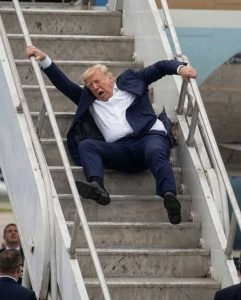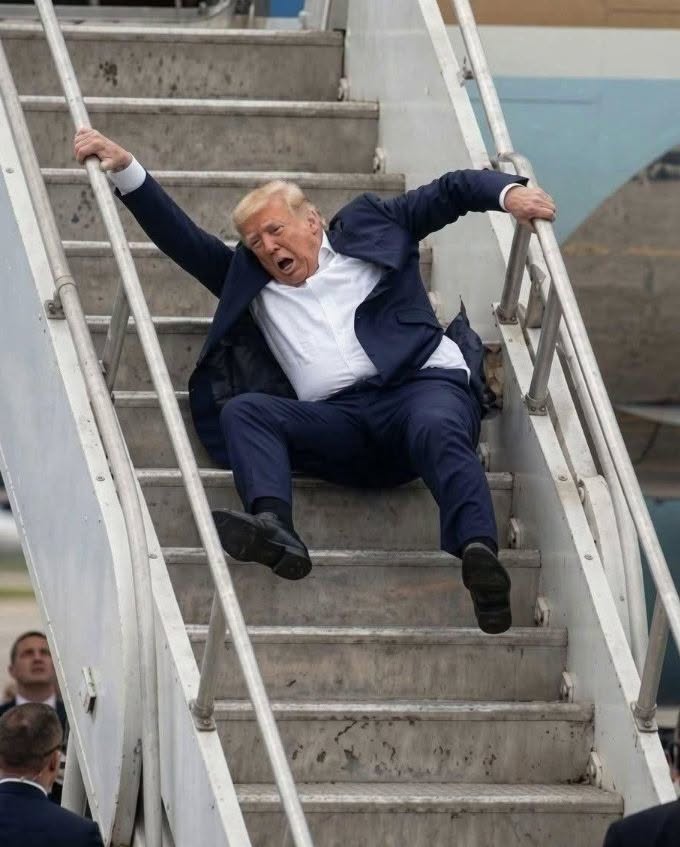
Trump “FALLS AGAIN”? White House Health Questions Trigger New Wave of Attention
A new wave of online speculation surrounding President Donald Trump’s health has sparked intense discussion after claims circulated that the president had “fallen again” and that the White House doctor was preparing to address the situation.
However, there is an important distinction between what is circulating online and what has been independently verified.
As of the latest available reporting, there is no confirmed official announcement establishing that President Trump recently suffered another fall. The White House physician’s most recent publicly released medical assessment described Trump as being in “excellent health,” while acknowledging several physical findings that had already attracted public attention.
The latest verified medical examination took place at Walter Reed National Military Medical Center in May 2026. Following that examination, physician to the president, U.S. Navy Capt. Sean Barbabella, said Trump remained in excellent health and demonstrated strong cardiac, pulmonary, neurological, and overall physical function.
The report nevertheless generated considerable discussion because it mentioned slight lower-leg swelling and benign bruising on Trump’s hands.
Those details quickly became part of a much larger conversation about the president’s health.
Trump is now 79 years old, making his physical condition a subject of intense public interest. As president, he carries one of the most demanding jobs in the world, involving long working days, extensive travel, public appearances, meetings with foreign leaders, political negotiations, and decisions involving national security.
Because of that responsibility, questions about the president’s health inevitably attract attention.
A fall, if one actually occurred, would naturally raise questions about whether there was an underlying medical issue.
But a fall by itself does not automatically indicate serious illness.
Older adults can experience falls for many reasons, including uneven surfaces, loss of balance, fatigue, footwear, environmental conditions, or simply an accidental misstep. Determining whether a fall is medically significant requires information from healthcare professionals and, when appropriate, diagnostic testing.
That is why the distinction between a verified medical event and an internet rumor matters.
Social media can transform an unclear image or short video into a dramatic story within minutes.
A moment in which someone appears unsteady can quickly become “the president collapsed.”
A pause can become “the president is seriously ill.”
A routine medical appointment can become “the White House is hiding something.”
Such claims can spread much faster than corrections.
That phenomenon has repeatedly affected public figures, especially presidents, whose every movement can be recorded by cameras.
Trump’s health has received particular scrutiny during his second term.
His May physical was notable not only because of the examination itself but also because the White House later disclosed that 22 medical specialists had evaluated him. The report included cardiovascular, neurological, pulmonary, cancer-screening, and other assessments.
The physician concluded that Trump was fit to perform the duties of president.
At the same time, the report recommended increased physical activity and weight loss, while describing his overall condition positively.
The mention of leg swelling attracted particular attention.
The White House has previously said that Trump has chronic venous insufficiency, a condition involving difficulty returning blood from the legs to the heart. Public reporting has connected that condition with the swelling observed in his lower legs.
The hand bruising also became a subject of public discussion. The White House physician characterized the bruising as benign and attributed it to factors including frequent handshaking and aspirin use.
None of those findings, however, establishes that Trump recently fell.
That is why readers should be cautious when encountering headlines using phrases such as “BREAKING,” “FALLS AGAIN,” or “DOCTOR BREAKS SILENCE.”
Such headlines are designed to create urgency and encourage people to click, comment, and share.
But a dramatic headline is not the same thing as confirmation from a physician or the White House.
If President Trump had suffered a significant medical emergency, credible reporting would normally be expected to provide details from official statements, medical personnel, or multiple reputable news organizations.
Until such information is available, the responsible approach is to treat claims of a new fall as unverified.
That does not mean questions about presidential health are unimportant.
Quite the opposite.
The public has a legitimate interest in knowing whether a president is physically capable of carrying out the responsibilities of the office.
Presidential health has historically been closely watched because an incapacitating medical condition could affect government operations, national security, and the continuity of executive leadership.
At the same time, the president retains medical privacy, and not every minor physical symptom needs to become a national controversy.
The challenge for journalists and the public is finding the balance between legitimate transparency and irresponsible speculation.
Trump himself has frequently projected confidence about his physical condition.
After his May examination, he said that everything had checked out “perfectly.” The subsequent medical report released by the White House similarly described him as being in excellent health.
That does not mean the president has no health issues.
Rather, it means his physician did not identify those publicly reported findings as preventing him from carrying out his duties.
That distinction is important.
A person can have medical conditions and still be capable of performing demanding work.
Likewise, an isolated incident such as a stumble or fall would not necessarily prove that someone is seriously ill.
What matters is the complete medical picture.
For now, that picture includes the May physical examination and the doctor’s conclusion that Trump was fit to serve.
There is no verified evidence in the latest reporting that he has suffered another serious fall.
The continuing speculation nevertheless demonstrates how quickly presidential health stories can become political stories.
Supporters may accuse opponents of exaggerating minor incidents.
Critics may argue that the public deserves more detailed information.
News organizations may analyze every public appearance for signs of physical difficulty.
And social media users may reach conclusions based on seconds of footage.
The safest approach is to separate observation from interpretation.
If a video appears to show someone stumbling, that is an observation.
Claiming that the person suffered a medical emergency is an interpretation.
Claiming that the person has a specific disease is a medical conclusion that requires evidence.
Those are three very different things.
For President Trump, the most recent official medical assessment remains reassuring according to his physician.
Dr. Barbabella said Trump demonstrated strong overall physical function and was fit to carry out the responsibilities of commander in chief.
So while the internet may continue to debate every appearance, movement, and moment captured on camera, there is currently no verified basis for declaring that Trump has suffered another serious fall.
The story should therefore be approached with caution.
If the White House or the president’s medical team confirms a new incident, the public can evaluate that information based on the facts.
Until then, sensational claims should not be treated as established news.
The health of a president matters enormously.
But so does the accuracy of the information surrounding that health.
In an era when rumors can reach millions of people before the truth has time to catch up, one simple rule remains essential:
Wait for verified facts before turning speculation into breaking news.