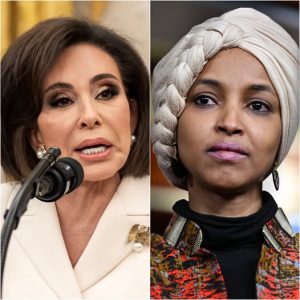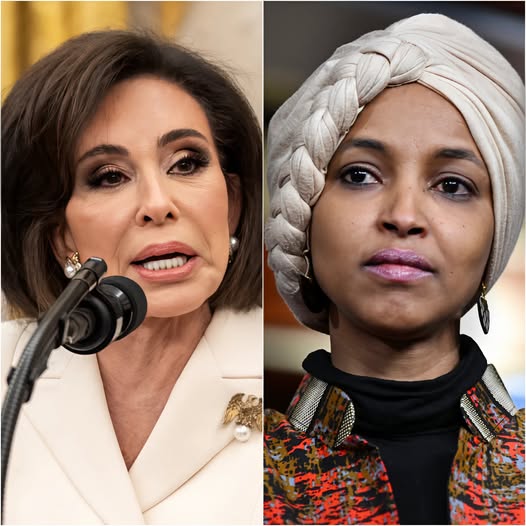
Headlines like “JEANINE PIRRO READS ILHAN OMAR’S RECORD — AND CNN FALLS INTO COMPLETE SILENCE” are designed to spark curiosity and emotion. They suggest a dramatic, almost cinematic confrontation — a moment where a single speech supposedly “stuns” a major network into quiet. But when you slow down and examine the mechanics of media, politics, and televised debate, the reality is usually far more nuanced than the headline implies.
To understand the context, it helps to look at the two figures involved.
Jeanine Pirro is a former prosecutor and judge who became a prominent television commentator known for forceful, opinion-driven segments. Her style is direct, prosecutorial, and often confrontational. She frames political arguments as moral or legal indictments, leaning into rhetoric that energizes viewers who already share her perspective.
On the other side is Ilhan Omar, a member of Congress representing Minnesota’s 5th District. Omar, a Somali-American refugee turned lawmaker, has been one of the most polarizing figures in Washington. Supporters see her as a bold progressive voice challenging U.S. foreign policy and domestic inequities. Critics argue her rhetoric on Israel, defense policy, and certain global issues crosses lines or lacks nuance.
When a headline claims Pirro “read Omar’s record” and that CNN “fell silent,” it paints a picture of a live confrontation in which one side delivered an irrefutable argument and the other had no response. In reality, television networks do not typically “fall silent” because of a rival commentator’s segment. Media ecosystems are competitive, segmented, and ideologically diverse. Fox News programming does not air on CNN, and vice versa. Each network frames political developments through its own editorial lens.
So what could such a headline be referring to?
Often, these viral narratives originate from a clip where a commentator lists past votes, public statements, or controversies associated with a politician. For Omar, that might include her votes on defense appropriations, her criticism of U.S. military intervention, her comments on Middle East policy, or past ethics investigations. Pirro’s approach would likely emphasize points critics find troubling, presenting them in rapid succession to build a case.
But “reading someone’s record” is not the same as adjudicating it. Every member of Congress has a public voting history. Those votes can be interpreted in multiple ways depending on one’s political philosophy. A vote against a military funding package, for example, may be framed by critics as weakening national defense — while supporters may describe it as opposing unnecessary spending or intervention.
The “CNN silence” portion of the headline plays into a broader narrative about media rivalry and ideological divides. It suggests that one network was rendered speechless by the force of an argument. In practice, major news networks respond to political claims through panel discussions, fact-checks, counter-segments, or simply by choosing different stories to prioritize. Silence can mean many things — editorial discretion, lack of perceived newsworthiness, or simply programming schedules.
There’s also a broader dynamic at play: the performance aspect of modern political commentary. Television debates and monologues are often structured to create decisive moments. The goal is less about persuading opponents and more about energizing an audience. Clips are shared on social media with bold captions. Emotional impact becomes currency.
The tension between Pirro and Omar symbolizes a wider ideological divide in American politics. Issues like immigration, national security, religious freedom, and foreign alliances are flashpoints. Omar’s identity as one of the first Muslim women elected to Congress has amplified scrutiny around her statements. Pirro has previously criticized her comments on Israel and U.S. foreign policy, sometimes arguing they reflect misplaced priorities. Omar has responded by defending her positions as rooted in human rights and constitutional principles.
When analyzing a headline like this, it’s useful to ask:
- What exactly was said?
- Was it a new revelation or a rehashing of publicly known information?
- Did the network in question actually respond, and if so, how?
- Is the “silence” literal or metaphorical?
In many viral cases, “silence” simply means there was no immediate on-air rebuttal in the same broadcast window. That does not equate to concession or defeat.
Another layer is the modern information environment. Short clips can circulate stripped of context. A fiery two-minute monologue may appear definitive online, even if it was part of a longer, more complex conversation. Viewers may not see subsequent analysis, corrections, or alternative perspectives.
Political theater thrives on contrast: prosecutor versus progressive lawmaker, conservative commentator versus liberal network. It simplifies complicated policy debates into good-versus-bad narratives. But governance is rarely that binary. Legislative records contain hundreds of votes across diverse policy areas. Judging them requires deeper engagement than a highlight reel.
Ultimately, what resonates in such moments is not necessarily who “won,” but how effectively the narrative aligns with audience expectations. Pirro’s audience expects a forceful critique of progressive lawmakers. Omar’s supporters expect strong pushback against conservative media framing. CNN’s audience expects its own editorial approach.
The headline promises a dramatic collapse into silence. The more realistic interpretation is a continuation of America’s polarized media ecosystem, where arguments echo within ideological communities rather than ending debates outright.
If you’d like, I can:
- Break down Ilhan Omar’s legislative record in detail and explain major controversies.
- Analyze Jeanine Pirro’s media style and influence.
- Or turn this into a fictional dramatic TV-studio showdown scene written like a political thriller.