Trump FALLS AGAIN! — What We Know About the President’s Latest Stumble
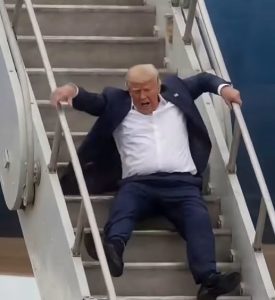
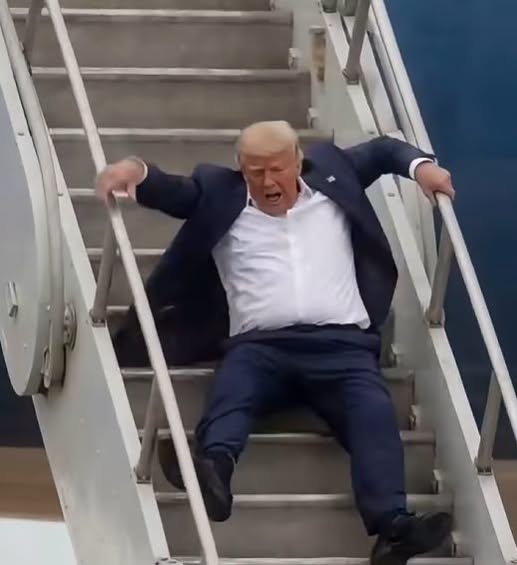
A dramatic moment involving President Donald Trump has once again triggered intense discussion online after footage appeared to show him struggling while descending the stairs from Air Force One in Cleveland on August 12, 2026. The moment quickly attracted attention because of the president’s age, previous public discussions about his health, and the highly political atmosphere surrounding virtually every appearance he makes.
However, it is important to separate what can actually be seen from speculation. Current reporting describes Trump having visible difficulty navigating the aircraft stairs during windy and rainy weather. He held onto the railing and appeared cautious as he made his way down, while an aide assisted him with an umbrella. There is no reliable evidence from the reporting available today that he suffered a serious medical emergency or that he was diagnosed with a new medical condition as a result of the incident.
The circumstances themselves are significant. Arriving in Cleveland, Trump was dealing with difficult weather conditions, including strong wind and rain. Those conditions can make aircraft stairs particularly challenging, especially when a person is simultaneously trying to maintain balance and hold an umbrella. Video of the moment nevertheless spread rapidly across social media, where viewers offered dramatically different interpretations of what they saw.
Some observers immediately described the footage as another fall or sign of deteriorating health. Others argued that the president was simply being cautious in unpleasant weather. Trump himself has previously explained that he sometimes takes stairs slowly because he does not want to fall in front of cameras. That explanation is relevant because presidential movements are often recorded from multiple angles, turning ordinary moments into widely discussed political stories.
The renewed attention also comes against a background of continuing public interest in Trump’s health. In May 2026, the White House released information from Trump’s physical examination, with White House physician Sean Barbabella describing the president as being in excellent health while also recommending increased physical activity and weight loss.
That medical assessment has not stopped questions from political opponents and some members of the public. In June, Rep. Jamie Raskin wrote to Barbabella questioning the transparency surrounding Trump’s medical care and asking for additional information about the medical specialists involved in the president’s evaluation.
Those political disagreements have made every visible physical moment involving Trump more likely to become controversial. A stumble, a pause, an awkward movement, or a moment of fatigue can become the subject of thousands of posts within minutes.
But a video alone cannot establish a medical diagnosis.
That distinction is particularly important when discussing the health of a sitting president. Medical conclusions require examination, medical history, testing, and professional evaluation. A person appearing unsteady for several seconds does not automatically mean that person has suffered a stroke, neurological disorder, heart problem, or other serious condition.
The Cleveland incident also illustrates how difficult it can be for public figures to control the interpretation of their physical appearances. Cameras are constantly present, and short clips can be separated from their original context. A several-second video may be viewed millions of times even though viewers do not know what happened immediately before or after the recording.
For Trump, this challenge is particularly pronounced because his physical condition has already become a recurring political subject.
The White House has continued to portray him as capable of performing the duties of the presidency. At the same time, critics have demanded greater transparency about his health. That disagreement is unlikely to disappear simply because of one medical examination or one public appearance.
The latest incident therefore raises more questions about political communication than it answers about Trump’s actual medical condition.
What should the public expect when a president appears to stumble? Should the White House immediately provide additional medical information? How much information should a president release about private medical matters? And at what point does a visible physical incident become important enough to warrant an official explanation?
These are legitimate questions, but they should be approached carefully.
Presidential health is a matter of public interest because the president carries enormous responsibilities. At the same time, speculation should not be presented as established fact. Saying that someone “looked unsteady” is different from claiming that the person suffered a medical crisis.
The distinction matters especially on social media, where sensational headlines can spread much faster than corrections.
The phrase “Trump FALLS AGAIN!” may attract attention, but the available reporting indicates something more nuanced: Trump appeared to struggle while descending the stairs of Air Force One in bad weather. That is visually striking, but it is not by itself evidence of a serious health event.
The controversy also demonstrates how political polarization shapes the way people interpret the same image. Supporters may see an older president carefully navigating dangerous weather. Critics may see evidence of declining physical ability. Neutral observers may simply see an 80-year-old man dealing with rain, wind, stairs, and an umbrella.
All three reactions can emerge from the same few seconds of video.
What happens next will depend largely on whether the White House provides additional information. If Trump experienced no injury, the incident may eventually disappear from the headlines as another brief moment captured on camera. If doctors release additional information, however, public discussion could intensify.
For now, the most responsible conclusion is simple: the footage deserves attention, but it does not justify a medical diagnosis.
Trump’s health will continue to be scrutinized because of his age, his position, and the extraordinary level of public attention surrounding his presidency. His doctors, the White House, journalists, political opponents, and supporters will all play roles in shaping the conversation.
The public, meanwhile, should remain cautious about viral claims.
A dramatic headline can make an ordinary stumble sound like a national emergency. A short video can create the impression that viewers have witnessed an entire medical episode when they have actually seen only a few seconds. And political arguments can quickly transform an uncertain moment into a confident claim.
The Cleveland footage is a reminder of why context matters.
Trump’s latest appearance may generate headlines, memes, criticism, and political debate, but determining whether there is a genuine medical problem requires much more than watching a video. Until qualified medical professionals provide new information, claims about a serious health crisis remain speculation.
For now, the clearest facts are that Trump was seen struggling on the Air Force One stairs during difficult weather conditions and that the moment quickly attracted widespread attention.
As the footage continues to circulate, the real story may ultimately be less about one stumble and more about the extraordinary level of scrutiny placed on every movement of a president whose age and health have become increasingly important parts of the national conversation.