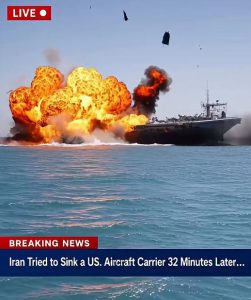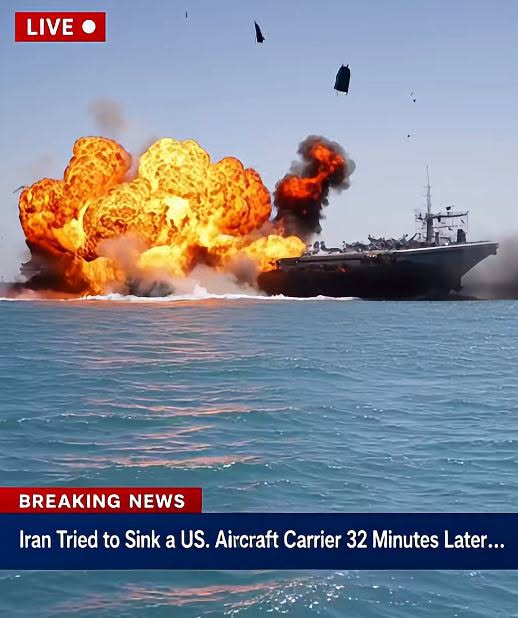
BREAKING UPDATE: Iran Tried to Sink a U.S. Aircraft Carrier — What Really Happened Next?
A dramatic headline has been circulating online claiming that Iran attempted to sink a U.S. aircraft carrier and that only 32 minutes later, everything changed.
The headline has attracted enormous attention because an attack on a U.S. aircraft carrier would represent an extraordinarily serious escalation in the ongoing conflict between Washington and Tehran.
But there is an important distinction between the viral story and verified reporting.
The specific “32 minutes later” scenario appears to come from online content that presents a fictional or dramatized military scenario as though it were breaking news. One article using nearly identical wording explicitly describes the event as a fictional scenario involving a missile ambush against a U.S. carrier.
That does not mean tensions between Iran and the United States are imaginary.
Far from it.
The two countries have been involved in a serious military confrontation, and Iran has launched attacks against U.S. forces in the region. In July 2026, U.S. officials said Iranian forces launched multiple ballistic missiles in a surprise attack against American forces in the Middle East, with U.S. defenses intercepting the missiles.
The USS Abraham Lincoln
One of the central U.S. Navy vessels in the current conflict is the aircraft carrier USS Abraham Lincoln.
The carrier has been deployed in support of American military operations against Iran for an exceptionally long period.
Recent reporting says the Lincoln has spent more than 240 consecutive days at sea, setting a record for the ship. Its prolonged deployment has also created growing concern about conditions aboard the vessel and the strain placed on its approximately 5,000 sailors.
The carrier has played an important operational role, supporting aircraft involved in U.S. military operations.
That makes it an obvious target for Iranian military planners and a major symbol of American military power in the region.
But there is no verified evidence that Iran successfully sank the Abraham Lincoln.
In fact, U.S. Central Command previously rejected Iranian claims that the carrier had been hit by ballistic missiles, saying the missiles did not come close and that the carrier continued operating.
Why Aircraft Carriers Are Such Important Targets
An American aircraft carrier is much more than a large ship.
It is essentially a mobile military base.
A carrier can carry dozens of aircraft and operate far from American territory. It is supported by other warships, aircraft, sensors, communications systems, and defensive weapons.
Because of this, attacking a carrier is extremely difficult.
A carrier strike group is designed to detect and respond to threats before they reach the carrier itself.
Potential threats can include aircraft, drones, cruise missiles, ballistic missiles, submarines, mines, and small attack boats.
The carrier therefore rarely operates alone.
Instead, it is surrounded by layers of protection.
That is one reason why headlines claiming that a carrier was suddenly “one missile away from destruction” should be treated carefully.
Modern naval warfare is considerably more complicated than simply firing a missile at a ship.
Iran’s Missile Threat
Iran has spent decades developing missiles capable of threatening ships and military installations.
Its military strategy relies heavily on missiles, drones, fast attack boats, mines, and other asymmetric capabilities.
Iran does not need to match the United States ship-for-ship to create danger.
Instead, it can attempt to make the operating environment increasingly difficult.
That could involve launching missiles from land, deploying drones, using smaller vessels, or threatening important waterways.
The Strait of Hormuz is particularly important.
The strategic waterway connects the Persian Gulf with the Gulf of Oman and is one of the world’s most important energy routes.
Any serious disruption could have consequences for oil prices and the global economy.
What About the “32 Minutes Later” Claim?
This is where the viral headline becomes problematic.
The phrase “32 minutes later” creates the impression of a precise, verified sequence of events.
It suggests that investigators or military officials have confirmed an attack, followed by a specific response exactly 32 minutes later.
However, the source currently circulating with nearly identical language describes the scenario as fictional.
That means the dramatic timeline should not be presented as confirmed history.
This distinction matters because military misinformation can spread extremely quickly.
A fictional scenario can be turned into a social-media video, then reposted with words such as “BREAKING NEWS,” causing viewers to believe that a real attack has occurred.
Once thousands of people share it, the original context can disappear.
Real Iranian Attacks Have Happened
Although the specific viral story is not verified, real attacks have occurred.
In July 2026, Iranian forces launched a surprise missile attack against U.S. forces in the Middle East, according to American officials. The U.S. military said its defensive systems intercepted the missiles.
There have also been Iranian claims regarding attacks against the USS Abraham Lincoln.
In March 2026, Iranian officials claimed that Qader anti-ship cruise missiles had been launched at the carrier and said the vessel changed position.
However, claims from one side of a war must be distinguished from independently verified facts.
The United States has previously rejected Iranian claims that the Lincoln was struck.
That is why the safest approach is to report what each side claims while clearly identifying disputed information.
The U.S. Response
The United States has demonstrated that it possesses substantial military capabilities in the region.
American forces have carried out operations against Iranian military targets and Iranian naval assets.
In March, the U.S. military released footage showing an American submarine attacking an Iranian warship with a torpedo. The Iranian vessel was reportedly operating in international waters off Sri Lanka.
The United States has also destroyed Iranian small boats during the conflict.
CBS reported that U.S. forces destroyed several Iranian boats that officials said were attempting to interfere with American military assets.
These events demonstrate that the conflict is already extremely dangerous without relying on an unverified “32-minute” story.
The Human Cost
Behind every military headline are human beings.
Thousands of American sailors are deployed far from home.
Iranian military personnel are also operating under dangerous conditions.
Civilians across the region face the consequences of conflict, including displacement, economic disruption, fear, and the possibility of further escalation.
Recent reporting has highlighted concerns about the prolonged deployment of the Abraham Lincoln.
American officials have disputed some reports concerning conditions aboard the carrier, while lawmakers have called for greater scrutiny of the sailors’ welfare.
The debate demonstrates another reality of modern warfare: military power depends not only on weapons and ships but also on the people operating them.
A New Carrier Moves Toward the Middle East
Another major development is the movement of the USS George Washington toward the Middle East.
The carrier is being positioned to relieve the Abraham Lincoln, which has endured an unusually long deployment.
The move also has broader strategic implications.
The redeployment temporarily reduces America’s aircraft-carrier presence in the western Pacific, raising concerns among U.S. allies about the balance between Middle Eastern operations and America’s Indo-Pacific commitments.
This illustrates how one conflict can affect military strategy thousands of miles away.
What Happens Next?
The most important question is whether the conflict continues to escalate.
A direct successful attack on a U.S. aircraft carrier would represent an enormous escalation.
It could trigger a major American military response and potentially draw additional countries into the conflict.
That is precisely why claims about carrier attacks need to be verified carefully.
A sensational headline may generate millions of views, but military reality is rarely as simple as a dramatic sentence suggests.
Final Thoughts
The claim that “Iran tried to sink a U.S. aircraft carrier — 32 minutes later…” should not currently be presented as a confirmed breaking-news event.
The “32 minutes later” scenario appears to originate from fictional or dramatized online material.
However, the underlying conflict is real.
Iran has launched attacks against U.S. forces.
The USS Abraham Lincoln has played a major role in American operations.
Iran has made claims about targeting the carrier, while U.S. officials have disputed some of those claims.
American forces have also conducted military operations against Iranian targets and naval vessels.
The situation remains dangerous and unpredictable.
For readers following the story, the most important rule is simple:
Do not confuse a dramatic headline with a verified event.
In wartime, information itself can become part of the battle.
The truth may be less sensational than the viral headline—but it is far more important.
As tensions continue, the world will be watching the movements of American warships, Iranian forces, regional governments, and diplomats.
One thing is certain: any confirmed attack that seriously damages or sinks a U.S. aircraft carrier would be a major international event, and it would be reported by multiple major news organizations and official military sources.
Until such confirmation exists, the “32 minutes later” story should be treated as unverified and likely fictionalized, rather than as established fact.