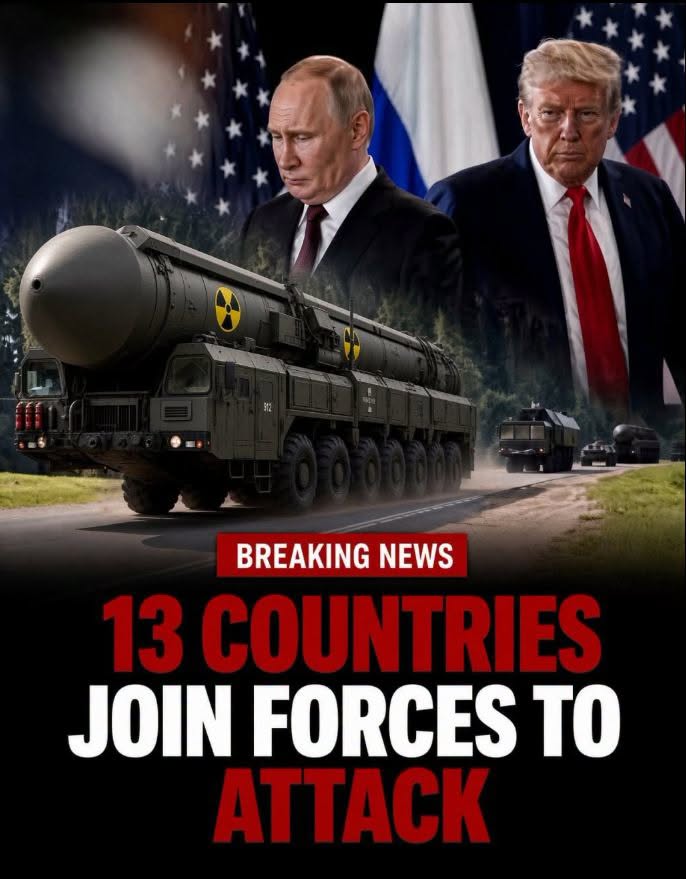
Breaking News: “13 Countries Join Forces to Attack” — What We Know and What the Headline Really Means
A dramatic headline claiming that “13 countries join forces to attack…” has been circulating widely on social media, attracting attention from people who are understandably concerned about the possibility of a major international conflict. Several Facebook posts using almost identical wording have appeared online, including posts and videos published during 2026. However, the existence of these posts does not by itself confirm that 13 countries have actually formed a military alliance to launch an attack.
That distinction is extremely important.
In an age when breaking news can spread around the world within minutes, sensational headlines can travel much faster than verified information. A phrase such as “13 countries join forces to attack” immediately creates an image of a huge international military operation. Readers may assume that a coordinated war has begun or that a new global conflict is underway. But without knowing which 13 countries, who they are attacking, where the attack is taking place, and what official governments have announced, the headline remains incomplete.
A search of currently available information finds multiple social-media posts repeating the same headline, but those results do not establish the claimed military action as a verified current event. One Facebook video using the wording was posted in May 2026, while other versions appeared in July 2026.
This raises an important question: Why do headlines like this become so popular?
The answer is simple. Fear and uncertainty attract attention.
When people see words such as “BREAKING,” “ATTACK,” “13 COUNTRIES,” or “WAR,” they naturally want to know what happened. They may click the post, share it with friends, or leave comments asking for more information. That increased engagement can cause the headline to spread even further.
But readers should pause before sharing.
A responsible approach is to look for confirmation from credible news organizations, official government statements, military announcements, or international organizations. A screenshot, Facebook video, or dramatic thumbnail is not enough to prove that a major international attack is occurring.
The number 13 is also significant because it makes the headline sound precise and authoritative. Yet a precise number without the names of the countries is not particularly useful. A genuine report about a multinational military operation would normally identify the participating nations and provide important details about the purpose of the operation.
There is another possibility that readers should consider. Sometimes several countries “join forces” for purposes that are not an attack at all. Countries can cooperate on maritime security, humanitarian assistance, military exercises, disaster response, intelligence sharing, peacekeeping, or protection of shipping routes. A multinational defense arrangement can therefore be described in dramatic language online even when the actual activity is more limited.
For example, there have been international discussions and cooperation involving maritime defense and security in strategically important regions. Such cooperation does not automatically mean that the participating countries have declared war on another nation.
The broader geopolitical environment also explains why these stories receive so much attention. Relations between major powers have become increasingly complicated, with disputes involving military alliances, territorial claims, trade routes, energy supplies, cyber operations, and strategic competition. Research published in 2025, for example, described increasing strategic competition involving China, Russia, Europe, the Arctic, outer space, and other areas.
This does not mean that every dramatic online claim is false. Real military developments can happen suddenly, and governments sometimes release information gradually. That is precisely why verification matters.
If a major attack involving 13 countries were confirmed, it would be an extremely significant international event. It could affect financial markets, transportation, energy prices, diplomatic relations, and the safety of civilians. Governments around the world would likely respond with official statements, and major international news organizations would provide extensive coverage.
Until that kind of confirmation exists, readers should avoid turning an unverified headline into a statement of fact.
The safest way to describe the current situation is therefore:
A viral headline is claiming that 13 countries have joined forces to attack, but the social-media posts circulating that phrase do not themselves provide sufficient evidence to establish that such an attack is actually happening.
This is a crucial lesson for anyone following breaking news online.
Before sharing a dramatic story, ask five questions:
Who is reporting it?
Which countries are involved?
Who is supposedly being attacked?
When and where did the attack happen?
Has the information been confirmed by reliable sources?
If those questions cannot be answered, caution is appropriate.
Social media can be useful for discovering that something may be happening, but discovery is not the same as verification. A viral post can be thousands of shares ahead of the truth.
For ordinary people, the best response to alarming international news is not panic. It is patience, verification, and critical thinking.
The world has experienced many moments when rumors spread faster than official information. Some rumors eventually turned out to contain elements of truth, while others were misleading, exaggerated, outdated, or completely unsupported. The difference can only be established by checking reliable evidence.
The headline “13 countries join forces to attack…” is therefore best treated as an attention-grabbing claim rather than confirmed fact unless authoritative sources provide the missing details.
For now, the most important message is simple: do not share a frightening headline simply because it says “Breaking News.” Check the evidence first.
International security is too serious to be reduced to a few dramatic words and a “See more” button.
If a genuine multinational military operation is confirmed, the public deserves clear information: the countries involved, the target, the location, the reason for the operation, and statements from responsible authorities.
Until those facts are available, readers should remain calm and skeptical.
Breaking news should be verified before it is believed—and especially before it is shared.