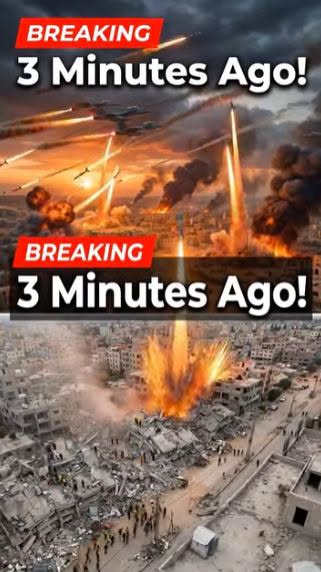
BREAKING NEWS: Israel and the Middle East Crisis — What Is Happening Now?
The latest developments involving Israel have once again placed the Middle East under intense international attention. Reports emerging on August 27, 2026, indicate that military activity and diplomatic tensions remain high across several fronts, while governments around the world continue watching closely for signs that the conflict could either move toward de-escalation or enter another dangerous phase.
However, one important point must be made clear: social-media headlines claiming that “Israel has just finished” a particular military operation should be treated cautiously until the specific claim is confirmed by reliable news organizations or official sources.
The situation is changing rapidly, and dramatic headlines can spread much faster than verified information.
According to current reporting, Israeli military operations and strikes remain part of the broader regional crisis. Reports describe continuing Israeli attacks involving Gaza, Syria, and Lebanon despite international diplomatic pressure.
The developments are especially significant because they come at a time when several countries are attempting to prevent the wider conflict from becoming even more dangerous.
A Region Still on Edge
The Middle East has experienced months of extraordinary tension. The conflict involving Israel, Iran, the United States, Palestinian armed groups, Hezbollah, and other regional actors has created a complicated security environment in which an event in one location can quickly affect countries thousands of miles away.
The situation in Gaza remains one of the central concerns.
Recent reports say Israeli airstrikes have continued despite calls for restraint and criticism from officials involved in efforts to establish or maintain a ceasefire.
That means any announcement describing an operation as “finished” needs to be understood in context. A military operation ending in one location does not necessarily mean that the broader conflict has ended.
For civilians, the uncertainty is particularly difficult.
Families living in areas affected by fighting can face disrupted access to food, water, electricity, medical care, shelter, and transportation. Even when fighting temporarily decreases, the consequences of previous violence can remain for months or years.
Diplomatic Pressure Is Growing
At the same time, international diplomatic efforts are continuing.
The United States has been involved in attempts to establish a broader framework for ending the fighting and improving conditions in Gaza. But a senior official associated with the U.S. ceasefire effort recently criticized Israel’s attacks and warned that continued violence could undermine diplomatic progress.
This highlights one of the central challenges facing negotiators: military actions and diplomatic negotiations are occurring simultaneously.
Governments may call for negotiations while military forces remain active on the ground.
That creates an extremely fragile environment.
A single strike, missile launch, political statement, or unexpected incident could potentially change the calculations of multiple governments.
The Iran Connection
The latest Israel-related developments are also connected to the much larger confrontation involving Iran.
Reuters reported on August 27 that the six-month U.S.-Israeli war with Iran had reached an “endgame,” describing the conflict as a costly stalemate rather than a decisive victory.
This is important because the Iran conflict has consequences far beyond the borders of Israel and Iran.
The Strait of Hormuz, one of the world’s most important energy shipping routes, has been severely disrupted. Regional governments are increasingly concerned about the economic and security consequences of a prolonged confrontation.
Qatar and other regional powers are now involved in diplomatic efforts aimed at finding an exit from the conflict. Reports indicate that Qatar’s foreign minister traveled to Tehran as part of efforts to reduce tensions and discuss safe passage through the Strait of Hormuz.
These diplomatic efforts demonstrate that countries across the region recognize the danger of allowing the conflict to expand indefinitely.
Gaza Remains a Major Concern
For millions of people watching the situation, Gaza remains at the center of the humanitarian crisis.
Israeli military strikes have continued to cause international concern, while Palestinian civilians continue to face the consequences of prolonged conflict. Recent reports describe damage to civilian infrastructure and continued uncertainty surrounding the ceasefire process.
The humanitarian situation makes every military development significant.
When people hear a headline announcing that an operation has “finished,” they may immediately wonder whether this means the fighting is over.
In most cases, the answer is more complicated.
A specific operation can end while another operation begins elsewhere. A temporary pause can occur without becoming a permanent ceasefire. Negotiations can make progress and then suddenly collapse.
That is why responsible reporting requires looking beyond the headline.
Why Verification Matters
Breaking-news stories can become viral within minutes.
A video posted on social media may be described as showing an event that happened “just minutes ago,” even though the footage may actually be days, weeks, or even years old.
Likewise, a headline may remove important context to make an event appear more dramatic.
This is particularly dangerous during wartime.
False or exaggerated reports can increase fear among civilians, influence public opinion, and make an already tense situation even more unstable.
Readers should therefore look for confirmation from multiple reputable news organizations before accepting extraordinary claims.
The latest available reporting does confirm that the region remains highly unstable. But it does not support turning an unspecified “Israel finishes…” headline into a definitive claim about a newly completed event.
What Happens Next?
The next few days could be extremely important.
Diplomats are trying to prevent further escalation, while military forces remain active across several areas.
Regional governments are also searching for ways to protect their own populations and economies from the consequences of the conflict.
The biggest question is whether diplomacy can move faster than military escalation.
If negotiations produce meaningful agreements, there could be an opportunity for reduced violence and improved humanitarian conditions.
If negotiations fail, however, the region could face another period of intensified fighting.
That uncertainty is why governments, financial markets, humanitarian organizations, and millions of ordinary people are watching developments closely.
A Message to Readers
The phrase “BREAKING NEWS” naturally attracts attention.
But during a conflict, the most important thing is not simply being first to share a story. It is being accurate.
A sensational headline may generate thousands of clicks, but accurate information protects readers from fear, confusion, and misinformation.
The current situation involving Israel remains serious. Military activity continues in parts of the region, diplomatic efforts are underway, and the broader confrontation involving Iran continues to create significant risks.
For now, the safest conclusion is that the crisis is not over.
There is no basis in the latest sources reviewed to claim that Israel has simply “finished” the entire conflict or that a final victory has been declared.
Instead, the region remains at a critical crossroads.
The coming days may bring new military developments, diplomatic breakthroughs, further negotiations, or additional escalation.
For civilians caught in the middle, the hope is simple: fewer airstrikes, fewer deaths, greater humanitarian access, and a lasting path toward peace.
The world is watching.
And as new information emerges, the difference between a dramatic headline and a verified fact has never been more important.