Archaeologists Are “Absolutely” Certain They Found the Lost City Where Jesus Performed Miracles
For centuries, one question has fascinated archaeologists, historians, and biblical scholars: Where exactly was Bethsaida, the ancient city associated with several important events in the life of Jesus?
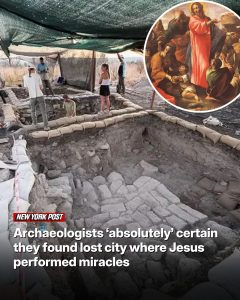
Now, in a development reported on August 29, 2026, archaeologists working at el-Araj, on the northern shore of the Sea of Galilee, say years of excavation have produced an extraordinary accumulation of evidence supporting their identification of the site as ancient Bethsaida. The excavation team’s academic director, Steven Notley, has described the evidence as making them “absolutely” confident in their conclusion.
But there is an important distinction: archaeology cannot prove that Jesus performed a miracle at a particular location. What researchers can investigate is whether a particular archaeological site corresponds to the ancient city described in historical and biblical sources.
And that distinction makes the discovery fascinating.
A City Hidden for Centuries
Bethsaida occupies an important place in the New Testament.
According to the Gospels, it was associated with the apostles Peter, Andrew, and Philip, and it was also connected with several episodes from Jesus’ ministry. Biblical accounts describe Jesus healing a blind man in the area and feeding a multitude with five loaves and two fish.
Yet the physical location of Bethsaida has been debated for generations.
Unlike famous ancient cities such as Jerusalem or Rome, Bethsaida disappeared from the historical landscape. Researchers knew the name from ancient texts, but locating the actual settlement became a major archaeological puzzle.
For decades, another site called et-Tell was considered a leading candidate. Excavations there began in 1987 under archaeologist Rami Arav, and the Bethsaida Excavations Project continues to argue for its identification with biblical Bethsaida.
Then another contender emerged.
That site was el-Araj.
Why El-Araj Became So Important
The el-Araj excavation began in 2016 after earlier surveys revealed archaeological material suggesting that the location had a much older history than previously believed.
Researchers found evidence of a Jewish settlement dating to the period associated with the New Testament, as well as later Roman and Byzantine remains.
Over successive seasons, the archaeological picture became increasingly complicated—and increasingly interesting.
The team discovered evidence suggesting that the settlement was not simply a small fishing village.
Instead, it appears to have developed into a more substantial urban center.
That fits remarkably well with the historical description of Bethsaida’s transformation under Herod Philip.
Ancient historian Josephus wrote that Herod Philip developed Bethsaida and elevated it to the status of a city, giving it the name Julias.
This historical detail is one of the reasons archaeologists are paying such close attention to what is being uncovered at el-Araj.
The New Discoveries
The latest excavation season reportedly produced a remarkable collection of Roman-period objects.
Among the discoveries were lamps, coins, cosmetic or makeup tools, basalt mortars, chalk stoneware, and Herodian lamps.
Researchers also identified architectural remains, including Roman walls and decorative elements associated with public structures.
Each artifact by itself might not seem extraordinary.
An ancient lamp does not have the word “Bethsaida” written on it.
A coin cannot announce that Jesus once walked past the building where it was found.
But archaeology rarely works through one spectacular object.
Instead, researchers build a case by looking at the total archaeological pattern.
What period was the site occupied?
Who lived there?
What kinds of objects were used?
What buildings existed?
How did the settlement develop?
Does the evidence match ancient descriptions?
When dozens or hundreds of clues begin pointing in the same direction, the identification becomes increasingly persuasive.
The Fishing Village Becomes a City
One of the most intriguing aspects of the Bethsaida debate concerns the city’s changing character.
The New Testament presents Bethsaida in a setting closely connected with fishing and the Sea of Galilee.
The archaeological evidence at el-Araj appears consistent with a settlement that developed over time.
Researchers have found indications of Jewish occupation during the first century and later evidence of urban development.
That transition matters.
If Bethsaida was transformed into a Roman-style city under Herod Philip, archaeologists would expect to see evidence of increasing urbanization.
And that is precisely what the excavation team believes it is seeing.
Rather than one isolated discovery, researchers are examining a landscape that appears to contain multiple phases of settlement.
Why the Location Matters
Geography is another major part of the argument.
Bethsaida is repeatedly associated with the Sea of Galilee in biblical and historical traditions.
El-Araj is located very close to the northern shore.
That makes it geographically attractive as a candidate.
By contrast, the distance between et-Tell and the modern shoreline has long been one of the questions surrounding that site’s identification.
Supporters of et-Tell have argued that ancient geological and environmental changes altered the shoreline, potentially explaining why the site is now farther from the water.
In other words, the debate isn’t simply about digging up old stones.
It involves geology, ancient geography, historical texts, archaeology, and the changing landscape of the Sea of Galilee.
The Two-Site Debate
For years, scholars have disagreed over whether et-Tell or el-Araj represents biblical Bethsaida.
This is important because headlines announcing that archaeologists have “found Bethsaida” can make the issue sound completely settled.
It isn’t universally settled.
The archaeological community has had competing interpretations of the evidence, and both sites have advocates.
The Bethsaida Excavations Project at et-Tell points to substantial archaeological remains, including occupation during the relevant historical periods.
Meanwhile, the el-Araj team argues that its discoveries provide a better match for the New Testament city and its historical development.
That disagreement is actually a normal and healthy part of archaeology.
Ancient sites rarely come with perfect labels.
Researchers have to reconstruct the past from incomplete evidence.
What About the Miracles?
This is perhaps the most fascinating part of the story.
The Gospels associate Bethsaida with extraordinary events.
One account describes Jesus healing a blind man.
Another describes the feeding of thousands.
Bethsaida was also connected with several of Jesus’ disciples.
But discovering the city does not prove that a particular miracle occurred there.
Archaeology can establish that a settlement existed.
It can reveal houses, roads, pottery, coins, religious objects, food remains, walls, and other evidence of daily life.
It can sometimes confirm details found in ancient texts.
But supernatural events themselves are outside the normal ability of archaeological methods to prove.
What archaeology can do is bring us closer to understanding the physical world in which the Gospel narratives were set.
And that is already enormously significant.
A Window Into the Time of Jesus
Imagine standing at the excavation site nearly two thousand years ago.
Instead of seeing an archaeological field, you would have seen a living community.
People would have been walking through streets.
Fishermen would have been working around the lake.
Merchants would have been selling goods.
Families would have been preparing meals.
Children would have been growing up in homes that would eventually disappear beneath centuries of soil.
The objects being uncovered today belonged to those people.
A small lamp might have illuminated someone’s home.
A coin might have passed through dozens of hands.
A cosmetic tool might have belonged to an ordinary person getting ready for the day.
These seemingly mundane artifacts are what allow archaeologists to reconstruct the human world of antiquity.
Why This Discovery Matters
Whether el-Araj ultimately wins universal acceptance as Bethsaida or the debate continues, the discoveries are important.
They reveal more about Jewish life in Galilee during the Roman period.
They demonstrate that communities in the region participated in changing political and economic systems.
And they provide researchers with a physical landscape that can be compared with ancient historical and biblical descriptions.
For Christians, the discoveries may also provide a powerful connection to the world described in the Gospels.
Walking through an archaeological site believed to be Bethsaida offers a tangible reminder that these stories were set in real landscapes inhabited by real people.
The Mystery Isn’t Completely Over
Despite the confident statements from the excavation team, archaeology rarely provides absolute certainty overnight.
The phrase “absolutely certain” reflects the team’s confidence, but other scholars may continue evaluating the evidence.
More excavation seasons could reveal additional structures.
New inscriptions could potentially change interpretations.
Dating evidence could refine our understanding of the settlement.
And the debate between el-Araj and et-Tell may continue.
That is how archaeology works.
Every discovery answers some questions while creating new ones.
The Lost City Returns
For nearly two thousand years, Bethsaida existed primarily in texts, traditions, and memories.
Now archaeologists are uncovering its physical remains layer by layer.
The stones cannot tell us exactly what happened on any particular day.
They cannot prove a miracle.
But they can reveal the world in which the Gospel stories unfolded.
And perhaps that is the most extraordinary part of this discovery.
Beneath the soil of northern Israel, researchers may be uncovering the streets, homes, objects, and buildings of a city that played an important role in the story of early Christianity.
The lost city is slowly becoming visible again.
And as archaeologists continue removing layer after layer of earth, one ancient question appears closer than ever to an answer:
Was this truly Bethsaida—the city where Jesus walked, taught, healed, and performed the miracles remembered for nearly two thousand years?
For the team excavating el-Araj, the growing collection of evidence says yes.
For the wider scholarly community, the story remains one of the most fascinating archaeological debates in the Holy Land.