Pics That Need a Double Take: Bizarre Photos From Confusing Perspectives
Some photographs make sense the moment you see them. Others make you stop, stare, and look again.
Then there are those rare pictures that seem to completely break the rules of reality.
A person appears to have impossibly long legs. A dog looks like it has a human face. Someone appears to be floating in midair. A tiny object suddenly seems enormous because of its position in the frame. Nothing has actually been altered, yet the photograph creates an illusion so convincing that your brain struggles to understand what it is seeing.
These are the pictures that truly deserve a double take.
The fascinating thing about confusing photographs is that most of them do not require complicated editing or special effects. Often, the explanation is surprisingly simple: perspective, timing, shadows, reflections, unusual angles, or two objects lining up perfectly at exactly the right moment.
Our brains are constantly trying to make sense of visual information. When a photograph contains an unusual combination of shapes and distances, the brain can make an incorrect assumption almost instantly.
That is when the magic happens.
Imagine seeing a photograph of a person standing beside a table. At first glance, it may look as though the person’s head has somehow been replaced by an object on the table. Look closer, however, and you realize the object is actually much farther away, perfectly aligned with the person’s body.
The photograph captured the moment from exactly the right angle.
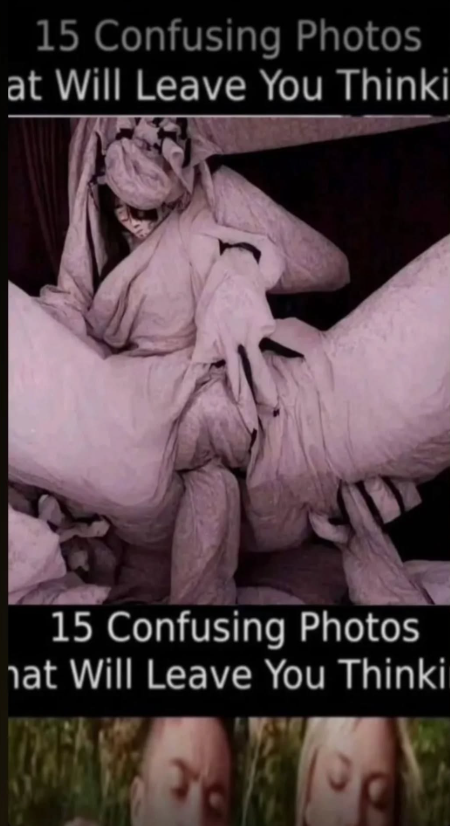
Another classic illusion occurs when someone appears to have an extra arm or leg. Usually, another person’s limb is positioned behind them, but because the bodies overlap, the brain initially interprets everything as belonging to one person.
For a second, the image looks completely impossible.
Then you notice the second person.
And suddenly everything makes sense.
Perspective is one of the most powerful ingredients in these bizarre photographs. Objects that are physically separated can appear connected when photographed from a particular position. A person standing several feet behind someone else can appear tiny enough to hold in one hand. A distant building can appear to rest directly on someone’s head. A vehicle parked farther away can look as though it is sitting on someone’s shoulder.
The camera does not lie.
It simply captures a two-dimensional representation of a three-dimensional world.
That difference is enough to fool us.
Timing can be just as important as perspective.
Consider a photograph taken at precisely the moment a bird flies behind someone’s head. Depending on the bird’s position, it might appear that the person has wings. A jumping dog can look like it is floating. A basketball can appear to be perfectly balanced on someone’s fingertip. A splash of water can freeze in the air and create a shape that looks completely artificial.
One fraction of a second can transform an ordinary scene into something extraordinary.
Reflections create another category of confusing images.
Mirrors, windows, shiny cars, puddles, and even sunglasses can produce reflections that make objects appear to exist in impossible locations. A photograph taken near a large glass building might make it look as though the sky continues directly through the structure. A puddle can reflect a building so clearly that viewers briefly wonder whether they are looking at an upside-down city.
The closer you look, the more interesting the illusion becomes.
Shadows can be equally deceptive.
A strange shadow may appear to belong to the wrong object. A person’s silhouette can stretch across the ground and create a bizarre shape. A tree’s shadow can resemble an animal. Several overlapping shadows can form what looks like a completely different figure.
Our brains naturally connect shapes to familiar objects, even when those shapes are only coincidences.
This is why some photographs become almost like visual puzzles.
You see something.
You make an assumption.
Then you notice one small detail that changes everything.
That detail might be a shoe positioned behind someone’s head. It might be a chair leg hidden beneath a coat. It might be another person standing exactly behind the subject. It might be a reflection in a window.
Suddenly, the impossible becomes ordinary.
One particularly entertaining type of optical illusion involves animals.
Dogs and cats are especially good at creating accidental visual confusion because of their flexible bodies and unpredictable movements. A dog’s head may appear to belong to another animal. A cat sitting behind a person’s shoulders can look like part of their clothing. Two animals standing close together can merge into what appears to be a completely different creature.
The animals, of course, have no idea what is happening.
They are simply standing there while humans struggle to understand the photograph.
Architecture can also create extraordinary illusions.
Buildings photographed from unusual angles can appear to lean, bend, or float. A staircase photographed from above may resemble an abstract pattern. A narrow alley can appear dramatically longer than it really is. Windows reflecting the surrounding environment can make buildings seem transparent.
The effect becomes even stronger when the photograph is taken with a wide-angle lens.
Another source of confusion is scale.
When there is no obvious reference point, it becomes difficult to determine how large something actually is. A rock photographed close to the camera may appear enormous while a mountain in the background looks surprisingly small. A person standing near a tiny object can make it appear gigantic.
This is why travel photographs can sometimes be particularly deceptive.
A photograph might make someone look as though they are touching the top of a famous monument when they are actually standing hundreds of feet away. A distant airplane can appear to be sitting in someone’s hand. The moon can look large enough to touch simply because the photographer has carefully positioned the subject.
These images are not necessarily manipulated.
They are carefully composed.
And that is what makes them so fascinating.
In the age of smartphones, almost everyone carries a camera capable of capturing these moments. The chances of accidentally photographing something bizarre are higher than ever.
People take pictures constantly.
Thousands of photographs are captured every second around the world, and among those ordinary images are occasional moments that are perfectly aligned, perfectly timed, or simply strange enough to confuse anyone who sees them.
Social media has made these photographs even more popular.
A confusing image can attract thousands of comments because viewers immediately want to solve the mystery. Some people notice the explanation within seconds. Others stare at the photograph for several minutes before understanding it.
The comment section often becomes part of the entertainment.
“Wait… what am I looking at?”
“Look behind the person!”
“I had to zoom in.”
“Now I can’t unsee it.”
These reactions are exactly what make optical-illusion photographs so enjoyable.
They turn a simple picture into a challenge.
There is also something psychologically satisfying about finally understanding a confusing image. At first, the brain experiences uncertainty. Then, after discovering the explanation, everything suddenly clicks into place.
That moment of realization is surprisingly rewarding.
It is similar to solving a puzzle.
The best double-take photographs often share one important characteristic: they are completely believable at first glance.
If an image looks obviously edited, the mystery disappears.
But when everything appears natural, the viewer begins questioning their own eyes.
Could that person really be floating?
Is that actually a giant animal?
Why does that building look upside down?
Does that person really have three arms?
The answer is almost always hiding somewhere inside the frame.
Sometimes the secret is in the background.
Sometimes it is in the foreground.
Sometimes it is simply the exact moment the shutter clicked.
And occasionally, the photograph remains strange even after you understand it.
That may be the most enjoyable part.
Photography has always been about capturing moments, but these unusual pictures demonstrate that the camera can capture much more than what we expect to see. A photograph freezes reality into a single frame, removing much of the movement and depth that normally help our brains understand the world.
The result can be wonderfully confusing.
So the next time you see a photograph that looks impossible, don’t scroll past immediately.
Stop.
Look again.
Check the background.
Follow the shadows.
Look for reflections.
Notice where people’s arms and legs actually connect.
Pay attention to objects that might be closer or farther away than they appear.
And most importantly, give the picture a second look.
Because sometimes the strangest photographs aren’t fake at all.
They are simply ordinary moments captured from extraordinary perspectives.
And that’s what makes them worth staring at twice.
The world is full of strange coincidences, unexpected angles, perfect timing, and visual tricks. All it takes is one camera, one unusual moment, and the right perspective to turn an everyday scene into a photograph that leaves everyone asking the same question:
“Wait… what am I looking at?”
Sometimes, the answer is obvious.
Sometimes, it takes a while.
And sometimes, even after you’ve figured it out, you’ll still want to look one more time.