From Boy to Prisoner: The Shocking 452-Year Sentence That Silenced the Nation
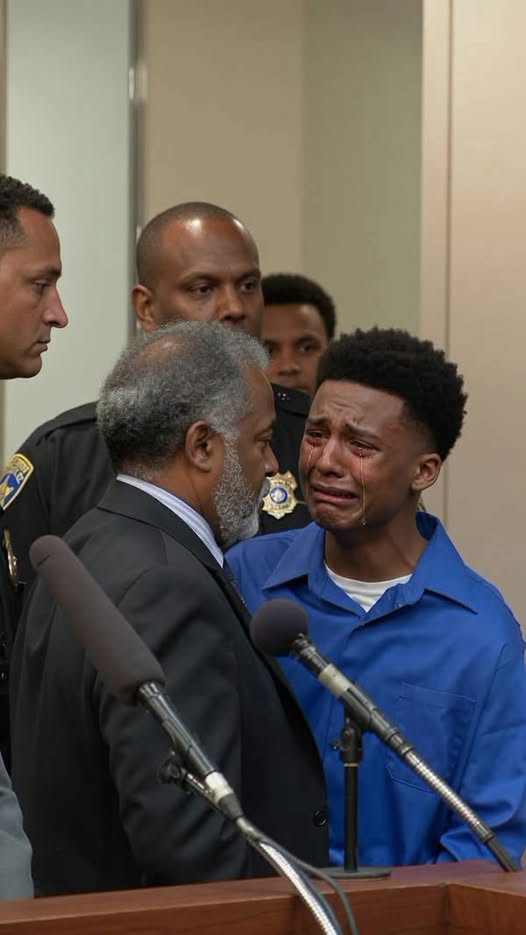
In the flickering glow of smartphone screens across the country, a video began to circulate. A young man in an orange jumpsuit sat in a courtroom, face pale, eyes wide. The audio—clear, authoritative, and devastating—announced the sentence: 452 years. The caption screamed of a boy who had barely crossed the threshold into adulthood, now condemned to die behind bars for a crime that, depending on the post, ranged from rape to arson to something even darker. Comments poured in by the thousands. Outrage. Horror. Calls for reform. Silence from those who simply stared at the number, trying to grasp how a human lifetime could be multiplied and then multiplied again until it became an abstraction, a mathematical certainty of never walking free.
The story spread like wildfire through Facebook groups, TikTok feeds, and private messages. It silenced dinner-table conversations. It dominated late-night scroll sessions. For a brief moment, the nation seemed to hold its collective breath, confronting the idea that a teenager could receive a sentence longer than the recorded history of some nations. Parents looked at their own sons and wondered. Advocates for juvenile justice seized the moment. Critics of “tough on crime” policies pointed to it as proof of a system gone mad. The number itself—452—felt engineered for maximum shock. Not life. Not 100 years. Four hundred and fifty-two. A sentence that outlived the boy who received it before he had even begun to live.
But the story was not true.
Fact-checkers quickly traced the footage. The young man in the orange jumpsuit was real. His name was Jacob Matthew Morgan. In 2015, as a 17-year-old in Rock Hill, South Carolina, he faced charges related to a fire that killed his 14-month-old stepbrother. Prosecutors charged him with murder and first-degree arson. The courtroom clip that went viral years later captured a bond hearing, not a sentencing. In February 2016, Morgan entered an Alford plea to reduced charges and received a 15-year sentence. He did not receive 452 years. The audio layered over the old video was almost certainly generated by artificial intelligence. The specific claim of a 452-year term for a teenager matched no court records, newspaper archives, or official databases. Searches across major engines and historical collections turned up nothing. The story that silenced the nation was a fabrication, a digital chimera built from real images and synthetic sound.
Yet the power of the false story revealed something deeper than a single hoax. It tapped into a genuine and long-standing American anxiety about juvenile sentencing. The United States has a documented history of handing extreme terms to people who committed crimes as children or teenagers. Consecutive sentencing practices can stack decades upon decades until the total exceeds any realistic human lifespan. The result is a functional life sentence without the formal label of “life without parole,” a distinction that has mattered in Supreme Court rulings limiting the harshest punishments for the young.
Consider Bobby Bostic. In 1995, at age 16, Bostic and an accomplice committed a series of armed robberies in Missouri. They held up people delivering Christmas presents, shot and wounded a man, and stole a car. Bostic was tried as an adult. In 1997, a judge imposed consecutive sentences totaling 241 years. The judge told him he would die in the Department of Corrections. Bostic’s parole eligibility was set so far in the future that it effectively meant he would never leave. The U.S. Supreme Court later declined to review the case. The original sentencing judge later expressed regret, calling the length “ridiculous.” Bostic’s story is not unique in its severity, only in how cleanly it illustrates the arithmetic of consecutive terms.
Other cases echo the same pattern. Teenagers convicted of non-homicide offenses have received stacked sentences of 100 years or more. Some of those sentences were later challenged under Eighth Amendment principles established in cases such as Graham v. Florida (2010), which held that life without parole for juveniles who did not commit homicide is unconstitutional, and subsequent rulings that extended scrutiny to de facto life terms. Courts have grappled with whether a 112-year sentence or a 241-year sentence is meaningfully different from formal life without parole when the defendant was a minor at the time of the offense. The legal system has moved, unevenly, toward requiring individualized consideration of youth, maturity, and the possibility of rehabilitation. Still, thousands of people sentenced as juveniles remain incarcerated under terms that will outlast them.
The viral 452-year claim succeeded because it compressed real systemic features into a single, digestible outrage. Extreme consecutive sentencing exists. Juveniles are still transferred to adult court in many jurisdictions. The public’s capacity for shock at the idea of a child being erased by the calendar is real. The fabricated number simply made the abstract concrete and the concrete viral. In an attention economy that rewards extremity, a 15-year sentence for a tragic arson case does not travel as far as a 452-year fiction. The real footage provided visual authenticity; the AI voice supplied emotional finality. Together they produced a moral panic detached from any actual courtroom outcome.
What the episode also revealed is the speed and fragility of collective belief online. Within hours of the video’s appearance, people treated the sentence as established fact. Comment threads filled with certainty. Some users claimed to remember the case. Others demanded the judge’s name. A few posted photos of their own children and vowed never to trust the system. The debunking arrived later and traveled more slowly. By then the emotional impression had already been made. The nation had been silenced by a story that never happened, yet the underlying questions the story raised remained unanswered.
Those questions are not abstract. How should a society punish adolescents whose brains are still developing impulse control, foresight, and moral reasoning? Neuroscience has established that the prefrontal cortex continues maturing into the mid-20s. The same science that informs debates about driving ages and alcohol sales has been slow to fully reshape criminal sentencing. Mandatory minimums, consecutive stacking, and the political appeal of appearing tough on crime continue to produce outcomes that look, from a distance, like the 452-year fantasy. The difference is that the fantasy was invented in a few keystrokes; the real sentences were written into law by elected officials and applied by judges.
There is also the quieter tragedy of the actual case that supplied the images. A 14-month-old child died in a fire. A 17-year-old faced the justice system. A family was shattered. Fifteen years is not nothing. It is a substantial portion of a young life. Yet that reality proved insufficiently dramatic for the algorithms. The demand for a more shocking number overrode the facts on the ground. In that sense the viral story did not merely misinform; it displaced a genuine human cost with a more marketable one.
Years from now, the 452-year claim will likely join the long catalog of digital myths—remembered, if at all, as an example of how easily fabricated audio and selective footage can commandeer public emotion. The deeper conversation it briefly interrupted will continue. Legislatures will debate age thresholds for adult prosecution. Courts will hear more challenges to stacked sentences. Advocates will keep arguing that a child who commits a terrible act remains, in important ways, a child. Opponents will insist that certain crimes forfeit any claim to youth as mitigation. The tension is old. The technology that amplified a false version of it is new.
In the end, no teenager received a 452-year sentence. The courtroom that appeared in the video did not deliver that judgment. The nation was not, in fact, silenced by a real ruling of that magnitude. What occurred was something more modern and more revealing: a collective encounter with a story that felt true because it exaggerated truths already present in the system. The shock was real. The sentence was not. And the questions the shock left behind are still waiting for answers that cannot be generated by artificial voices or measured in centuries that no human will ever serve.