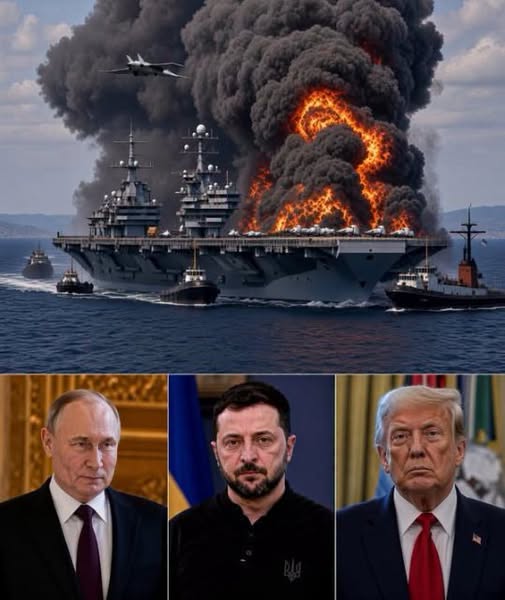
BREAKING: Russian Su-57 Pilot Allegedly Destroys U.S. Aircraft Carrier Carrying 700 Tanks — What We Actually Know
A dramatic headline has been spreading rapidly online:
“BREAKING 30 minutes ago: Russian Su-57 pilot destroys U.S. aircraft carrier carrying 700 tanks…”
The wording sounds like an extraordinary military event has just taken place. Posts circulating online describe a Russian Su-57 fighter allegedly attacking a U.S. aircraft carrier and causing catastrophic destruction.
But there is a major problem with the story.
There is currently no credible confirmation that the alleged attack actually happened.
Several websites are repeating versions of the same headline, but the available material does not provide reliable evidence from the U.S. military, Russian authorities, or major international news organizations confirming that a U.S. aircraft carrier was destroyed. One site carrying the headline explicitly describes the story as fictional rather than real news.
That distinction matters because a genuine attack on an American aircraft carrier by a Russian military aircraft would be an extraordinary international event.
The Headline Sounds Real — But Headlines Are Not Evidence
The viral post uses familiar breaking-news language: “30 minutes ago,” “destroyed,” “Russian Su-57,” and “700 tanks.”
Those words are designed to create urgency.
A reader sees the headline and immediately imagines a huge explosion at sea, aircraft scrambling from a carrier deck, sailors rushing to emergency stations, and governments around the world reacting to a sudden military crisis.
But sensational wording does not establish that the event occurred.
In fact, versions of essentially the same claim have appeared online repeatedly, sometimes using “13 minutes ago,” “20 minutes ago,” or “30 minutes ago.” The repeated appearance of nearly identical headlines can create the impression of multiple confirmations even when websites are simply repeating the same unverified story.
The Su-57 Is Real
One reason the story may appear believable is that the aircraft involved is real.
The Russian Su-57 is a genuine advanced fighter aircraft developed by Russia. It is associated with Russia’s modern combat aviation capabilities.
But the existence of the Su-57 does not prove that a particular Su-57 pilot carried out the attack described in the viral story.
This is an important distinction.
Real military equipment is frequently used in fictional stories, simulations, video games, movies, animations and misleading social-media posts.
And that appears to be particularly relevant here.
The Viral Videos Are Another Warning Sign
At least one YouTube video carrying almost exactly the same headline explicitly identifies itself as a virtual game simulation using ARMA gameplay rather than authentic combat footage. The description states that the material is a simulation and that combat scenarios may differ from real events.
That means viewers should be extremely careful if they encounter dramatic footage showing a fighter attacking a carrier.
A realistic-looking explosion does not automatically mean that the explosion happened in real life.
Modern military simulations can contain aircraft, ships, missiles, smoke, fire and realistic camera movements that can look remarkably convincing when separated from their original context.
A short clip posted without explanation can therefore be mistaken for genuine battlefield footage.
What About the Claim of “700 Tanks”?
Perhaps the most suspicious detail in the headline is the claim that the aircraft carrier was carrying 700 tanks.
U.S. aircraft carriers are primarily designed as floating airbases. Their purpose is to operate aircraft, support aviation operations and project air power from the sea.
They are not ordinarily configured as giant transport ships carrying hundreds of main battle tanks.
The U.S. military does operate specialized vessels for transporting vehicles, equipment and personnel. Therefore, the phrase “aircraft carrier carrying 700 tanks” should immediately make readers question whether the story has confused different types of military ships or simply invented a dramatic detail.
Some versions of the viral story also change the numbers and descriptions, another warning sign that the narrative is not based on a consistent verified report.
Why a Real Carrier Attack Would Be Huge News
A U.S. aircraft carrier is not an ordinary ship.
It is one of the most recognizable and strategically important platforms operated by the U.S. Navy.
A confirmed attack that destroyed such a vessel would raise immediate questions:
Which carrier was attacked?
Where did it happen?
When did it happen?
How many people were aboard?
What weapon was used?
Was the attack confirmed by satellite imagery?
Did the U.S. Department of Defense issue a statement?
Did Russian authorities acknowledge the incident?
What happened to the carrier’s accompanying ships and aircraft?
Those questions would quickly become the focus of governments, military officials, journalists and defense analysts around the world.
Yet the viral story does not provide the kind of independently verifiable evidence expected from an event of such magnitude.
Why These Stories Spread So Quickly
Military stories are especially effective at generating clicks and shares.
They combine fear, technology, geopolitics and dramatic imagery.
A headline mentioning Russia, America, a stealth fighter and an aircraft carrier immediately captures attention.
Adding a phrase like “30 minutes ago” makes people feel that they are witnessing history as it happens.
But that urgency can also discourage careful verification.
People may share first and investigate later.
By the time reliable information becomes available, the original claim may already have been copied onto dozens of pages.
This creates an illusion of confirmation.
Ten websites repeating the same unsupported claim do not necessarily represent ten independent sources.
They may simply represent ten copies of the same rumor.
The Difference Between a Simulation and Reality
This story is also a reminder of how difficult it can be to distinguish real footage from simulated footage online.
Military video games and simulations can recreate modern aircraft and warships with impressive visual detail.
The Su-57, aircraft carriers, missile launches and explosions can all be represented inside virtual environments.
Once a video is removed from its original context, viewers may not know whether they are watching:
- Real military footage
- A training exercise
- A movie
- A video game
- A military simulation
- Computer-generated imagery
- Old footage from another event
That is why the source of the video is just as important as what appears inside the video.
What We Can Actually Say
The available evidence allows us to separate several facts from the viral claim.
The Russian Su-57 is real.
U.S. aircraft carriers are real.
Both countries possess highly sophisticated military forces.
Videos depicting Su-57-versus-carrier scenarios exist online.
Some videos using essentially the same headline are explicitly identified as simulations.
However, there is no credible confirmation available establishing that a Russian Su-57 has destroyed a U.S. aircraft carrier carrying 700 tanks.
That is the key point.
What Should Readers Do Before Sharing?
When an extraordinary military headline appears, stop for a moment.
Look for the name of the ship.
Look for the location.
Look for official statements.
Check whether reputable international news organizations are reporting the same event independently.
Watch the original video description.
Look for indications that footage is from ARMA, another game, a simulation or an older military exercise.
And most importantly, distinguish between “reports are circulating” and “the event has been confirmed.”
Those are two completely different statements.
Final Thoughts
The headline claiming that a Russian Su-57 pilot destroyed a U.S. aircraft carrier carrying 700 tanks is certainly dramatic.
But dramatic does not mean confirmed.
The evidence currently available points to an unverified viral claim, with related videos identified as virtual military simulations rather than authentic combat footage.
Several websites have repeated the story, but repetition alone does not establish its truth. One publication explicitly labels its version a fictional story, while other reports acknowledge that independent confirmation is absent.
If an American aircraft carrier were genuinely destroyed by a Russian fighter, the consequences would be enormous and the event would demand extensive independent confirmation.
For now, the responsible approach is to treat the viral headline as unverified, not as confirmed breaking news.
The lesson is simple:
Before believing the explosion, check the source.
Before sharing the headline, check the evidence.
And before calling something “breaking news,” make sure it actually happened.