This Forensic Doctor Took Advantage of the Situation—Without Knowing That He Was Being Watched
The hospital corridor was unusually quiet that evening.
Most of the staff had already gone home, leaving only a small overnight team to handle emergencies. At the far end of the building was a department few ordinary visitors ever entered—the forensic medicine unit.
It was a place where difficult questions were answered.
When someone died under mysterious circumstances, forensic doctors were responsible for examining the evidence, documenting injuries, collecting samples, and helping investigators understand what had happened. Their work could influence police investigations, court cases, and, most importantly, the search for truth.
That was why the events of that night were so disturbing.
According to the fictional account that follows, a forensic doctor named Daniel had worked at the hospital for more than a decade. He was considered experienced and confident. Colleagues trusted him because he appeared to know exactly what he was doing.
But confidence can sometimes become dangerous when someone begins to believe that nobody is watching.
It started with an unusual case.
A patient had died unexpectedly, and investigators had requested a forensic examination. The circumstances surrounding the death were unclear. Several details did not immediately fit together, and detectives wanted every piece of evidence carefully documented.
Daniel was assigned to the examination.
When he entered the examination room, he believed he was alone.
The security guard had stepped away. The investigators were working in another section of the building. Daniel knew the normal procedures and began preparing the room.
But what he did not know was that the hospital had recently upgraded its security system.
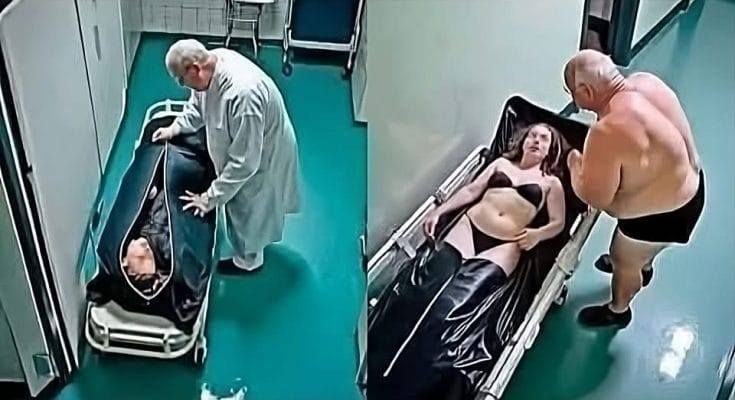
A new camera had been installed near the entrance.
Daniel had been told about the general security upgrades, but he apparently did not realize that the camera covered part of the hallway leading to the examination area.
More importantly, another person was watching.
A junior technician named Michael had noticed something unusual earlier that week. Several small inconsistencies had appeared in the department’s records. Nothing was immediately dramatic, but the paperwork surrounding certain examinations did not always match the timestamps in the computer system.
Michael initially assumed it was an administrative mistake.
Then he noticed another discrepancy.
And another.
Instead of confronting anyone, Michael reported his concerns through the hospital’s internal compliance process.
That decision would eventually become extremely important.
On the night of the examination, Daniel believed he had complete control over the situation.
The case involved sensitive evidence, and he knew that every action should be documented. Yet, according to the fictional story, he began behaving in a way that violated established procedures.
He moved evidence without properly recording the transfer.
He opened documentation before another required staff member arrived.
And then he made a decision that changed everything.
Daniel apparently believed that because the room was private, his actions would remain private too.
He was wrong.
The security footage captured his movements in the hallway.
The electronic system recorded when certain files were accessed.
And the department’s digital logs recorded changes made to the case documentation.
Nobody noticed immediately.
Daniel finished his work and left the department.
The next morning, Michael reviewed the records.
Something immediately caught his attention.
The time Daniel claimed to have completed a particular procedure did not match the electronic access record.
Michael checked again.
Then he compared the security footage.
The discrepancy was real.
He contacted his supervisor.
At first, nobody wanted to jump to conclusions. A timestamp mismatch could have many innocent explanations. Computers malfunction. Staff members make mistakes. Files can be opened accidentally.
So the hospital began a formal review.
What they discovered was more complicated.
Several records connected to previous cases showed similar irregularities.
Investigators began examining the cases one by one.
They did not initially assume criminal wrongdoing. Instead, they reconstructed the timeline of each examination.
Who entered the room?
Who handled the evidence?
When was each file accessed?
When were samples transferred?
Who signed the documentation?
The deeper they looked, the more questions appeared.
Daniel was eventually called into a meeting.
He expected an ordinary administrative discussion.
Instead, he found several investigators waiting for him.
A large monitor displayed a timeline.
The first timestamp appeared.
Then another.
Then another.
Daniel remained silent.
The investigators explained that they were not accusing him of anything yet. They simply wanted an explanation for the inconsistencies.
He offered several explanations.
Some sounded plausible.
Others were difficult to reconcile with the digital records.
Then the investigators showed him the security footage.
The room became silent.
Daniel finally realized something he had failed to consider.
The evidence was not based on one person’s memory.
There were multiple independent records.
Security cameras.
Computer logs.
Electronic signatures.
Access histories.
And written documentation.
Together, they created a timeline that was difficult to ignore.
The investigation continued for weeks.
Other staff members were interviewed. Records were preserved. Previous cases were reviewed. Independent experts were brought in to determine whether procedures had been properly followed.
The hospital also contacted the appropriate authorities because forensic evidence must be handled according to strict legal and professional standards.
The most important lesson was not simply about one doctor.
It was about accountability.
In forensic medicine, even a small mistake can have enormous consequences.
A missing sample can create doubt.
An undocumented transfer can weaken evidence.
An incorrect timestamp can raise questions about the entire chain of custody.
And if someone intentionally interferes with evidence, the consequences can extend far beyond the workplace.
Families waiting for answers can be affected.
Investigators can be misled.
Courts can receive incomplete information.
And innocent people can potentially suffer because evidence was not handled correctly.
That is why forensic procedures are designed with multiple safeguards.
The fictional story also illustrates another important point: people sometimes assume that wrongdoing can remain hidden simply because they believe they are alone.
But modern institutions leave digital footprints everywhere.
Electronic records document access.
Security systems document movement.
Computer networks record activity.
Laboratories maintain chain-of-custody records.
And other employees may notice inconsistencies that someone attempting to hide their actions never anticipated.
Eventually, the investigation into Daniel’s conduct reached its conclusion.
The authorities would determine whether any laws or professional rules had actually been violated. Until such findings were made, allegations remained allegations—not proven facts.
For the people involved, however, the experience changed the way they viewed their workplace.
Michael, the junior technician, later reflected on the decision that started everything.
He had almost ignored the first discrepancy.
It seemed too small.
Too ordinary.
Too easy to explain away.
But he decided to document it anyway.
That simple decision became the first step toward uncovering a much larger problem.
The story ends with a powerful reminder.
Professional authority does not place someone above accountability.
A uniform does not make someone infallible.
A title does not make someone immune from investigation.
And being alone in a room does not necessarily mean that nobody will ever know what happened there.
In forensic science, the smallest details can matter.
A timestamp.
A signature.
A camera angle.
A missing entry.
A computer record.
One detail may appear meaningless by itself.
But when those details are placed together, they can tell an entirely different story.
That is ultimately what makes forensic investigation so fascinating.
The evidence speaks—even when the people involved do not.
And sometimes, the person who believes nobody is watching discovers too late that the truth has been quietly recording itself all along.