Trump FALLS AGAIN! — White House Doctor Breaks Silence!
A dramatic headline has been spreading rapidly across social media, claiming that President Donald Trump “fell again” and that a White House doctor has finally broken silence about his health.
The story has attracted enormous attention because anything involving the health of a sitting U.S. president can quickly become a major public issue. But behind the shocking headline is a much more complicated story—and one that deserves careful examination before anyone accepts the viral claim as fact.
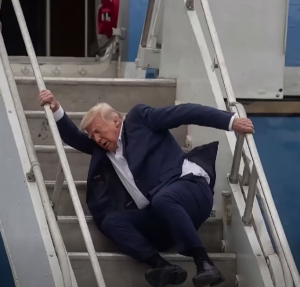
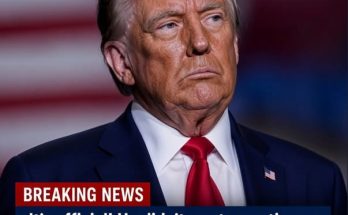
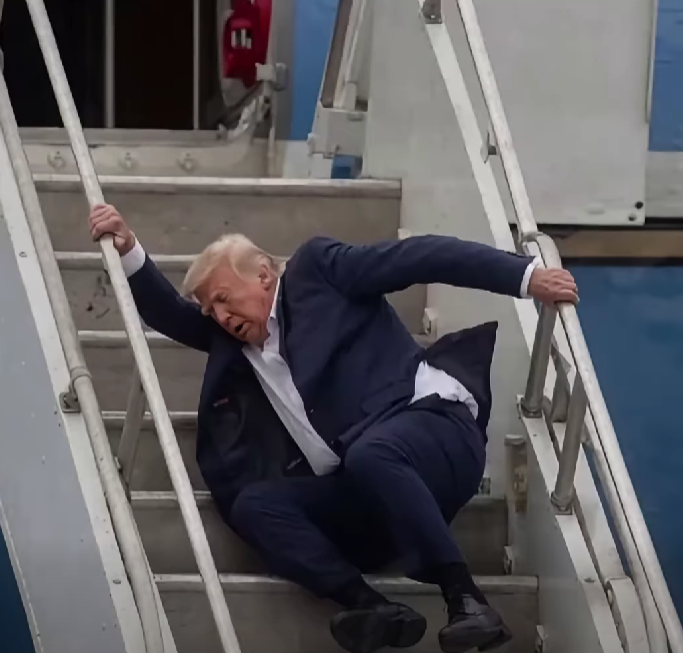
According to reporting published in late August and early September 2026, a video circulating online appeared to show Trump stumbling or collapsing near his presidential vehicle. The video was presented with a dramatic television-style banner declaring, “Trump falls again! White House doctor breaks silence.”
However, fact-checking found that the viral presentation was misleading. The footage had been manipulated, including through artificial-intelligence-generated alterations, and the original footage did not show Trump collapsing as portrayed in the viral version.
That distinction is extremely important.
A video can look convincing while still presenting an entirely different reality from the original recording. Modern editing and artificial intelligence make it possible to take authentic footage, alter a person’s movements, add dramatic graphics, and create a story that appears to be breaking news.
For millions of people scrolling through Facebook, TikTok, X, and other platforms, the first few seconds of such a video may be all they see.
The result is a powerful emotional reaction.
Some viewers immediately become concerned about the president’s health. Others criticize him. Still others share the video with friends and family because they believe they are passing along an important news development.
But sharing a dramatic claim does not make the claim true.
What about the White House doctor?
Another major part of the viral story is the claim that a White House physician “broke silence” and revealed information about Trump’s condition.
As of the available reporting, there is no verified physician statement confirming that Trump suffered a major medical emergency connected to the viral video.
That does not mean that questions about presidential health are unreasonable. Presidents receive extensive medical care, and their health can be a legitimate matter of public interest.
But a legitimate question is different from a confirmed diagnosis.
Trump’s physician, Captain Sean P. Barbabella, has previously released official information about the president’s health. In May 2026, Trump underwent an annual physical examination at Walter Reed National Military Medical Center. The White House released a memorandum describing the examination and stating that 22 specialty providers were involved in the evaluation.
The existence of a detailed medical examination, however, should not be confused with confirmation of the viral fall story.
Likewise, seeing a president stumble—or watching a manipulated video that appears to show a stumble—is not enough to determine whether someone has a particular medical condition.
Medical diagnoses require appropriate examination, medical history, and, when necessary, diagnostic testing.
Why the video became so powerful
The story demonstrates how modern political information can travel at incredible speed.
A sensational headline such as “Trump FALLS AGAIN!” immediately creates curiosity.
People want to know:
What happened?
Where did it happen?
Was he injured?
Did doctors discover something?
Why wasn’t the public told?
Is the president okay?
Those questions encourage people to click, comment, and share.
Social-media algorithms can then amplify the material, exposing it to even more users.
The original context can disappear.
A video that began as ordinary footage can suddenly become part of a completely different narrative.
This is especially important when artificial intelligence is involved. AI-generated or AI-altered videos can create realistic movements that never happened. A viewer who does not know the original footage may have difficulty recognizing the manipulation.
That is why the source of a video matters just as much as the video itself.
Trump’s actual public appearances
There is also another important point.
Trump continues to make public appearances and participate in presidential events. The White House published video of Trump making an announcement on healthcare on September 18, 2026.
Current reporting is also focused on numerous political and diplomatic activities involving the administration, including preparations for Chinese President Xi Jinping’s upcoming U.S. state visit.
Those developments provide a broader context for understanding what is happening around the president.
At the same time, public appearances cannot substitute for medical examinations. A person’s appearance in a video does not allow the public to diagnose a medical condition.
The same principle applies in reverse: a moment of awkward movement does not automatically prove that something is seriously wrong.
Why people should be careful
The phrase “White House doctor breaks silence” carries particular weight because it suggests inside information.
If a genuine physician statement existed, responsible reporting would normally provide identifiable sourcing, the date of the statement, and details about what was actually said.
Instead, viral posts often use vague language.
They may say:
“Doctors are worried.”
“Sources reveal the truth.”
“White House insiders are terrified.”
“Doctors finally broke their silence.”
But without a verifiable source, these statements remain claims rather than established facts.
That distinction is essential.
The internet is full of old photographs, recycled videos, altered clips, misleading headlines, and AI-generated material that can appear new even when it is not.
The bigger lesson
The controversy surrounding the “Trump falls again” headline is bigger than one politician.
It illustrates a challenge facing everyone who gets news through social media.
The technology for creating convincing fake content is becoming increasingly sophisticated. At the same time, people are consuming information faster than ever.
A shocking headline may be shared thousands of times before anyone checks where it originated.
That is why viewers should pause before sharing.
Check the date.
Find the original video.
Look for independent reporting.
Search for an official statement.
Ask whether reputable news organizations are reporting the same event.
And most importantly, separate what is confirmed from what is merely claimed.
What we actually know
The viral headline claiming that Trump “fell again” and that his White House doctor revealed a serious hidden medical problem is not supported by verified evidence currently available.
Fact-checking has identified manipulated footage behind one widely circulated version of the claim, while the original footage did not show the dramatic collapse portrayed online.
Trump has also undergone a publicly documented annual medical examination, with the White House releasing a physician’s memorandum about that examination in May 2026.
That is where the confirmed information currently stands.
The story may continue to evolve, and genuinely new medical information could emerge in the future. But until there is a verified statement, authentic footage, or reliable reporting establishing a new incident, the dramatic social-media headline should not be treated as confirmation of a medical emergency.
In an era when one edited video can reach millions of people within hours, the most important question is not simply:
“Did you see the video?”
It is:
“Do we know that the video is real?”
And in this case, that question changes the story completely.