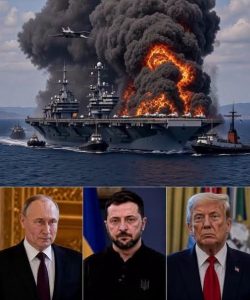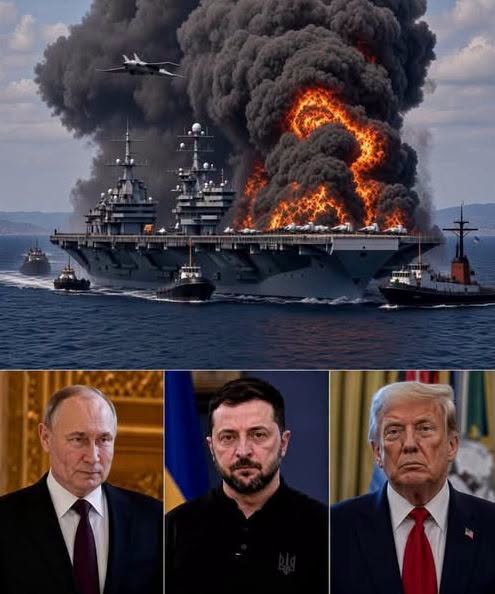
🚨 BREAKING: Russian Su-57 Pilot Allegedly Destroys U.S. Aircraft Carrier Carrying 700 Tanks — What Really Happened?
A dramatic headline has been spreading rapidly across social media claiming that a Russian Su-57 pilot has destroyed a U.S. aircraft carrier reportedly carrying 700 tanks.
The headline sounds like an extraordinary breaking-news event, but there is an important problem: there is no credible confirmation that this attack actually happened.
Several websites have recently published versions of the same story, using almost identical wording such as “30 minutes ago,” “13 minutes ago,” and “Russian Su-57 pilot destroys U.S. aircraft carrier.” However, searches for reliable confirmation do not establish that a U.S. carrier was attacked or destroyed. One website carrying the claim explicitly describes its version as a fictional story rather than real news.
The Story Spreads Online
The claim is built around an extremely dramatic scenario.
According to the viral narrative, a Russian Su-57 allegedly approached a heavily protected American aircraft carrier and carried out a devastating strike. The supposed attack is described as happening suddenly, leaving little time for defensive systems to respond.
Images and videos accompanying the headline make the story appear even more convincing.
But this is exactly where viewers need to be careful.
At least one widely circulated video using essentially the same headline identifies itself as an ARMA 3 virtual game simulation, not authentic combat footage. Its description explicitly states that it is a simulated scenario and that the combat shown is not real-world footage.
Another video circulating with the same claim likewise identifies the material as ARMA 3 gameplay and a military simulation.
That distinction is extremely important.
A realistic-looking explosion on video does not automatically mean an actual military attack occurred.
The Su-57 Is Real
The Russian Su-57 is not fictional.
It is a real advanced Russian fighter aircraft and is one of the most recognizable aircraft associated with Russia’s modern military aviation program.
That real aircraft is what makes the viral story sound believable.
But the existence of the aircraft does not prove that a particular pilot carried out the alleged attack.
A real weapon, aircraft, soldier, ship, or military base can easily be inserted into a fictional scenario, video game, simulation, or misleading social-media post.
This is one reason military misinformation can be so difficult to identify at first glance.
What About the “700 Tanks”?
Perhaps the most unusual part of the headline is the claim that the American aircraft carrier was carrying 700 tanks.
This detail deserves particular scrutiny.
U.S. aircraft carriers are primarily designed to operate aircraft and function as mobile naval airfields. Their central role involves launching and recovering aircraft, supporting air operations, projecting power, and operating as part of larger carrier strike groups.
The idea that an aircraft carrier was transporting hundreds of tanks therefore requires additional explanation and evidence.
Different versions of the viral story have also used slightly different descriptions and numbers, another reason readers should avoid assuming that every version represents a separate confirmed report.
What Would a Real Carrier Attack Mean?
If a Russian fighter had actually destroyed a U.S. aircraft carrier, the consequences would be enormous.
This would not be an ordinary military story.
A confirmed direct attack by Russian forces against a U.S. carrier would represent an extraordinary escalation between two nuclear-armed powers.
There would likely be intense international attention, official statements, military briefings, satellite analysis, emergency diplomatic activity, and extensive reporting from major international news organizations.
The identity of the carrier would also be one of the first questions.
Which ship was attacked?
Where was it located?
When did the incident occur?
How many personnel were aboard?
Were aircraft on the deck?
What weapons were involved?
What evidence exists?
Those questions remain unanswered by the viral posts.
Why the Headline Says “30 Minutes Ago”
Another major warning sign is the repeated use of phrases such as “30 minutes ago” or “13 minutes ago.”
This type of wording creates urgency.
It encourages people to click immediately rather than stop and verify.
The same basic headline has appeared online repeatedly over a period of months, with different websites reposting or modifying the wording. That makes the claim look like a continuing breaking-news event even though the underlying story has not been independently confirmed.
This is a common pattern with viral misinformation.
A story can be copied from one website to another.
Then another page republishes it.
Then someone creates a video about it.
Then another account posts the video with “BREAKING” added to the title.
Soon, hundreds or thousands of people may see the claim.
But repetition is not independent confirmation.
Dramatic Images Are Not Proof
The photographs associated with the story are also designed to create an emotional reaction.
A burning aircraft carrier surrounded by smoke is naturally shocking.
But an image alone cannot prove when or where it was taken.
It may come from an unrelated accident, military exercise, movie, video game, computer-generated scene, or an older event.
This is why journalists and investigators normally look for additional evidence before identifying an image as proof of a new event.
The same principle applies to videos.
If footage comes from a military simulation, it should never be presented as genuine battlefield footage.
What Reliable Evidence Would Look Like
For such a major event to be considered confirmed, readers would expect evidence from multiple independent sources.
That could include official statements, verified imagery, credible international reporting, satellite observations, military communications, or other independently verifiable evidence.
Instead, the current versions of this story are primarily circulating through sensational websites and social-media posts.
One website publishing the exact claim states that it is fictional.
Other versions acknowledge that there is no official confirmation.
That means the story should not be presented as an established military event.
Why People Believe Stories Like This
Military technology is naturally fascinating.
The words “Russian Su-57,” “U.S. aircraft carrier,” “700 tanks,” and “breaking news” immediately create a dramatic mental picture.
The headline also creates a sense that something enormous has happened just moments ago.
When people are shocked, they may share first and verify later.
That is exactly why sensational military stories spread so quickly.
The safest response is to slow down.
Ask who originally reported it.
Look for the name of the ship.
Check whether official authorities have commented.
Look for independent reporting.
Examine the original video.
And determine whether the footage is real, old, digitally generated, or from a video game.
The Bottom Line
The Russian Su-57 is real.
U.S. aircraft carriers are real.
Military tensions between major powers are real.
But the specific claim that a Russian Su-57 pilot has destroyed a U.S. aircraft carrier carrying 700 tanks has not been credibly confirmed.
The dramatic videos associated with the claim include material explicitly identified as virtual military simulation footage.
The websites repeating the headline do not provide the kind of independent evidence that would be expected for an event of this magnitude.
So before sharing the headline as fact, remember one important rule:
A viral post is not the same thing as verified news.
The story may continue appearing across Facebook, YouTube, and other social-media platforms, especially because dramatic military headlines generate enormous attention.
But until credible evidence establishes the location, identity of the vessel, circumstances of the alleged attack, and official confirmation, the claim should be treated as unverified rather than confirmed breaking news.
In today’s information environment, the most powerful response to a shocking headline is not to share it immediately.
It is to ask one simple question:
“Where is the evidence?”
Sometimes that question reveals the difference between a genuine breaking-news event and a story created to generate clicks, views, and reactions.