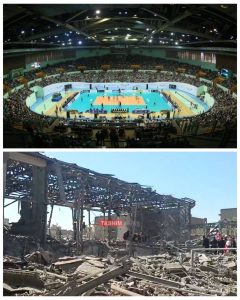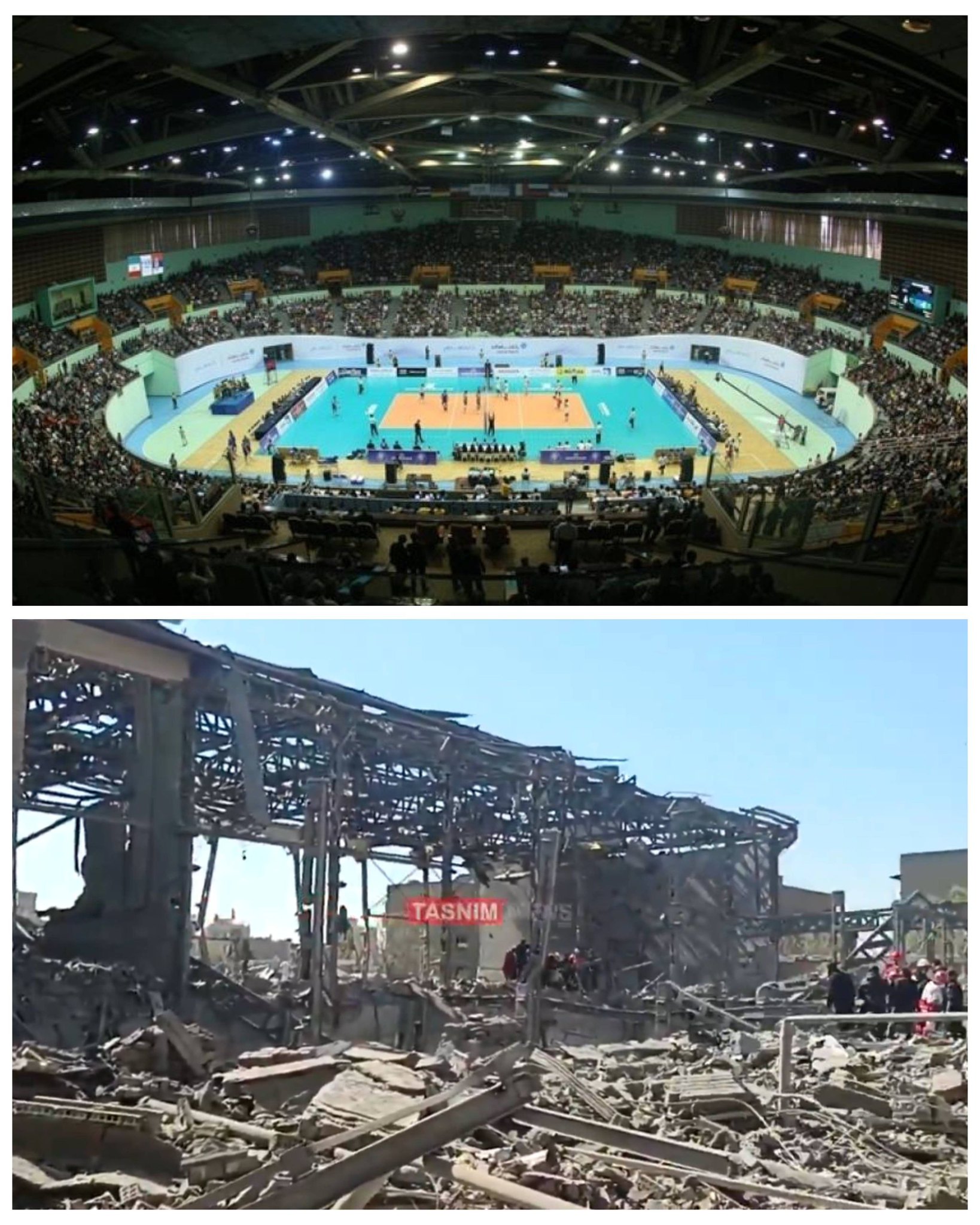
The destruction of a major sports arena in Tehran has become one of the most controversial developments in the rapidly escalating war between the United States, Israel, and Iran. Reports on March 5 indicate that a 12,000-seat indoor arena inside the Azadi Sports Complex in Tehran was destroyed during a wave of airstrikes carried out amid the widening conflict. The facility had long served as a venue for major sporting events, including volleyball, martial arts competitions, and international basketball tournaments.
For decades, the Azadi complex represented one of Iran’s most important athletic centers. Located in western Tehran, the sprawling complex contains multiple stadiums, training facilities, and sports federation offices. The indoor arena that was destroyed in the strike could seat roughly 12,000 spectators and regularly hosted national volleyball matches and regional tournaments.
A Cultural and Sporting Landmark
Before the war reached the capital, the arena was known primarily as a center of sports and youth culture. Iranian volleyball, one of the country’s most popular sports, often held national team games there. The facility also hosted wrestling tournaments, basketball competitions, and martial arts championships that drew thousands of fans.
For many residents of Tehran, the complex represented more than just a sports venue—it was a symbol of normal life. Families gathered there to watch games, university students attended competitions, and international teams occasionally played exhibition matches in front of packed crowds.
Sports complexes like Azadi have historically played an important role in Iranian society. Athletic events provide rare moments when people from different backgrounds come together in a country often defined by political tension and strict social rules.
The Strike
According to multiple reports, missiles struck the indoor arena early Thursday as part of a broader series of attacks targeting infrastructure across Tehran. The strike reportedly leveled the main hall and damaged nearby facilities, including buildings used by sports federations and athlete dormitories.
Officials and media outlets in Iran condemned the attack, arguing that sports facilities should not be targeted in wartime. Some Iranian sports officials called the destruction of the arena a violation of international humanitarian principles that generally seek to protect civilian institutions such as schools, hospitals, and sports venues.
Images and video circulating online showed sections of the structure collapsed, with debris scattered across the surrounding grounds. Windows in adjacent buildings were shattered by the blast, and parts of nearby training facilities were reportedly damaged.
Claims About Military Use
Some sources have reported that authorities had been using certain sports venues in Iran as staging areas for security forces or equipment during the conflict. According to reports from Iranian and international outlets, several stadiums and sports complexes were allegedly used to gather security personnel or store vehicles and supplies.
If true, such use could change how military planners categorize these locations under the laws of war. International humanitarian law allows attacks on civilian structures if they are being used for military purposes, though such decisions remain highly controversial and often disputed.
Independent verification of how the facility was being used at the moment of the strike remains difficult due to the ongoing conflict and limited access for journalists.
A War Reaching the Capital
The strike on the Azadi arena took place during one of the most intense phases of the ongoing 2026 Iran conflict, which has seen widespread airstrikes across multiple provinces. Large sections of Tehran have experienced repeated bombardments, causing widespread fear among residents and major disruptions to daily life.
Civilian infrastructure across the capital—including residential buildings, government offices, and public facilities—has been affected by the fighting. Many residents have fled certain districts or are staying indoors amid air-raid alerts and missile defense activity.
The destruction of the sports arena underscores how the conflict has expanded beyond strictly military installations and into areas associated with everyday civilian life.
Impact on Iranian Sports
The loss of the Azadi indoor arena is also a major blow to Iranian sports. National leagues and international competitions have already been disrupted by the war, with many events postponed or canceled.
Athletes who trained at the complex have lost access to one of the country’s most important facilities. Several sports federations that used offices in the complex reportedly suffered damage as well, potentially disrupting training programs and youth development systems.
Iran has invested heavily in sports infrastructure over the past several decades as part of broader efforts to promote international competition and national pride. Facilities like those in the Azadi complex were central to that effort.
International Reaction
The strike has drawn strong reactions from different sides of the geopolitical divide. Iranian officials and some international observers have condemned the destruction of the sports arena as an attack on civilian infrastructure.
Meanwhile, supporters of the military campaign argue that facilities used for military purposes can become legitimate targets under the rules of armed conflict.
The incident highlights the increasingly blurred line between civilian and military spaces in modern warfare. Governments sometimes repurpose public infrastructure during emergencies, which can place those locations at risk.
The Human Dimension
Beyond the political and military debates, the destruction of the arena represents a loss felt by ordinary people. Sports venues often hold memories of victories, celebrations, and moments of national pride.
For thousands of Iranian fans, the arena was where they watched their national volleyball team compete, attended tournaments, or simply enjoyed an evening of sports entertainment.
In times of war, such places can quickly transform from centers of joy into symbols of destruction.
A War That Continues to Escalate
The strike on the Azadi sports arena is only one episode in a broader conflict that continues to intensify across the Middle East. Missile attacks, airstrikes, and military operations are now affecting multiple countries and strategic locations throughout the region.
As long as the war continues, infrastructure—whether military or civilian—remains vulnerable to destruction. The loss of the Tehran arena serves as a reminder that modern warfare rarely stays confined to traditional battlefields.
Instead, it often spreads into the spaces where ordinary life once unfolded: homes, schools, workplaces—and even stadiums filled with cheering fans.