Duxford Onlookers Recall the Moment an Out-of-Control Plane Came Toward Them Before a Hero Pilot Brought It Down in a Field
For spectators gathered at Duxford, the day was supposed to be about aviation.
They had come to watch historic aircraft take to the sky, hear the roar of powerful engines and enjoy the spectacle of pilots demonstrating machines that had defined generations of aviation.
But in an instant, the atmosphere changed.
What had looked like a normal aircraft display suddenly became a terrifying fight for survival as a plane appeared to lose control and head toward the people watching from the ground.
For those closest to the incident, the memory remains extraordinarily vivid.
They saw an aircraft approaching in a way that did not look right. Instead of continuing safely through its planned flight path, it appeared to be heading toward the spectators.
For a few terrifying seconds, nobody knew exactly what was going to happen.
Then the pilot made a decision that would save lives.
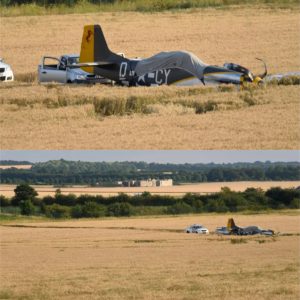
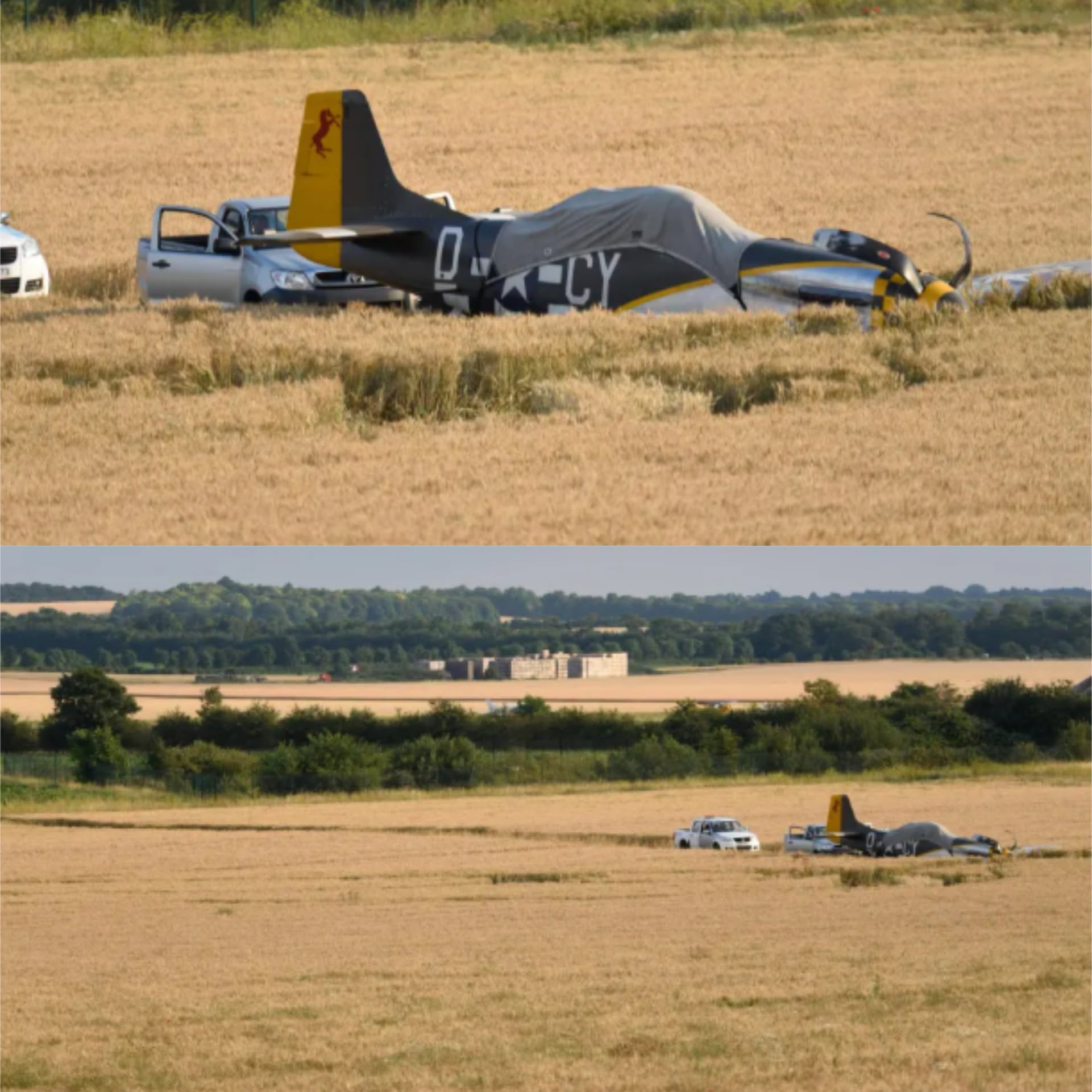
Rather than allowing the aircraft to continue toward the crowd, he managed to bring it down in a field.
The aircraft was lost, but the decision potentially prevented an even greater tragedy.
A Day of Aviation History
Duxford has long been associated with aviation.
The former RAF airfield in Cambridgeshire is famous for its military history and its connection with historic aircraft. Today, it is a major destination for aviation enthusiasts, museums and air displays.
For spectators, watching aircraft fly over the historic airfield can be an unforgettable experience.
The excitement is part of the attraction.
Engines thunder overhead.
Aircraft accelerate across the sky.
Crowds point upward as pilots perform carefully planned maneuvers.
Most of the time, everything goes exactly as intended.
But aviation demonstrations also involve risk.
Even experienced pilots cannot eliminate every possibility of mechanical failure or unexpected aircraft behavior.
On this particular occasion, spectators were about to see just how quickly a display could become an emergency.
The Sudden Change
The first signs that something was wrong were difficult for spectators to interpret.
People watching from the ground do not have access to the information available to a pilot.
They cannot see every instrument.
They cannot hear every cockpit warning.
They do not know whether an aircraft is responding normally to the pilot’s controls.
All they can do is watch.
And what the Duxford spectators saw was an aircraft that appeared to be heading toward them.
The mood changed immediately.
What had been excitement became fear.
Some people began moving away.
Others remained frozen, watching the aircraft as it approached.
There was no time for a carefully organized evacuation.
There was only the instinctive human reaction to danger.
Get away.
Find cover.
Move.
A Terrifying Few Seconds
Aircraft travel incredibly quickly.
At display speeds, an aircraft can cross a large distance in seconds.
That means spectators may have almost no time to react when something goes wrong.
The people watching at Duxford could see that the aircraft was not where it was supposed to be.
The possibility that it might reach the crowd was horrifying.
For those standing directly in its apparent path, the situation must have felt almost unreal.
An aircraft that had moments earlier represented excitement and entertainment now appeared to be a threat.
There was no way to know whether the pilot could regain control.
The spectators could only watch.
The Pilot’s Decision
Inside the cockpit, the situation was completely different.
The pilot had to make decisions under enormous pressure.
He had to assess the aircraft’s condition, altitude, speed and direction while simultaneously considering the people on the ground.
If the aircraft could not safely return to its intended flight path, another option was needed.
The pilot needed somewhere to put the aircraft.
A field offered the best chance of avoiding the spectators.
Choosing an emergency landing site is never simple.
The pilot must consider obstacles, buildings, roads, power lines and the condition of the terrain.
But there is one overriding priority:
Keep people alive.
The pilot managed to guide the aircraft away from the crowd and toward a field.
For the spectators, the aircraft was no longer heading directly at them.
That moment must have brought both relief and terror.
The Crash
The aircraft eventually came down in the field.
The impact was dramatic.
Smoke and debris may have followed as the aircraft struck the ground, but the crucial fact was that it was no longer heading toward the spectators.
The pilot’s decision had changed the outcome.
Instead of an aircraft crashing into a densely populated viewing area, it came down away from the crowd.
The consequences could have been dramatically different.
The aircraft could be replaced.
Human lives could not.
The Meaning of “Hero”
After an aviation accident, people often use the word “hero.”
But heroism in aviation is rarely about dramatic gestures.
Sometimes it is simply about making the correct decision when there is almost no time to think.
A pilot experiencing an emergency has to control fear and focus on the problem.
There may be no perfect solution.
There may only be the least dangerous option.
In this case, bringing the aircraft down in a field meant accepting the loss of the machine in order to protect people on the ground.
That is the kind of decision that demonstrates professionalism and courage.
The pilot was not simply trying to save himself.
He was thinking about everyone beneath him.
What the Spectators Remember
For eyewitnesses, the most powerful memories are often not the moments immediately after the crash.
They are the seconds before it.
The moment when people realized the aircraft was coming toward them.
The sound of the engine.
The sight of the aircraft moving in an unexpected direction.
The realization that something was seriously wrong.
Those memories can remain vivid for years.
Some spectators may remember the people around them suddenly running.
Others may remember a moment of silence as everyone watched the aircraft.
And many will remember the instant they understood that the pilot had managed to steer it away.
What had initially appeared to be an unavoidable disaster had become a narrow escape.
Why Aviation Displays Carry Risks
Air shows are carefully regulated and planned, but they cannot eliminate every risk.
Pilots performing demonstrations operate highly capable machines, sometimes at relatively low altitudes and high speeds.
Mechanical problems can happen.
Weather can change.
Aircraft systems can fail.
Human beings can make mistakes.
The safety procedures surrounding modern air displays exist because aviation authorities understand these risks.
Emergency planning is therefore an essential part of every major event.
Ground teams, emergency services and pilots all have to be prepared for situations that organizers hope will never occur.
The Duxford incident demonstrates why those preparations matter.
A Narrow Escape
For the spectators, the accident could easily have become one of the worst days in the site’s history.
Instead, the aircraft came down away from them.
That distinction matters enormously.
An uncontrolled aircraft heading toward a crowd represents one of the most frightening scenarios imaginable at an air show.
The pilot’s ability to redirect it toward a field gave people on the ground a chance to survive.
It also demonstrated the importance of having open areas surrounding aviation display zones.
A field can become a crucial emergency landing site.
What looks like empty countryside can suddenly become the difference between a serious accident and a mass-casualty disaster.
Remembering the Pilot
Whenever an aircraft is lost, attention naturally turns to the machine.
People want to know what type it was, what happened to it and why it crashed.
But the human story is more important.
The pilot was placed in an impossible situation and had to act immediately.
There was no time to consult a manual or discuss options with a team.
The decision had to be made in the cockpit.
And the consequences were enormous.
By directing the aircraft away from the spectators, the pilot demonstrated the central responsibility of every aviator: protect human life whenever possible.
A Day the Spectators Will Never Forget
Duxford has witnessed countless remarkable moments in aviation history.
Thousands of people have gathered there to celebrate aircraft, pilots and the extraordinary history of flight.
But for the people who witnessed this particular incident, the day became memorable for a very different reason.
They saw an aircraft apparently heading toward them.
They experienced the fear of not knowing what would happen next.
And they watched as the pilot fought to regain control and ultimately brought the aircraft down in a field.
The aircraft could not be saved.
But the people on the ground were.
That is why the incident continues to be remembered.
It is a reminder that aviation is both magnificent and unforgiving.
Behind every spectacular air display are pilots carrying enormous responsibility. When something goes wrong, they have only seconds to make decisions that can determine whether an accident becomes a tragedy.
For the Duxford spectators, those seconds seemed to last forever.
They watched an aircraft come toward them.
They feared the worst.
Then the pilot turned a terrifying situation into a survivable one.
The roar of the engine eventually faded, the emergency response began, and the crowd slowly understood that the worst outcome had been avoided.
Years later, the memory remains powerful—not simply because an aircraft crashed, but because of where it crashed.
Away from the crowd.
In a field.
And because one pilot, faced with an extraordinary emergency, made a decision that put the lives of people on the ground first.