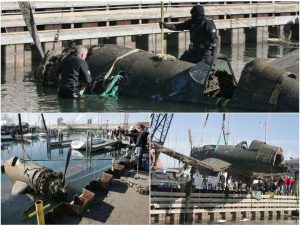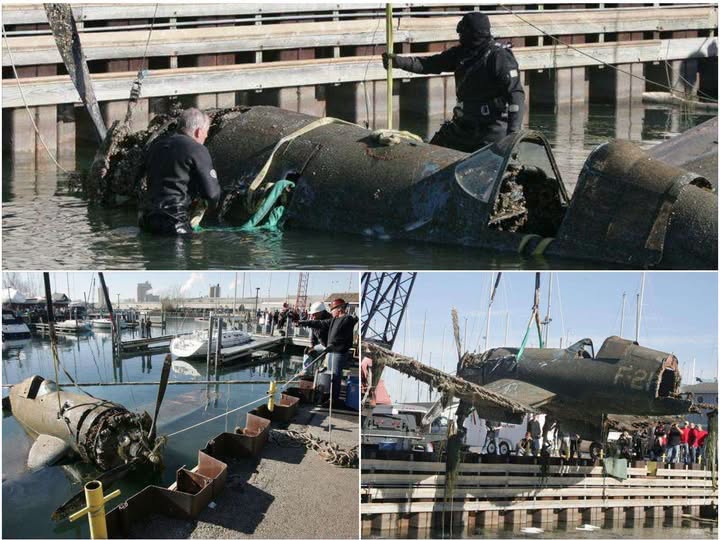
World War II-Era Plane Recovered From Lake Michigan: A Forgotten Piece of History Returns to the Surface
For decades, the cold waters of Lake Michigan have guarded one of the most fascinating chapters of American aviation history. Beneath the surface, aircraft from another era have rested in darkness, preserved by the lake and largely hidden from public view. Now, the recovery of a World War II-era airplane has brought renewed attention to these remarkable underwater time capsules and the men who once trained over the Great Lakes.
The discovery and recovery of an aircraft from Lake Michigan is far more than an unusual salvage operation. It is a journey into the past—a chance to reconnect with the technology, training, and human stories surrounding one of the most important periods in modern history.
During World War II, the United States dramatically expanded its military aviation program. Thousands of young men entered flight training, learning to operate increasingly sophisticated aircraft under demanding conditions. The Great Lakes became an important part of that enormous training effort.
Lake Michigan played a particularly unusual role because it served as a natural training ground for naval aviators. Aircraft carriers were used in training exercises, and pilots practiced takeoffs and landings that could prepare them for the dangers they might encounter at sea.
Those exercises were not without risk.
Training flights could go wrong for many reasons. Mechanical failures, weather, pilot mistakes and difficult operating conditions sometimes resulted in aircraft disappearing beneath the lake. In some cases, the pilots survived. In others, accidents ended tragically.
For decades, many of the aircraft lost during this period remained where they fell.
The freshwater environment of the Great Lakes can preserve underwater artifacts remarkably well. Unlike saltwater, freshwater does not create exactly the same corrosive conditions found in the ocean. As a result, aircraft recovered from the Great Lakes can sometimes retain surprising amounts of their original structure.
For historians and aviation enthusiasts, every recovered piece can provide valuable information.
An airplane sitting on the bottom of a lake is not simply an old machine. It can be a physical record of a particular moment in history. Its engine, cockpit, instruments, markings and construction can help researchers understand how aircraft were built, operated and maintained during the war years.
The recovery process itself can be extraordinarily difficult.
Finding an aircraft underwater is only the beginning. Search teams may have to use sonar, underwater cameras, remotely operated equipment and specialized diving techniques to locate and document a wreck. Visibility in the Great Lakes can be extremely limited, making underwater work challenging.
Once an aircraft is located, specialists must determine its condition and how best to bring it to the surface without causing additional damage.
A decades-old airplane can be extremely fragile. Components may have deteriorated, metal sections may have weakened and parts of the structure can become unstable after spending generations underwater.
Lifting such an aircraft requires careful planning.
Divers and recovery crews may use lifting equipment, support structures, cables or flotation systems designed to distribute weight safely. The goal is not simply to pull the aircraft upward. It is to preserve as much of the historical object as possible.
After reaching the surface, another phase of the journey begins.
An aircraft that has spent decades underwater cannot simply be washed off and placed in a museum. Waterlogged materials, corrosion and accumulated sediment must be treated carefully. Conservators may spend months or even years stabilizing individual components.
The process can be slow, but every step matters.
The recovered airplane can also help answer questions about the people connected to it.
Who flew the aircraft?
Why was it in the area?
What happened during its final flight?
Was the pilot training for carrier operations?
Was there a mechanical problem?
Did witnesses report the accident?
Sometimes the answers can be found through military records, newspaper reports, pilot logs, photographs and archival documents.
That is one of the most powerful aspects of aircraft recovery. The physical wreckage can lead researchers back to the human story.
For the young men who trained during World War II, aviation was often a pathway into an uncertain future. Many were barely adults when they climbed into military aircraft. They were learning skills that would eventually place them in combat thousands of miles from home.
A training accident could therefore become a deeply personal tragedy for families.
In other cases, the story may be one of survival. A pilot could escape from a damaged aircraft and later continue training or serve elsewhere during the war.
Every recovered aircraft has the potential to tell a different story.
Lake Michigan is particularly important to aviation historians because its waters contain a remarkable collection of historic aircraft. The lake became closely associated with U.S. Navy flight training during World War II, creating an underwater archive unlike almost anywhere else in the country.
Today, the aircraft recovered from these waters help preserve the memory of that period.
They also remind us how quickly technology can become history.
An airplane that once represented cutting-edge engineering may now look primitive compared with modern aircraft. Yet when it was built, that machine represented years of research, engineering and manufacturing effort.
Its recovery allows modern generations to see that technology firsthand.
There is also something emotionally powerful about seeing an aircraft emerge from the water after decades in darkness.
For years, it may have existed only as a location on an underwater map or a story passed between researchers. Then, suddenly, its shape becomes visible again.
A wing appears.
A section of the fuselage emerges.
Old markings become recognizable.
Pieces that were once touched by pilots, mechanics and ground crews return to daylight.
In that moment, history feels surprisingly close.
The recovery of a World War II-era plane from Lake Michigan is therefore not merely about an airplane. It is about remembering an era when aviation was changing rapidly and when thousands of people devoted their lives to mastering the skies.
It is about the pilots who trained over the Great Lakes, the mechanics who kept aircraft flying, the families waiting for loved ones to return, and the engineers who created machines capable of crossing oceans and changing the course of history.
Most importantly, recoveries like this ensure that these stories are not forgotten.
Every aircraft eventually becomes obsolete. Every generation eventually passes. But artifacts can survive, giving future generations something tangible to study and remember.
A plane that spent decades beneath Lake Michigan can therefore become more than a recovered wreck.
It can become a time capsule.
And when that time capsule finally returns to the surface, it brings with it a story from a world that existed more than eighty years ago—a story of courage, technology, danger, sacrifice and the remarkable people who took to the skies during one of history’s defining moments.
The lake kept the secret for generations.
Now, the aircraft has another chance to speak.