Chilling Audio Reveals the Final Moments Before Private Jet Crashes Onto a Freeway2
A routine flight suddenly turned into a terrifying emergency when a private jet lost power and crashed onto a busy South Florida highway. The frightening incident left witnesses stunned, disrupted traffic, and raised urgent questions about what can happen when an aircraft encounters a life-threatening problem with little time to respond.
The most disturbing detail was the radio communication between the pilot and air traffic control. The exchange offered a glimpse into the desperate effort to find a safe place to land as the situation rapidly deteriorated.
The tragedy serv
 ed as a sobering reminder that even experienced pilots can face emergencies in which every second matters.
A Flight That Took a Terrifying Turn
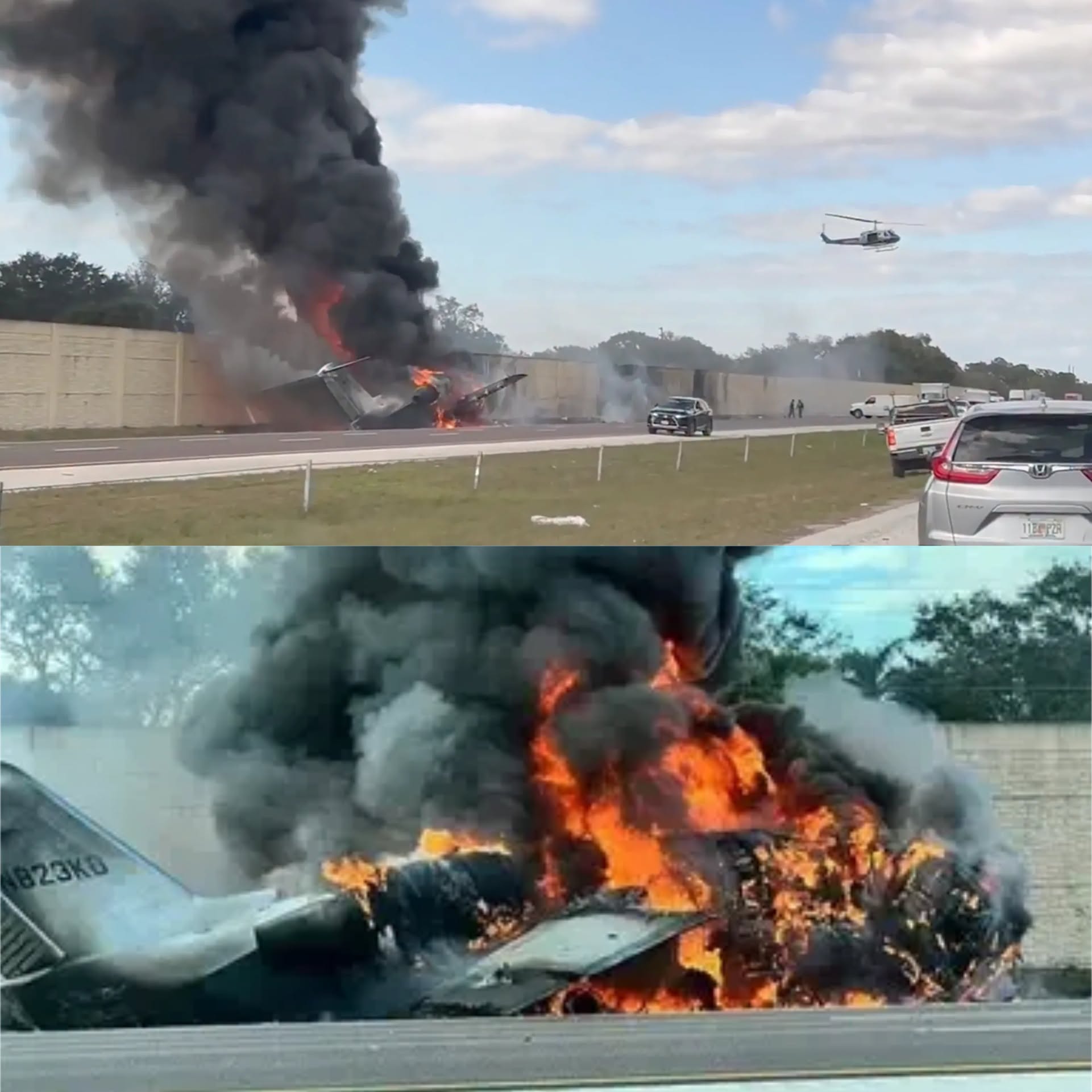
On February 9, 2024, a Bombardier Challenger 600 business jet crashed onto Interstate 75 near Naples, Florida. According to contemporary reporting, five people were aboard the aircraft, and two people died. Three others survived.
The aircraft had been operating a flight from Naples toward Ohio State University Airport when disaster struck. Reports indicated that the pilots encountered a serious problem involving both engines.
For passengers and crew, what had begun as an ordinary journey became a fight to get the aircraft safely onto the ground.
Private jets are often associated with luxury, comfort, and convenience. Their passengers may expect a smooth flight, quiet cabins, and a quick arrival at their destination. But behind the comfort is a complex aircraft that depends on multiple systems functioning properly.
When a major system fails, pilots must assess the situation, communicate with air traffic controllers, and determine the safest available course of action.
In this case, the emergency unfolded with devastating consequences.
The Radio Communication That Revealed the Emergency
One of the most striking details reported after the crash was the communication between the pilot and air traffic control.
According to published reports, the pilot announced that both engines had failed and declared an emergency. He was attempting to land the aircraft but warned that the jet might not reach the runway.
The exchange revealed the enormous pressure facing the crew.
An aircraft experiencing a loss of engine power may still be capable of gliding, depending on its altitude, speed, configuration, and other circumstances. However, a pilot has limited time to choose a landing location and manage the aircraft’s remaining energy.
A runway is usually the preferred destination because it offers a prepared surface and emergency services. But if an aircraft cannot reach the airport, the crew may have to consider other options.
A highway can appear to offer a relatively straight stretch of ground. Yet it presents serious hazards, including moving vehicles, roadside obstacles, power lines, traffic signs, and limited room to maneuver.
The pilot must consider all of these dangers while trying to maintain control.
The radio exchange did not simply communicate an aircraft malfunction. It illustrated the urgency of a situation in which the crew was running out of safe options.
The Moment the Jet Came Down
As the emergency developed, the aircraft descended toward the ground near Interstate 75.
Motorists traveling along the highway suddenly found themselves close to an aviation disaster. A jet that should have remained high above the road was now coming down in an area filled with ordinary traffic.
The crash caused a fire and left wreckage scattered across the roadway.
For drivers who witnessed the incident, the experience was frightening and difficult to comprehend. One moment, they were traveling along a familiar route. The next, they were confronted with a serious aircraft accident unfolding nearby.
Highways are designed for vehicles, not emergency aircraft landings. A jet descending toward a busy road can endanger its occupants as well as motorists who have no warning that an aircraft is approaching.
Even when drivers react quickly, they may have very little time to avoid danger.
The incident also created a major emergency response. Firefighters and other first responders had to address the wreckage, assess the victims, and help secure the scene.
Authorities also faced the challenge of managing traffic around a crash site where fuel, fire, and damaged aircraft components could create additional hazards.
Why Losing Both Engines Is So Dangerous
Modern aircraft are engineered with extensive safety systems, and pilots train for a wide range of emergencies. Nevertheless, a complete loss of engine power presents an exceptionally demanding situation.
Without functioning engines, an aircraft cannot continue powered flight as normal. The pilot must use the aircraft’s remaining energy to maintain control and reach a suitable landing location.
Altitude becomes especially important because it determines how much time and distance may be available.
Weather, wind direction, visibility, aircraft weight, and the surrounding terrain can all affect the available options.
A pilot must also communicate with air traffic control while managing the aircraft. Controllers can provide information about nearby airports, traffic, and potential landing locations, but they cannot directly fly the aircraft from the control tower.
When an emergency develops close to the ground, the time available for decision-making may be extremely limited.
That is why pilots practice emergency procedures repeatedly. Training helps them respond systematically rather than becoming overwhelmed by the pressure of the moment.
However, training cannot eliminate every risk, particularly when multiple systems fail or circumstances leave no suitable landing location.
The People Behind the Headlines
It is easy to focus on dramatic recordings, wreckage photographs, and the technical questions surrounding an aircraft accident.
But every aviation tragedy involves people whose lives are affected long after the initial news coverage ends.
Passengers place their trust in the crew responsible for transporting them safely. Pilots carry the responsibility of making critical decisions under pressure. Families wait for loved ones to arrive, often without imagining that a routine journey could end in disaster.
When an accident occurs, relatives may suddenly find themselves facing grief, uncertainty, and unanswered questions.
Survivors can also face a difficult recovery, including physical injuries and the emotional effects of experiencing a frightening event.
First responders and witnesses may carry memories of what they saw for years.
Behind every statistic is a human story that deserves compassion and respect.
What Investigators Must Determine
After a serious aircraft crash, investigators work to establish exactly what happened and why.
They may examine engine components, maintenance records, flight data, available recordings, pilot communications, and witness accounts.
Investigators also consider whether mechanical problems, maintenance issues, environmental conditions, operational decisions, or a combination of factors contributed to the accident.
The presence of a reported engine failure does not automatically establish the underlying cause. Investigators must determine what led to the failure and whether other factors affected the aircraft’s ability to reach a safe landing location.
This distinction matters because aviation investigations are intended not only to explain a tragedy but also to help prevent similar accidents in the future.
A reliable conclusion requires evidence rather than speculation.
Although the reported radio communication provided important information about the emergency, it was only one part of the larger investigation.
A Sobering Reminder About Aviation Safety
The South Florida crash demonstrated how quickly a serious aviation emergency can unfold and how its consequences can extend far beyond the aircraft itself.
The people driving along Interstate 75 were not expecting to become witnesses to a plane crash. They were simply going about their daily lives.
That is part of what makes an accident involving a public highway so frightening. It brings an extraordinary danger into an ordinary setting.
Aviation safety depends on careful maintenance, effective training, sound decision-making, and thorough investigation whenever something goes wrong.
No single measure can prevent every accident, but examining failures and learning from them can improve safety over time.
The reported radio communication from this crash offered a glimpse of the difficult decisions involved in an emergency landing attempt. It also reminded the public that pilots sometimes face circumstances in which there is no easy or completely safe choice.
Final Thoughts
The private jet crash near Naples, Florida, remains a sobering example of how suddenly a routine flight can become a life-threatening emergency.
The reported engine failure, the urgent communication with air traffic control, and the aircraft’s impact near a busy highway all underscore the importance of understanding aviation emergencies without rushing to conclusions about their causes.
The most important lesson is not the shock of the audio or the dramatic images of the wreckage. It is the human cost of the tragedy and the importance of learning from every serious accident.
What are your thoughts on the challenges pilots face when both engines fail and a safe runway may be out of reach? Share your thoughts respectfully in the comments.
Reporting note: This article is based on published accounts of the February 9, 2024, South Florida crash. The radio exchange is paraphrased rather than presented as a complete transcript, and no unverified cockpit recording is claimed to exist.