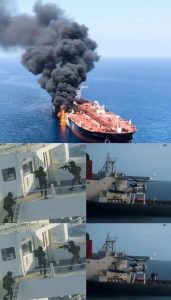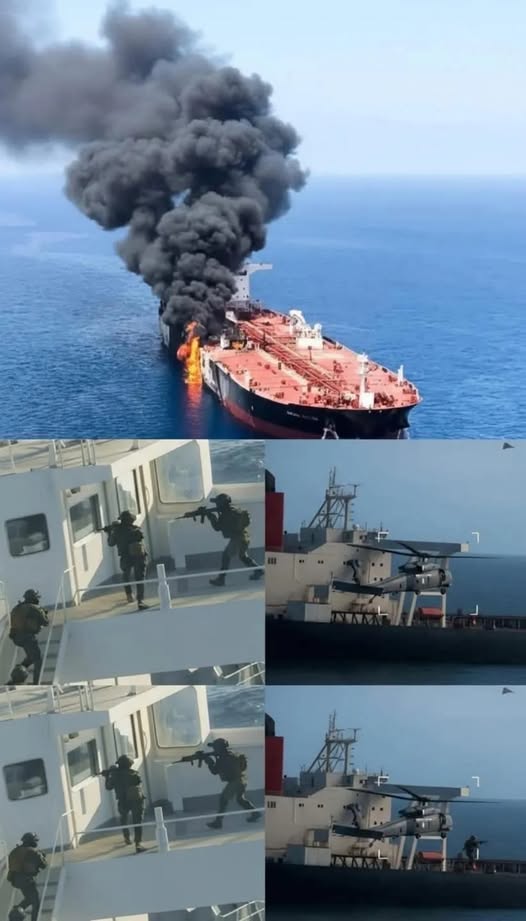
Reports began circulating early this morning about a dramatic operation in which the United States Army reportedly intercepted and captured a suspicious vessel in waters near Venezuela, sparking intense discussion among military analysts and international observers. While initial information remains limited, early details suggest that the operation involved a coordinated effort between American military units and regional security partners aimed at stopping what officials described as a potentially dangerous maritime activity.
According to preliminary statements from defense officials, the vessel was detected during routine surveillance operations carried out in the Caribbean region. Monitoring systems used by U.S. forces identified unusual movements from a medium-sized boat traveling at high speed and reportedly operating without clear identification signals. Such behavior immediately triggered concern among military command centers responsible for monitoring shipping lanes and maritime security in the region.
Once the vessel was flagged as suspicious, nearby U.S. military assets were alerted. Units associated with the United States Southern Command, which oversees American military operations in Latin America and the Caribbean, began tracking the boat’s movements. Surveillance aircraft and naval support reportedly maintained visual contact while ground command evaluated the situation and determined the appropriate response.
Military sources say the vessel was eventually intercepted by forces operating in coordination with American security teams. Although reports vary about the exact details of the interception, witnesses and unofficial sources claim that the boat attempted to change course multiple times before finally being surrounded and forced to stop. Once the vessel halted, military personnel boarded it to secure the crew and inspect its contents.
The capture of the boat has raised numerous questions about its purpose and cargo. Officials have not yet confirmed what was found on board, but speculation has ranged from possible smuggling operations to illegal arms transportation. The Caribbean region has long been a hotspot for illicit maritime activity, including narcotics trafficking and unauthorized weapons shipments, making the interception particularly significant from a regional security perspective.
Security experts note that operations like this are not uncommon in areas where international shipping routes intersect with regions known for organized crime. The United States has maintained a strong presence in Caribbean waters for decades, often working alongside local governments to monitor and disrupt criminal networks operating across national boundaries.
In this case, authorities have emphasized that the interception was carried out according to international maritime law. When vessels behave in ways that suggest illegal activity—such as failing to transmit proper identification signals or attempting to evade monitoring systems—military forces are permitted to investigate under certain legal frameworks. However, officials have been careful to state that the investigation is still ongoing and that final conclusions have not yet been reached.
The involvement of Venezuela in the situation has also drawn attention. Relations between the United States and Venezuela have been tense for years due to political disagreements and economic sanctions. Because of this complicated diplomatic relationship, any military activity in the region tends to attract significant international scrutiny.
Despite those tensions, maritime security in the Caribbean often involves complex cooperation between multiple countries. Smuggling routes frequently cross several national jurisdictions, meaning that intercepting suspicious vessels sometimes requires communication between different governments and law-enforcement agencies.
Military analysts say that the key focus now will be on determining who was operating the vessel and what its intended destination was. If illegal cargo or criminal activity is confirmed, the captured crew members could face charges under international or U.S. law. Investigators will also likely examine communication devices, navigation systems, and cargo records found aboard the boat to piece together its route and purpose.
Another important element of the investigation will be identifying whether the vessel was operating independently or as part of a larger network. In many maritime smuggling cases, boats are only one small component of a wider operation involving logistics coordinators, financial backers, and distribution groups operating in multiple countries.
Regional security experts believe the incident highlights the continuing challenges faced by governments attempting to secure busy shipping routes. The Caribbean Sea serves as a major corridor for commercial trade, fishing operations, and tourism. At the same time, its vast stretches of open water make it difficult to monitor every vessel traveling through the region.
Technological advancements have improved surveillance capabilities in recent years. Radar systems, satellite tracking, and maritime patrol aircraft now allow authorities to identify unusual movements more quickly than ever before. Still, intercepting suspicious vessels often requires rapid coordination between air, sea, and ground units—something that can be difficult in fast-moving situations.
For the United States Army, the operation represents another example of the broader security role American forces play in protecting international waterways. While the Army is more commonly associated with land operations, its personnel frequently participate in joint missions with naval and coast guard units when regional security concerns arise.
Officials have indicated that more information will likely be released once the initial investigation is completed. For now, authorities are focused on examining the vessel, interviewing its crew, and determining exactly what led to the dramatic interception.
The incident has already sparked widespread interest online, with many people eager to learn what exactly was discovered aboard the captured boat. Until official statements clarify the details, however, much of the discussion remains speculative.
What is clear is that the event demonstrates how quickly routine surveillance operations can turn into major security incidents. A single suspicious vessel on the open sea can trigger a chain reaction involving military command centers, patrol units, and international coordination.
As investigators continue their work, the captured boat remains under military control while authorities gather evidence and determine the next steps. Whether the vessel was part of a criminal network, a smuggling attempt, or something else entirely is a question that officials hope to answer in the coming days.
Until then, the dramatic interception near Venezuela serves as a reminder that the world’s oceans remain both vital highways of global commerce and complex arenas where security forces must stay constantly alert.