BREAKING: Oil Tanker Slams Into Docked River Cruise Ship in New Orleans — Passenger Vessel Capsizes Into the Mississippi River
A frightening maritime accident at the Port of New Orleans has drawn national attention after an oil tanker collided with a docked passenger river cruise ship, causing the smaller vessel to capsize on the Mississippi River.
The incident, which occurred on November 13, 2026, transformed an ordinary day at the busy port into a major emergency response. Passengers, crew members, emergency personnel, and nearby boat operators were suddenly caught up in a dramatic rescue operation.
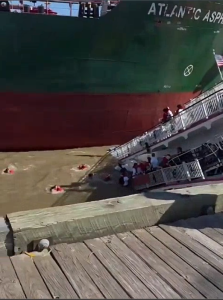
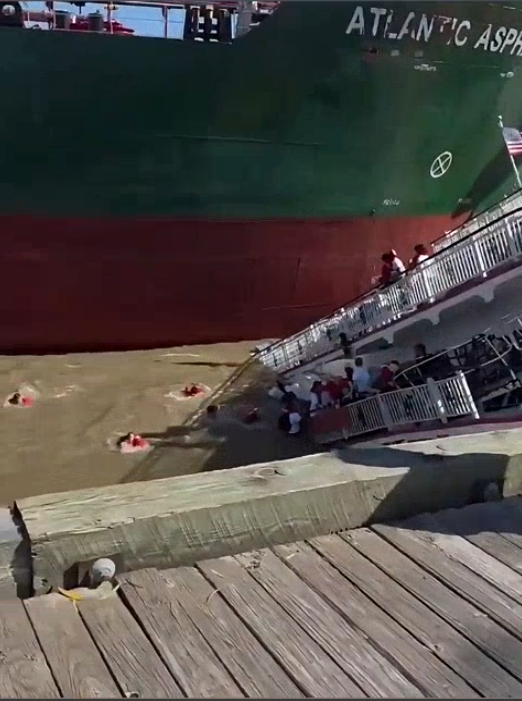
The passenger vessel, identified as the American Heritage, was struck by the much larger tanker Atlantic Asphalt while docked near the Port of New Orleans.
The collision caused the riverboat to take on water and eventually overturn.
For those aboard, what should have been a peaceful river cruise became an experience they would never forget.
A Routine Stop Turns Into a Disaster
The American Heritage, operated by American Cruise Lines, was at the Port of New Orleans when the collision happened.
The vessel had reportedly been docked for approximately two hours, and passengers were beginning the process of disembarking.
Everything appeared to be proceeding normally until the Atlantic Asphalt approached and struck the passenger ship.
The force of the collision caused significant damage, and the smaller vessel began taking on water.
Within a short period, the American Heritage tipped onto its side and partially sank into the Mississippi River.
Witnesses described a chaotic scene as emergency personnel rushed toward the damaged boat.
Passengers and crew members needed immediate assistance, while nearby vessels moved into position to help with the rescue.
More Than 100 People Were Involved
One of the biggest concerns immediately following the collision was the number of people aboard the passenger vessel.
Initial reports indicated that approximately 129 passengers were aboard, along with crew members.
New Orleans Mayor Helena Moreno later explained that the total number of people who had been aboard could have been between 180 and 190 because some passengers had already disembarked.
This distinction became important as authorities worked to establish an accurate passenger count.
Emergency responders needed to account for everyone and identify anyone who might have been trapped or injured.
The operation involved several agencies, including the New Orleans Fire Department, New Orleans Police Department, Harbor Police, and the U.S. Coast Guard.
Nearby boat operators also assisted in bringing people to safety.
A Dramatic Rescue on the Mississippi River
As the riverboat overturned, emergency crews faced a challenging situation.
The Mississippi River is a powerful commercial waterway, and working around large vessels requires careful coordination.
Some passengers needed assistance after entering the water, while others were evacuated from the damaged vessel.
Rescuers worked to move people away from the capsized boat and transport them to locations where medical personnel could evaluate them.
The response involved boats, emergency vehicles, and medical teams positioned along the waterfront.
The priority was straightforward: locate every passenger, rescue anyone in danger, and make sure injured people received medical attention.
The speed of the response became one of the most important factors in the operation.
Thirty-Two People Transported to Hospitals
Authorities later confirmed that 32 people were transported to hospitals following the collision.
Fortunately, officials reported that none of the injuries were critical at the time of the announcement.
Even so, the accident was serious enough to require a substantial medical response.
Some passengers may have experienced injuries during the impact or evacuation, while others required evaluation after the frightening experience.
For families waiting for updates, the announcement that everyone had been accounted for brought enormous relief.
Mayor Moreno described the outcome as a miracle on the Mississippi, recognizing the efforts of those who helped rescue the passengers.
There were no reported fatalities in the initial official updates.
What Caused the Collision?
One of the biggest questions surrounding the incident concerns the Atlantic Asphalt.
Early information from officials suggested that the tanker may have experienced a steering problem before striking the American Heritage.
A possible loss of steering was identified as an important line of investigation.
However, investigators still need to establish exactly what happened.
A mechanical failure, operational problem, or another contributing circumstance cannot be ruled in or out without the investigation’s findings.
The National Transportation Safety Board launched an investigation into the collision.
Investigators are expected to examine the vessels, review available communications, inspect relevant mechanical systems, and interview witnesses and crew members.
Their work will help determine why the tanker struck the docked passenger ship and whether any safety failures contributed to the accident.
The Mississippi River Is a Critical American Waterway
The accident also highlights the importance of safety along the Mississippi River.
The river is one of the most important commercial transportation routes in the United States.
It supports the movement of agricultural products, fuel, industrial materials, and other goods.
Large commercial vessels regularly travel through the region, while passenger boats and cruise ships operate nearby.
Because different types of vessels share the waterway, navigation and communication are essential.
An incident involving a large tanker and a passenger vessel demonstrates how serious the consequences can be when something goes wrong.
Even when a passenger boat is docked, nearby commercial traffic and port operations require careful coordination.
Government Officials Respond
Louisiana Governor Jeff Landry traveled to New Orleans following the incident to monitor the emergency response.
Local authorities worked alongside state and federal agencies to coordinate assistance.
President Donald Trump also thanked emergency responders and the Coast Guard for their work.
The response highlighted the importance of cooperation during major transportation emergencies.
For the passengers and crew members involved, the immediate priority was receiving assistance and finding a safe place to recover.
The cruise operator also faced the responsibility of communicating with affected passengers and families.
Questions That Investigators Must Answer
Several important questions remain.
Why did the tanker strike the passenger ship?
Was there a mechanical problem with its steering system?
Were there warning signs before the collision?
Could additional precautions have prevented the accident?
And what changes might be necessary to improve safety for passenger vessels operating near major commercial ports?
These questions will require evidence rather than speculation.
The NTSB investigation will be particularly important in identifying the sequence of events and determining whether safety recommendations are necessary.
Its findings could help prevent similar incidents in the future.
Final Thoughts
The collision at the Port of New Orleans is a powerful reminder of how quickly a normal day can turn into a life-threatening emergency.
A large oil tanker struck a docked river cruise ship, causing the American Heritage to capsize on the Mississippi River.
More than 100 passengers were involved, 32 people were transported to hospitals, and emergency responders worked together to ensure everyone was accounted for.
Although the incident could have ended much worse, the coordinated rescue effort helped prevent reported loss of life.
Behind every number are real people, families, and crew members whose lives were suddenly interrupted by an unexpected disaster.
As investigators continue examining the collision, the most important priorities are supporting those affected, understanding what happened, and making sure that lessons are learned.
The Mississippi River has witnessed countless moments in American history. On November 13, it became the scene of a frightening maritime emergency that reminded everyone why safety, preparation, and rapid emergency response matter so much.