TRUMP AND RUBIO UNDER THE SPOTLIGHT: U.S. AID TO SOMALIA SPARKS MAJOR POLITICAL DEBATE — SHOULD AMERICA CONTINUE SENDING MONEY?
A major debate over American foreign policy is drawing attention after the Trump administration took action to suspend assistance benefiting Somalia’s federal government. The issue has raised questions about American taxpayer money, government accountability, humanitarian assistance, and the future of relations between Washington and Mogadishu.
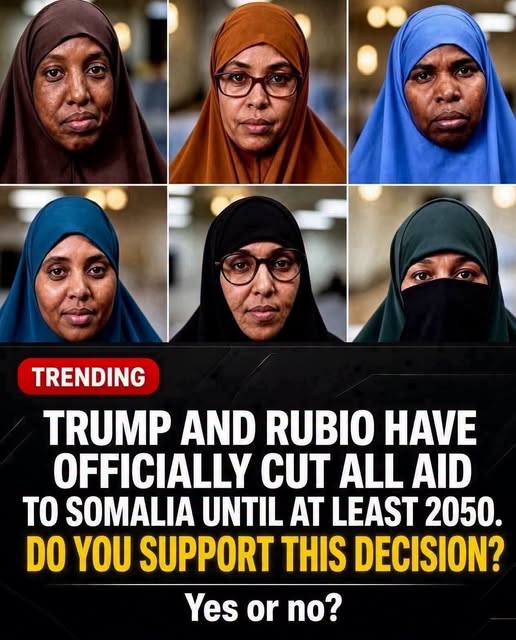
An image circulating on social media claims that President Donald Trump and Secretary of State Marco Rubio have officially cut all aid to Somalia until at least 2050. The headline has generated strong reactions, with some people supporting a tougher approach to foreign assistance while others are concerned about the consequences for ordinary Somali families.
But what actually happened? And what does this decision mean for the United States, Somalia, and the millions of people affected by humanitarian challenges in the region?
The real story is more complicated than the viral headline suggests.
1. Why Somalia has become the center of attention
Somalia, located in the Horn of Africa, has experienced decades of political instability, armed conflict, economic difficulties, and humanitarian emergencies.
The country has struggled with droughts, flooding, displacement, food insecurity, and security threats. Millions of people have faced difficult living conditions, while international organizations have worked to provide food, medical supplies, clean water, and other essential assistance.
The United States has historically been one of Somalia’s major international aid providers.
American assistance has supported different programs, including humanitarian relief, health services, development initiatives, and security cooperation.
However, foreign assistance has also become an increasingly controversial subject in Washington.
Many American taxpayers want greater transparency about where their money goes, how foreign governments use assistance, and whether international programs produce meaningful results.
These questions have become especially important under the Trump administration’s broader effort to restructure American foreign assistance.
2. The dispute that triggered the suspension
One of the most important developments occurred in January 2026.
The U.S. State Department announced that it had suspended assistance benefiting Somalia’s federal government following allegations involving an American-funded World Food Programme warehouse in Mogadishu.
According to American officials, Somali authorities had demolished the warehouse and seized approximately 76 metric tons of food assistance intended for vulnerable civilians.
The U.S. government said it expected accountability and corrective action before assistance benefiting the Somali federal government could resume.
The allegations created a serious disagreement between Washington and Mogadishu.
Somali officials disputed the American accusations, while the World Food Programme confirmed that the warehouse had been demolished and that the nutritional commodities had been recovered.
The disagreement highlighted a difficult question: how should international donors respond when they believe assistance is not being handled properly?
For the Trump administration, accountability became a central issue.
For humanitarian organizations, the priority remained ensuring that food and other essential supplies reached the people who needed them.
These two concerns do not necessarily have to conflict, but finding a solution requires cooperation and effective oversight.
3. Marco Rubio’s role in the debate
Secretary of State Marco Rubio has been an important figure in the administration’s foreign policy direction.
His department is responsible for overseeing major aspects of American diplomatic relations and foreign assistance.
Under the administration’s approach, foreign aid programs have faced reviews, cancellations, restructuring, and new oversight requirements.
Supporters of these changes argue that American assistance should advance national interests and demonstrate measurable results.
They believe taxpayer-funded programs should be carefully examined to prevent waste, corruption, and misuse.
Critics, however, warn that reducing assistance too quickly can damage important international relationships and create humanitarian consequences.
Somalia illustrates the difficulty of balancing these competing priorities.
A decision involving government assistance can also affect communities that depend on international support, even when those communities have no responsibility for disputes between governments.
4. Congress enters the discussion
The debate did not remain limited to the executive branch.
On April 16, 2026, Republican Congressman Ronny Jackson introduced H.R. 8334, known as the Taxpayer Protection and Somalia Accountability Act of 2026.
The legislation proposed suspending bilateral and multilateral foreign assistance to the Government of Somalia.
Representatives Andy Barr, Max Miller, James Baird, and Tim Burchett joined as cosponsors.
The bill was referred to the House Committee on Foreign Affairs and the Committee on the Judiciary.
This distinction is important.
Introducing a bill does not mean Congress has approved it. A proposal must go through the legislative process before it can become law.
The available congressional record identifies H.R. 8334 as an introduced bill, not an enacted law.
Therefore, it would be inaccurate to tell readers that Congress has officially approved a permanent cutoff of all American aid to Somalia.
5. Why some Americans support reducing foreign aid
For Americans who support stronger restrictions on foreign assistance, the issue begins with responsibility to taxpayers.
The United States faces numerous domestic challenges.
Families are dealing with the cost of housing, healthcare, education, groceries, and everyday necessities. Communities across the country need infrastructure improvements, public safety resources, and economic opportunities.
Supporters of reducing overseas assistance argue that Washington should carefully examine international spending before committing additional money.
They frequently raise several questions:
- Are American taxpayers receiving clear reports about how their money is spent?
- Are foreign governments being held responsible for their actions?
- Can humanitarian assistance be delivered without being diverted?
- Should financial assistance continue when serious disagreements remain unresolved?
- Would some of these resources be more effective if invested in American communities?
These are legitimate public-policy questions.
People who support stronger oversight do not necessarily oppose humanitarian assistance. Some believe assistance should continue only when there are reliable safeguards, transparent reporting, and clear objectives.
From this perspective, accountability is not simply a political slogan. It is an important part of responsible government spending.
6. Why others are concerned about cutting assistance
There is another side to this discussion.
Somalia faces serious humanitarian challenges, and ordinary civilians are often the most vulnerable when international assistance is reduced.
Children, pregnant women, displaced families, and people experiencing severe food insecurity may depend on humanitarian programs for basic necessities.
When assistance is suspended, the consequences can extend beyond government offices.
Hospitals, nutritional programs, educational initiatives, and emergency relief operations may face financial difficulties.
Humanitarian organizations also warn that reducing international assistance can make it harder to respond to droughts, disease outbreaks, and displacement.
Another concern involves regional security.
Somalia has faced a long-running threat from the extremist organization Al-Shabaab. International security cooperation has been part of efforts to strengthen Somali institutions and prevent militant groups from expanding their influence.
A sudden reduction in certain forms of support could create additional challenges for regional security efforts.
This does not mean every aid program should continue without examination.
Instead, it demonstrates why decisions about foreign assistance require careful consideration of both financial accountability and humanitarian consequences.
7. What about the claim that aid is ending until 2050?
This is the most misleading part of the viral image.
The image presents the year 2050 as though the United States has already established a permanent end date for assistance to Somalia.
However, the available official records do not establish a 2050 cutoff.
The January 2026 suspension concerned assistance benefiting Somalia’s federal government.
The separate congressional proposal, H.R. 8334, sought suspension of bilateral and multilateral assistance to the Somali government, but its introduction did not make it law.
These developments should not be confused with an enacted policy permanently eliminating every form of American humanitarian assistance to Somalia.
Foreign assistance can include different categories:
- Humanitarian food assistance.
- Emergency medical support.
- Development programs.
- Security cooperation.
- Educational initiatives.
- Financial assistance benefiting government institutions.
These programs may have different funding arrangements, oversight requirements, and legal authorities.
A suspension affecting one category does not automatically prove that every other category has ended.
That is why readers should be cautious when encountering headlines that use phrases such as “all aid” or “until 2050” without providing official documentation.
8. The financial questions facing American taxpayers
Foreign assistance is a significant part of America’s international engagement.
According to Pew Research Center’s July 2026 analysis, U.S. foreign assistance disbursements fell substantially during fiscal year 2025.
The analysis found that approximately $47.3 billion was distributed in foreign assistance during that fiscal year, compared with approximately $73.5 billion in fiscal year 2024, adjusted to 2025 dollars.
These numbers demonstrate the scale of changes in American foreign assistance.
They also explain why the issue has become a subject of intense political discussion.
For many Americans, the question is not simply whether the United States should help other countries.
It is whether the money is being used effectively, whether programs have measurable results, and whether the government is providing enough transparency.
Those concerns deserve serious attention regardless of political party.
9. What this could mean for U.S.-Somalia relations
The relationship between the United States and Somalia involves more than foreign aid.
The two countries have shared interests involving regional stability, counterterrorism, diplomacy, economic development, and security.
A prolonged disagreement over assistance could make cooperation more difficult.
Somalia’s government has an interest in maintaining international partnerships, while Washington wants greater accountability and assurances that American resources are being used appropriately.
Both sides face difficult decisions.
For Somalia, rebuilding trust with international donors may require stronger financial controls, clearer reporting, and cooperation with independent investigations.
For the United States, policymakers must determine how to maintain essential humanitarian and security objectives while addressing concerns about the use of taxpayer money.
A successful outcome would ideally protect American interests while minimizing unnecessary suffering among ordinary civilians.
10. What should happen next?
The coming months will be important for determining how the debate develops.
Congressional action, State Department decisions, diplomatic discussions, and humanitarian assessments will all influence the future of American assistance.
Lawmakers will have opportunities to debate the proposed legislation and consider its potential consequences.
American officials will also need to communicate clearly about which programs remain suspended, which programs may continue, and what conditions would allow assistance to resume.
Meanwhile, humanitarian organizations will continue facing the challenge of delivering essential services in a country affected by conflict, displacement, and recurring natural disasters.
The public deserves accurate information about these developments.
A political decision involving foreign assistance should be judged using documented policies, actual funding decisions, and measurable outcomes rather than dramatic social media graphics.
Final thoughts: Should America put its taxpayers first?
This controversy raises a question that goes far beyond Somalia.
How should the United States balance its responsibility to American taxpayers with its role in helping vulnerable populations around the world?
Some Americans believe the country should reduce foreign assistance and focus more resources on domestic priorities.
Others believe humanitarian support is an important part of American leadership and that cutting assistance can create consequences that ultimately affect international stability.
Both perspectives raise important questions about government responsibility, national interests, and the consequences of public policy.
The challenge is finding an approach that protects taxpayer resources without unnecessarily harming innocent civilians.
Ultimately, the debate should be based on facts, transparency, and accountability.
WHAT DO YOU THINK?
Should the United States continue providing assistance to Somalia only under stricter accountability requirements, or should Washington reduce assistance until the Somali government demonstrates meaningful improvements?
Do you believe American taxpayer money should primarily focus on problems at home, or should the United States maintain a strong humanitarian role internationally?
Share your opinion respectfully in the comments.
One thing is certain: Americans deserve transparency about where their tax dollars go and how decisions affecting millions of people are made.