Some People Have Two Different Eye Colors — The Rare and Beautiful Condition Known as Heterochromia Has Everyone Fascinated!
Imagine looking into someone’s eyes and discovering something truly extraordinary: one eye is blue while the other is brown, or perhaps one is green while the other has a completely different shade. At first, you might wonder whether the person is wearing colored contact lenses. But sometimes, the difference is entirely natural. It is a fascinating condition called heterochromia, and it gives some people an appearance that is genuinely unique.
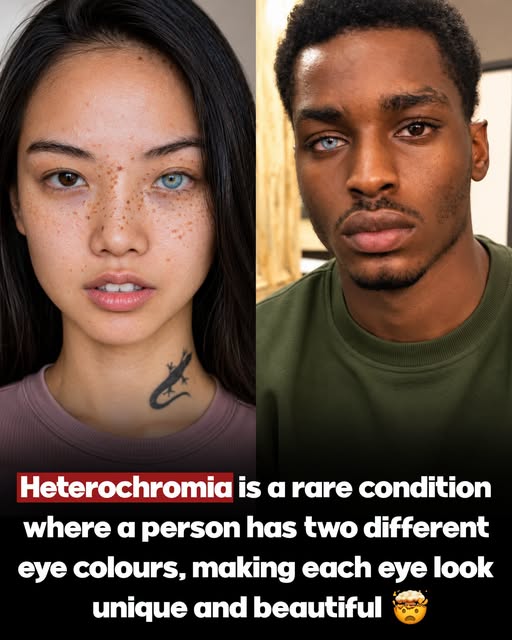
Heterochromia is a condition in which a person’s eyes have different colors or different amounts of pigmentation. Although it is relatively uncommon in humans, it is a natural variation that has fascinated doctors, scientists, photographers, and curious observers for generations.
For people who have it, their eyes may become one of their most recognizable features. Some have one blue eye and one brown eye, while others have subtle combinations of green, gray, hazel, and amber. In certain cases, the difference is so striking that people immediately notice it.
But what causes this unusual appearance? Is it dangerous? Can someone develop it later in life? And why do some people have only a small section of their iris in a different color?
The answers reveal an interesting part of human biology.
What exactly is heterochromia?
The word heterochromia comes from Greek roots. “Heteros” means different, while “chroma” refers to color. Together, the term describes a difference in coloration.
When people talk about heterochromia, they are usually referring to the iris, the colored part of the eye surrounding the pupil.
The iris contains pigments that help determine whether someone’s eyes appear blue, green, brown, hazel, or another shade.
Melanin is particularly important. It is the pigment responsible for coloration in several parts of the human body, including the skin, hair, and eyes.
Generally, higher concentrations of melanin in the iris are associated with darker eye colors, while lower concentrations can contribute to lighter appearances.
However, eye color is more complicated than a simple measurement of pigment. Genetics, the structure of the iris, and the way light interacts with its tissues all contribute to the final appearance.
In people with heterochromia, pigmentation differs between the eyes or within an individual iris.
The three main types of heterochromia
Heterochromia is generally described in three main forms. Each one creates a different appearance.
1. Complete heterochromia
This is the type many people imagine when they hear about two different eye colors.
Complete heterochromia occurs when one iris has a noticeably different color from the other.
For example, someone might have one blue eye and one brown eye. Another person might have one green eye and one hazel eye.
The contrast can be dramatic, especially when the colors are very different.
Some people are born with this characteristic, and it may remain unchanged throughout their lives.
2. Sectoral heterochromia
Sectoral heterochromia occurs when one section of an iris has a different color from the rest.
Instead of having two completely different eyes, a person may have a blue iris with a brown section or a green iris containing a noticeable amber area.
The different-colored section can resemble a small patch or wedge.
This type can be particularly fascinating because the difference may be visible only when someone looks closely.
3. Central heterochromia
Central heterochromia creates a different appearance.
In this type, the area surrounding the pupil has a different color from the outer portion of the iris.
For example, someone might have blue eyes with a golden or amber ring around the pupil.
Another person might have green eyes with a brownish center.
The colors gradually blend into one another, creating a distinctive pattern.
People sometimes confuse central heterochromia with ordinary hazel eyes because both can contain multiple colors. However, the specific distribution of pigmentation helps distinguish them.
Why do some people develop different-colored eyes?
One of the biggest reasons for heterochromia is variation in the distribution or amount of melanin in the iris.
Genetics plays an important role in determining eye color. Multiple genes influence pigmentation, which helps explain why eye color can vary considerably even among members of the same family.
During development, differences in pigment production or distribution can result in one iris appearing different from the other.
In many people, this variation is present from birth or becomes noticeable during early childhood.
Sometimes, however, heterochromia develops later.
This is an important distinction because not every case has the same explanation.
Can someone be born with heterochromia?
Yes!
Congenital heterochromia is present at birth or develops during early childhood.
For many individuals, it is simply a natural genetic characteristic. It does not necessarily indicate a medical problem.
A child might be born with one blue eye and one brown eye, and both eyes may remain healthy.
In other cases, differences in pigmentation may be associated with inherited conditions or developmental variations.
For example, certain genetic conditions can affect the pigmentation of the eyes, skin, or hair.
One example is Waardenburg syndrome, a group of genetic conditions that can involve distinctive eye coloration, changes in hair or skin pigmentation, and sometimes hearing differences.
However, having different-colored eyes does not automatically mean someone has a genetic syndrome.
Many people with congenital heterochromia are otherwise completely healthy.
Can eye color change during someone’s lifetime?
This is where things become particularly interesting.
Some babies are born with lighter-colored eyes that gradually become darker during infancy as melanin production develops.
That is why a baby’s eye color may not represent the final shade they will have as an adult.
However, a noticeable change in eye color later in life deserves attention.
Acquired heterochromia occurs when the appearance of one or both irises changes after birth.
There are several possible explanations.
An eye injury may affect pigmentation. Certain eye diseases can also cause changes in iris appearance. Inflammation, including a condition called uveitis, may affect the structures inside the eye.
Some medications used to treat glaucoma can also increase pigmentation in the iris.
In addition, certain tumors or other eye conditions may change the appearance of the iris.
This is why someone who suddenly notices a new difference between their eyes should arrange an examination with an eye-care professional.
A change in eye color should not automatically be dismissed as a harmless variation.
Is heterochromia dangerous?
For many people, heterochromia is harmless.
Individuals born with stable differences in iris pigmentation often experience no vision problems because of the condition itself.
Their eyes may function normally, and the difference is simply a distinctive physical characteristic.
However, acquired heterochromia can sometimes be a sign of an underlying eye condition.
The important question is not only whether the eyes look different but also when the difference appeared and whether other symptoms are present.
Pain, redness, blurred vision, light sensitivity, or sudden changes in appearance should be evaluated by an eye-care professional.
Early assessment can help identify problems that may require treatment.
Therefore, although congenital heterochromia is often harmless, new changes should receive proper medical attention.
Can heterochromia affect eyesight?
Heterochromia itself does not generally interfere with vision.
The iris controls how much light enters the eye by adjusting the size of the pupil. A difference in iris color does not automatically mean that this function is impaired.
Someone with one brown eye and one blue eye can have perfectly normal eyesight.
However, if the pigmentation difference is connected to another medical condition, that underlying condition may affect vision or other aspects of eye health.
This is another reason professional evaluation is important when heterochromia develops unexpectedly.
Why is heterochromia so fascinating to people?
Human beings naturally notice differences, especially when they involve something as expressive as the eyes.
Eyes are among the first features people notice during a conversation. They communicate emotion, attention, and personality.
When someone has two different-colored eyes, that difference can make their appearance especially memorable.
Photographers often find heterochromia visually interesting because the contrast creates unusual patterns and striking portraits.
Artists have also used different-colored eyes as a symbol of individuality, mystery, and uniqueness.
In movies, television, and literature, characters with different-colored eyes are sometimes portrayed as unusual or mysterious.
However, real people with heterochromia are not mysterious because of a medical condition. They simply have a natural variation in pigmentation.
Their eye color does not determine their personality, intelligence, abilities, or character.
Is heterochromia inherited?
Genetics can contribute to congenital heterochromia, but inheritance is not always straightforward.
Eye color involves multiple genes, and the relationship between those genes is more complicated than the simple dominant-and-recessive explanations often taught in basic biology.
Some families may have several members with unusual eye pigmentation, while others may have only one individual with the characteristic.
A person can also develop heterochromia without a clear family history.
The presence of different-colored eyes in one family member does not mean every child or relative will inherit the same appearance.
Can heterochromia occur in animals?
Absolutely!
In fact, heterochromia is well known in several animal species.
Dogs and cats are particularly familiar examples.
<PRIVATE_PERSON> Some cats have one blue eye and one green, yellow, or amber eye. This appearance is especially associated with certain white cats, although it can occur in other cats as well.
Certain dog breeds, including Siberian Huskies and Australian Shepherds, can also display different-colored eyes or variations in iris pigmentation.
In animals, genetics plays an important role, although particular patterns may also be associated with coat-color genetics and development.
The result can be remarkably beautiful.
A dog with one icy-blue eye and one warm-brown eye may look as though its eyes were carefully painted in two different shades.
But just like humans, animals with unusual eye coloration should receive veterinary attention if their eye appearance changes suddenly or they show signs of discomfort.
Can someone get heterochromia through colored contact lenses?
Colored contact lenses can create the appearance of heterochromia, allowing people to temporarily wear two different eye colors.
For example, someone with naturally brown eyes might wear one blue contact lens while leaving the other eye unchanged.
This can create a striking appearance for photography, costumes, or personal style.
However, contact lenses must be properly fitted and used according to professional guidance.
Even decorative lenses can cause infections, scratches, and other serious problems when purchased from unreliable sources or used incorrectly.
Natural heterochromia and contact-lens effects may look similar in photographs, but their origins are very different.
A reminder that human differences are beautiful
Perhaps the most important thing about heterochromia is the reminder that human beings do not all look the same.
Some people have freckles, others have unusual hair colors, and some have distinctive patterns in their eyes.
These differences are part of the natural variation that makes every person unique.
For someone with heterochromia, their eyes may attract questions or compliments throughout their life. Some might enjoy explaining the condition, while others may simply consider it an ordinary part of who they are.
There is no need to treat the condition as something frightening or strange.
When it is congenital and medically uncomplicated, it is simply a beautiful variation in pigmentation.
Science helps explain how it happens, but it does not take away from the individuality of the people who have it.
The beauty of two different eyes
Heterochromia is a fascinating example of how complex the human body can be.
A small difference in pigment distribution can create two eyes that look completely different or produce a subtle ring of color within a single iris.
For many people, the condition is present from birth and causes no health problems. For others, changes in eye pigmentation can develop later and may require medical evaluation.
Understanding that distinction is important.
So, the next time you meet someone with one blue eye and one brown eye, remember that you may be looking at a rare and fascinating natural variation.
Behind those beautiful eyes is a little lesson in genetics, biology, and the extraordinary diversity of the human body.
And perhaps that is what makes heterochromia so special: it reminds us that sometimes the most remarkable things about people are the natural differences that make them uniquely themselves.