The call came just before sunrise.
Daniel had barely slept, his mind racing with numbers, risks, and quiet prayers whispered into the dark. On the other end of the line, the hospital coordinator’s voice was calm but urgent: a match had been confirmed. Everything was ready. Today was the day.
He sat on the edge of his bed, staring at his hands—the same hands his father once held when teaching him to ride a bike, the same hands that now held the power to save that father’s life. It didn’t feel heroic. It felt necessary.
Down the hall, his mother was already awake, moving slowly, as if the wrong step might shatter the fragile hope filling the house. When Daniel entered the kitchen, she turned, her eyes red but determined.
“Are you ready?” she asked.
Daniel nodded, though he wasn’t sure anyone could ever truly be ready for something like this.
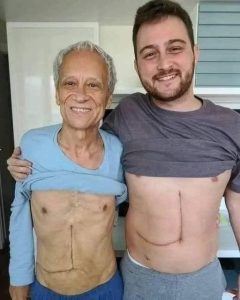
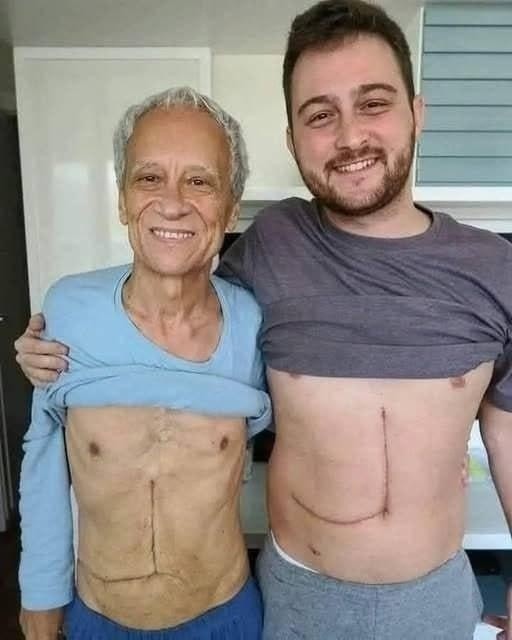
At the hospital, everything moved quickly. Forms were signed. Doctors explained the procedure again, using careful language that tried to balance honesty with reassurance. A portion of Daniel’s liver would be removed and transplanted into his father. The liver was unique—it could regenerate. In time, both would heal.
“That’s the miracle of it,” the surgeon said.
Daniel smiled faintly. He wasn’t thinking about miracles. He was thinking about his father lying in a hospital bed down the hall, growing weaker by the day, his skin pale, his voice thinner each time they spoke.
Before they were taken into separate operating rooms, Daniel was allowed a few minutes with him.
His father looked smaller than Daniel remembered. Illness had a way of shrinking even the strongest people.
“You don’t have to do this,” his father said, his voice barely above a whisper.
Daniel pulled up a chair and leaned in. “I already decided a long time ago,” he replied. “You just didn’t know it.”
His father tried to smile, but emotion overtook him. “I’m supposed to protect you,” he said.
“And you did,” Daniel answered gently. “My whole life. Let me do this now.”
They didn’t say goodbye. It felt too final. Instead, Daniel squeezed his father’s hand, holding on for a moment longer than usual, as if memorizing the feeling.
Then the nurses came.
The operating room was bright and cold. Machines beeped steadily, marking time in a way that felt both clinical and sacred. As Daniel lay on the table, a nurse adjusted his blanket.
“Think of something that makes you happy,” she said softly.
Daniel closed his eyes. He thought of childhood summers, his father teaching him how to fish, laughing when Daniel fell into the water. He thought of birthdays, late-night talks, and quiet moments that had shaped who he was.
“Count back from ten,” someone instructed.
Ten.
Nine.
Eight.
The world faded.
—
Hours passed in a blur of surgical precision and silent hope.
The transplant was successful.
At first, everything seemed to go exactly as planned. Daniel was moved to recovery, his body beginning the long process of healing. His father’s surgery had also gone well—the new liver tissue had been successfully transplanted, and early signs were promising.
The family exhaled, cautiously.
But recovery is rarely simple.
Two days later, Daniel developed complications.
It started with a fever.
At first, the doctors weren’t overly concerned. Infections can happen after major surgery. Antibiotics were administered, and he was closely monitored. But the fever didn’t break. It climbed higher.
By the third day, his condition had worsened.
Sepsis, they said.
The word hung in the air like a storm cloud.
Daniel drifted in and out of consciousness. Tubes and monitors surrounded him, their steady rhythms now tinged with urgency. His mother rarely left his side, her hand resting gently on his arm, as if her presence alone could anchor him.
“Stay with me,” she whispered again and again.
In another wing of the hospital, his father was beginning to recover. His strength was slowly returning, his body accepting the transplant. But he hadn’t yet been told about Daniel.
The doctors debated how and when to share the news.
“He needs time to heal,” one said.
“But he deserves to know,” another argued.
In the end, truth couldn’t be delayed forever.
When Daniel’s father finally learned what was happening, he insisted on being taken to his son, despite his own fragile state.
They wheeled him into the ICU, the room quiet except for the hum of machines.
For a moment, he didn’t recognize the figure in the bed.
Daniel looked so still.
So small.
The roles had reversed in the most painful way imaginable.
“Danny,” his father said, his voice breaking.
No response.
He reached out, his hand trembling, and placed it over his son’s.
“I’m here,” he said. “I’m still here.”
Tears streamed down his face. “You gave me life,” he whispered. “You can’t leave me now.”
Days stretched into nights.
The infection fought hard, but so did Daniel.
Doctors worked tirelessly, adjusting treatments, monitoring every change. Slowly—almost imperceptibly at first—there were signs of improvement. The fever began to drop. His vital signs stabilized.
Hope returned, fragile but real.
One morning, as sunlight filtered through the hospital window, Daniel stirred.
His eyes opened slightly, unfocused at first. His mother, who had been dozing in a chair, jolted awake.
“Daniel?” she said, her voice trembling.
He blinked, then turned his head weakly toward her.
“Hey,” he murmured.
It was barely a sound, but it was everything.
Tears flowed freely now—not of fear, but of relief.
Later that day, his father was brought in again. This time, when he spoke, Daniel heard him.
“You scared me,” his father said, attempting a shaky smile.
Daniel managed a faint grin. “Guess we’re even now,” he whispered.
They both laughed softly, though the sound was thick with emotion.
Recovery would still take time. There would be more challenges ahead, more moments of doubt and fatigue. But the worst had passed.
Weeks later, they left the hospital together.
Two survivors.
Two lives forever changed.
At home, things were quieter. Slower. More intentional. The little moments—morning coffee, shared meals, simple conversations—felt deeper now, filled with a gratitude that words couldn’t fully capture.
One evening, as they sat outside watching the sunset, Daniel’s father turned to him.
“I don’t know how to thank you,” he said.
Daniel looked out at the fading light. “You already did,” he replied.
“How?”
“By being here.”
There was a long pause, the kind that doesn’t need to be filled.
Sometimes, love isn’t loud or dramatic. Sometimes, it’s found in sacrifice, in resilience, in the quiet decision to give everything for someone else.
Daniel didn’t see himself as a hero.
He saw himself as a son.
And for him, that was enough.