Son Who Donated Part of His Liver to His Father Unfortunately Ends Up Facing the Unexpected…
When doctors first said that Michael Harris needed a liver transplant, the room fell silent.
The 58-year-old father of three had always been strong—the kind of man who fixed broken fences himself, coached neighborhood baseball teams, and never missed a family dinner. But years of undetected liver disease had quietly progressed until one morning he collapsed at work.
Within days, specialists delivered the devastating truth.
Without a transplant, Michael might not survive the year.
His family sat together in the hospital cafeteria, stunned. The waiting list for donor organs was long, unpredictable, and painfully slow. Time was not on their side.
That was when his youngest son, Daniel, spoke.
“I’ll do it,” he said.
Everyone turned toward him.
Daniel was only 27, a software engineer who had just started building his own life. He had plans, ambitions, and a future that seemed wide open. Yet his decision came without hesitation.
“You gave me life,” Daniel told his father. “Now let me help save yours.”
A Difficult Choice
Living liver donation is possible because the liver can regenerate. Surgeons can remove a portion from a healthy donor, and both donor and recipient livers grow back over time.
Still, the procedure carries risk.
Doctors explained every complication carefully—pain, infection, long recovery periods, and rare but serious outcomes. Daniel listened quietly, nodding through each warning.
His mother worried endlessly.
“You don’t have to do this,” she whispered one night.
Daniel smiled gently. “I want to.”
Tests confirmed he was a perfect match.
The surgery was scheduled within weeks.
The Day of the Operation
The morning of the transplant felt surreal.
Hospital corridors buzzed with controlled urgency. Nurses moved efficiently while family members clung to hope.
Before being wheeled into surgery, Michael gripped his son’s hand tightly.
“I should be protecting you,” he said, voice shaking.
Daniel laughed softly. “You raised me to do the right thing. This is protection.”
They were taken into separate operating rooms.
For nearly twelve hours, surgeons worked carefully—removing part of Daniel’s liver and transplanting it into his father.
When the doctors finally emerged, exhausted but smiling, the family exhaled for the first time that day.
The surgery had been successful.
Michael’s new liver began functioning immediately.
It felt like a miracle.
Recovery and Hope
Michael recovered steadily. Within days, his skin regained color, his energy returned, and optimism filled the hospital room.
Daniel’s recovery, however, proved slower.
Donors often experience significant pain and fatigue after surgery, but doctors reassured everyone that his symptoms were normal.
He joked through discomfort, insisting he’d be back at work soon.
“You owe me big time,” he teased his father.
Michael promised endless home-cooked meals and fishing trips once they were both healthy again.
For a moment, it seemed the story would end perfectly—a son’s sacrifice saving a father’s life.
But life rarely follows simple endings.
The Unexpected Turn
Two weeks after discharge, Daniel began experiencing severe abdominal pain.
At first, he ignored it.
He didn’t want to worry his family after everything they’d already endured. He assumed recovery simply took longer than expected.
Then came fever.
Weakness.
Shortness of breath.
His mother insisted he return to the hospital.
Tests revealed a rare post-surgical complication—an internal infection that had spread rapidly despite earlier signs appearing mild.
Doctors acted immediately, rushing Daniel into intensive care.
The same hospital that had celebrated success now held its breath again.
A Father’s Guilt
Michael, still recovering himself, struggled to process what was happening.
He sat beside Daniel’s bed every day, watching machines monitor the son who had saved his life.
“I should be the one lying there,” he whispered repeatedly.
Guilt weighed heavily on him.
Daniel had taken the risk willingly, yet Michael couldn’t escape the feeling that his survival had come at too high a price.
Family members reassured him that Daniel made his choice out of love, not obligation.
But love doesn’t erase fear.
Fighting Back
Doctors worked tirelessly, adjusting treatments, administering antibiotics, and monitoring organ function around the clock.
Daniel drifted between sleep and awareness.
One evening, he opened his eyes and saw his father sitting nearby.
“You look better than me,” Daniel joked weakly.
Michael laughed through tears.
“You saved me,” he replied.
Daniel shook his head gently. “We saved each other.”
Those words became a turning point.
After several tense days, Daniel’s condition stabilized. The infection began responding to treatment.
Recovery would be long—but possible.
A New Understanding
Months later, both father and son walked slowly through a local park together.
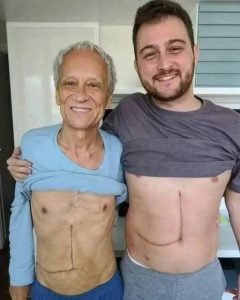
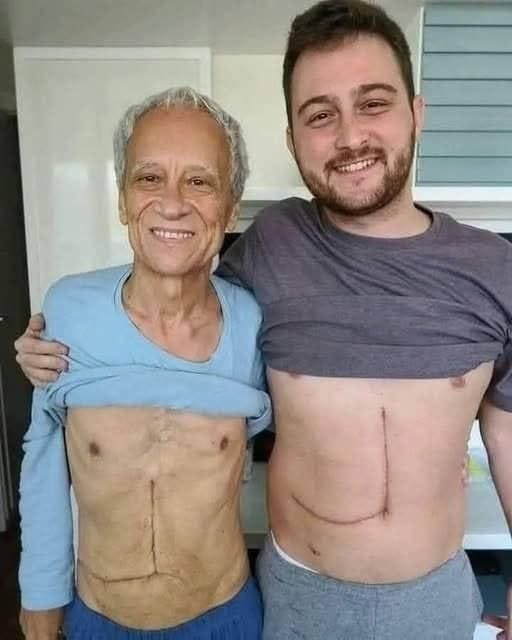
Their scars remained visible reminders of what they had endured.
Michael’s health had improved dramatically thanks to the transplant. Daniel, though still regaining strength, had returned to normal life step by step.
The experience changed them both.
They spoke more openly. They valued ordinary moments—coffee at sunrise, family dinners, quiet conversations.
The ordeal taught them something profound: sacrifice isn’t measured by suffering but by love freely given.
The Lesson Behind the Story
Living organ donation represents one of humanity’s most extraordinary acts of compassion. Thousands of families each year face impossible choices, balancing risk against hope.
Daniel’s journey revealed an important truth.
Heroic decisions don’t guarantee easy outcomes.
Even acts of deep love can carry unexpected challenges.
Yet those challenges also reveal resilience—the ability of families to endure uncertainty, fear, and recovery together.
Michael often tells people that receiving part of his son’s liver gave him more than survival.
It gave him perspective.
He stopped postponing joy. He called friends more often. He volunteered to support transplant awareness programs, sharing their story to encourage others to become donors or register for organ donation.
Daniel, meanwhile, never viewed himself as a hero.
“I just did what family does,” he says whenever asked.
Love That Lives On
Today, father and son celebrate two birthdays each year: the day they were born and the day of the transplant.
They understand how fragile life can be—and how powerful love becomes when people choose courage over fear.
The unexpected complication could have ended in tragedy.
Instead, it became a reminder that healing is rarely a straight path. Sometimes survival requires sacrifice, patience, and faith in one another.
Because in the end, the true miracle wasn’t just medical success.
It was the bond between a father and son—strong enough to face danger, uncertainty, and recovery together.
And that bond, unlike any organ or operation, is something no illness could ever take away.