Chaos at the White House Correspondents’ Dinner
The ballroom glittered beneath cascading chandeliers as journalists, politicians, comedians, and celebrities gathered for one of Washington’s most anticipated traditions: the White House Correspondents’ Dinner. Laughter echoed through the grand hall while camera flashes illuminated tuxedos and evening gowns. The atmosphere felt celebratory, almost carefree — a rare moment when politics paused for humor.
No one expected the night to turn into a scene of panic.
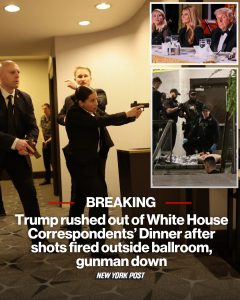
Shortly after 9:15 p.m., guests were finishing their first course when a loud popping sound echoed from outside the hotel entrance. At first, many assumed it was fireworks or construction noise. The band briefly stopped playing, and conversations faltered.
Then came the screaming.
Security personnel stationed near the ballroom doors suddenly pressed hands to their earpieces. Their expressions hardened instantly. Within seconds, Secret Service agents moved with rehearsed precision toward the head table.
“Remain seated,” one staff member urged guests, though his trembling voice betrayed the seriousness of the moment.
Outside the hotel, a lone gunman had reportedly opened fire near the main entrance, sending guests and bystanders running for cover. Witnesses later described shattered glass, overturned barricades, and people diving behind parked vehicles as sirens began to fill the night air.
Inside, confusion spread faster than information.
Phones buzzed across the room as attendees checked social media and text messages. Rumors multiplied: Was it an attack? Was anyone hurt? Was the president safe?
Secret Service agents quickly formed a protective perimeter around former President Donald Trump, who had been attending the dinner as a high-profile guest. Within moments, agents escorted him toward a secured exit behind heavy curtains near the stage.
The movement did not go unnoticed.
Gasps rippled across the ballroom as guests realized something serious was unfolding. Some stood, others ducked instinctively beneath tables. A journalist near the back described the scene as “a strange mix of disbelief and fear — like watching a movie you suddenly realize you’re inside.”
Hotel security announced a temporary lockdown.
Doors were sealed. Curtains were drawn shut. Staff instructed attendees to remain calm and stay away from windows. The once-lively dinner transformed into a silent, anxious gathering where whispered conversations replaced laughter.
Outside, law enforcement vehicles converged rapidly. Police officers established a perimeter while tactical units swept surrounding streets. Helicopters circled overhead, their searchlights cutting through the Washington night.
Early reports suggested the gunman had fired several rounds into the air and toward the building’s entrance before attempting to flee. Officers confronted the suspect near a barricaded street corner only blocks away.
Witnesses described chaos: guests in formal attire running barefoot across pavement, journalists clutching laptops instead of purses, and hotel staff guiding frightened attendees into service corridors for safety.
Back inside the ballroom, event organizers attempted to reassure guests.
“We are coordinating closely with law enforcement,” an announcer said over the sound system. “Please remain calm.”
Some attendees began live-reporting from their seats, turning the locked-down ballroom into an impromptu newsroom. Others called family members, assuring them they were safe.
Minutes stretched into what felt like hours.
Eventually, word spread that the suspect had been taken into custody without further violence. Authorities believed the individual acted alone, though investigations continued to determine motive.
Relief swept through the room — cautious, fragile relief.
Medical teams treated several individuals outside for minor injuries sustained while fleeing, but no fatalities were reported. Emergency responders escorted shaken guests back into the hotel through alternate entrances once the area was secured.
Around 10:05 p.m., officials confirmed that Trump had been safely evacuated to a secure location. The Secret Service declined to provide additional details but stated that all protectees were accounted for and unharmed.
Inside the ballroom, applause broke out spontaneously when the announcement came. The emotional release was immediate; strangers hugged, laughter returned nervously, and some guests wiped away tears.
The dinner, however, was effectively over.
Organizers canceled scheduled speeches and performances, prioritizing safety over tradition. Guests were dismissed in small groups as security conducted final sweeps of the building.
Outside, flashing lights painted the hotel façade red and blue. Reporters who had arrived expecting to cover jokes and political satire instead delivered breaking-news updates about an unfolding security scare.
Law enforcement officials later held a late-night press briefing.
“This incident appears to have been isolated,” a spokesperson said. “There is no ongoing threat to the public. We are continuing to investigate the suspect’s intentions.”
Questions remained unanswered: Why target such a high-profile event? Was the dinner itself the objective, or merely an opportunity for attention?
Security experts noted that events combining political leaders, journalists, and celebrities present uniquely complex challenges. Despite extensive planning, unpredictability remains the greatest threat.
By midnight, the streets around the hotel had largely cleared. Barricades were removed, and investigators collected evidence under bright portable lights.
For many attendees, the evening left a lasting impression.
One correspondent summarized the experience simply: “We came expecting comedy. We left reminded how quickly normal life can change.”
Social media quickly filled with accounts from guests describing the surreal transition from celebration to crisis. Some shared gratitude for the swift response of security teams; others reflected on the vulnerability felt even within heavily protected spaces.
The White House Correspondents’ Dinner has long symbolized the intersection of politics and journalism — an evening meant to highlight democracy’s lighter side. This fictional night, however, underscored something deeper: the resilience of people under pressure and the importance of preparedness in an uncertain world.
As dawn approached, Washington returned to its familiar rhythm. Morning commuters passed the hotel unaware of how dramatically the previous evening had unfolded inside its walls.
The ballroom lights were off. Tables stood empty. Programs lay abandoned beside half-finished desserts — silent reminders of a night that began with laughter and ended in history.
And for those who were there, the echoes of sirens and sudden fear would linger long after the headlines faded.