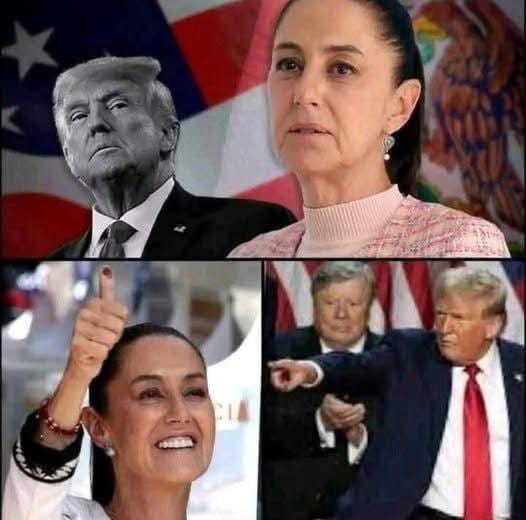
Mexican President States That Trump Is Not an Enemy — A Surprising Shift in Political Tone
In a moment that captured international attention, Mexico’s president, Claudia Sheinbaum, recently made headlines after stating publicly that former U.S. president Donald Trump should not be viewed as an enemy of Mexico. The remarks sparked debate across political circles, social media platforms, and diplomatic communities, as observers analyzed what the statement might mean for future relations between the two neighboring countries.
The relationship between Mexico and the United States has long been complex, shaped by geography, trade, immigration, culture, and shared economic interests. Statements from national leaders carry significant weight, especially when addressing figures as polarizing as Trump, whose presidency marked one of the most tense periods in modern U.S.–Mexico diplomacy.
A Statement That Drew Immediate Attention
During a press briefing discussing cross-border cooperation and regional stability, President Sheinbaum emphasized the importance of separating political disagreement from diplomatic hostility. According to her remarks, nations must work together regardless of ideological differences, especially when their economies and populations are deeply interconnected.
Sheinbaum explained that while Mexico and Trump often disagreed on policy matters — particularly immigration enforcement and border security — diplomacy requires engagement rather than confrontation.
Her message appeared to signal a pragmatic approach rather than an endorsement of Trump’s policies. She framed the statement as an acknowledgment that international relationships depend on dialogue, negotiation, and mutual interests.
Political analysts quickly noted that the wording represented a careful balancing act: recognizing past tensions while leaving room for future cooperation.
Historical Context Behind the Relationship
To understand the significance of Sheinbaum’s comment, it’s important to revisit the political climate during Trump’s presidency from 2017 to 2021. Trump’s administration frequently emphasized stricter immigration controls and proposed the construction of expanded border barriers, policies that drew strong reactions from Mexican leadership and citizens alike.
At the time, diplomatic exchanges were often tense. Trade negotiations surrounding the replacement of NAFTA with the United States–Mexico–Canada Agreement (USMCA) became defining moments in bilateral relations.
Despite public disagreements, economic collaboration continued. Trade between the two countries reached record levels, demonstrating how political rhetoric and economic reality often operate on separate tracks.
Sheinbaum’s recent statement appears to reflect this reality: nations may clash publicly while continuing to cooperate strategically.
Diplomacy Over Personal Politics
Experts suggest the president’s remarks were less about Trump as an individual and more about redefining diplomatic tone. Modern geopolitics increasingly requires leaders to work across political divides, particularly as global supply chains, migration challenges, and security concerns demand collaboration.
Mexico’s economy remains closely tied to the United States. Millions of jobs on both sides of the border depend on stable relations, making confrontation risky for either nation.
By describing Trump as “not an enemy,” Sheinbaum reinforced the idea that political leaders come and go, but national partnerships endure.
Some observers viewed the statement as preparation for potential future political scenarios in the United States, including the possibility of Trump returning to political power or influencing future policy debates.
Reactions Inside Mexico
Public reaction within Mexico was mixed. Supporters praised the president’s diplomatic maturity, arguing that international leadership requires calm pragmatism rather than emotional rhetoric.
Business leaders and economists largely welcomed the tone, noting that stability in U.S.–Mexico relations reassures investors and strengthens cross-border commerce.
However, critics questioned whether the statement risked minimizing past conflicts or overlooking controversial policies that affected migrants and border communities.
Political commentators across Mexican media emphasized that acknowledging diplomacy does not necessarily imply agreement with previous actions or political positions.
Response in the United States
In the United States, reactions varied along political lines. Some American analysts interpreted Sheinbaum’s statement as a sign that international leaders recognize the enduring influence of Trump within U.S. politics.
Others viewed it as a reminder that foreign governments often prioritize long-term national interests over partisan debates taking place inside American domestic politics.
Diplomats noted that international relations rarely revolve around personal feelings between leaders. Instead, cooperation is driven by shared challenges such as trade security, climate change, migration management, and regional economic growth.
The Role of Economic Interdependence
One of the strongest forces shaping U.S.–Mexico relations is economic interdependence. Mexico has become one of the United States’ largest trading partners, with billions of dollars in goods crossing the border daily.
Manufacturing supply chains stretch across both countries, linking industries such as automotive production, agriculture, technology, and energy.
Because of this deep connection, leaders on both sides often seek stability even during political disagreements. Sheinbaum’s remarks may reflect an understanding that maintaining constructive communication benefits citizens more than escalating political conflict.
Immigration and Border Cooperation
Immigration remains one of the most sensitive topics between the two nations. Policies introduced during Trump’s presidency reshaped border enforcement strategies and sparked intense debate internationally.
Sheinbaum’s statement did not revisit specific policies but instead highlighted the need for cooperative solutions addressing migration’s root causes — including economic inequality, regional instability, and climate pressures.
Analysts suggest that framing political opponents as partners rather than adversaries may open pathways for future negotiations regardless of who holds power in Washington.
A Changing Diplomatic Style
Observers also point to a broader global trend: leaders increasingly emphasize pragmatic diplomacy over ideological confrontation. In an interconnected world facing economic uncertainty and geopolitical tension, cooperation often outweighs political rivalry.
Sheinbaum’s comment may represent this evolving diplomatic philosophy — acknowledging differences while refusing to escalate them into permanent hostility.
International relations scholars note that such language can lower tensions, signal openness to dialogue, and strengthen negotiating positions.
Political Strategy or Genuine Shift?
Some political strategists argue that the statement could serve multiple purposes simultaneously. It may reassure international markets, signal openness to future negotiations, and present Mexico as a stabilizing actor in North American politics.
Others believe it reflects Sheinbaum’s governing style, which emphasizes institutional cooperation and long-term policy continuity rather than personal political disputes.
Regardless of motivation, the remarks highlight how diplomacy often requires nuance rather than absolute positions.
Looking Ahead
As North America faces shared challenges — economic competition, technological change, climate risks, and migration pressures — cooperation between Mexico and the United States remains essential.
Whether or not Trump returns to political leadership, the underlying message of Sheinbaum’s statement is clear: international relationships must transcend individual personalities.
Diplomatic bridges, once built, are easier to maintain than to rebuild after conflict.
Final Thoughts
The declaration that Donald Trump is “not an enemy” does not erase past disagreements, nor does it signal full political alignment. Instead, it underscores a fundamental truth of global politics: nations must work together even when leaders disagree.
President Claudia Sheinbaum’s remarks serve as a reminder that diplomacy thrives on communication, realism, and shared interests. In an era defined by polarization, choosing cooperation over confrontation may prove to be one of the most powerful political strategies available.
As observers continue to analyze the statement, one thing is certain — the future of U.S.–Mexico relations will depend less on rhetoric and more on practical collaboration between two nations whose destinies remain closely linked.