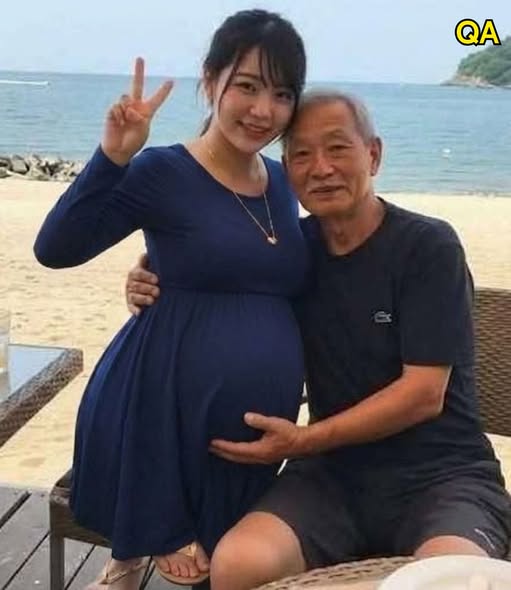
The Sad Girl Marries a 70-Year-Old
Elena had always worn sadness like a second skin. At twenty-six, she moved through New York City like a ghost in oversized sweaters, her dark hair perpetually falling over eyes that had forgotten how to sparkle. Her mother had died of cancer three years earlier, leaving behind medical bills that swallowed Elena’s bookstore salary whole. Her father had vanished when she was twelve. Friends had drifted away, tired of her quiet cancellations and heavier silences. Loneliness wasn’t dramatic for Elena; it was simply the weather she lived in.
So when Richard Caldwell, seventy years old, silver-haired, and quietly wealthy, began visiting her bookstore every Tuesday, she didn’t see a predator. She saw steadiness. He bought first editions he didn’t need, asked gentle questions about her favorite novels, and never once made her feel small. One rainy afternoon he offered her an umbrella and a simple truth: “You look like someone who’s been carrying the world alone for too long.”
Six months later, he proposed. Not with fireworks or grand gestures, but over coffee in his Upper West Side apartment. “I don’t expect romance, Elena. I’ve had that. What I want is companionship. Someone to share quiet mornings with. In return, you’ll never worry about money again.” His eyes were kind, his voice steady. He had no children, no greedy relatives hovering. Just a heart condition and a desire for dignity in his final years.
She said yes.
The wedding was small—just a judge, two witnesses, and a modest lunch afterward. Elena wore a simple ivory dress. Richard wore a navy suit that still fit him perfectly. When he kissed her cheek at the end of the ceremony, it felt more like a promise of safety than passion. That night they slept in separate rooms. He didn’t push. She was grateful.
For ten days, life felt like the closest thing to peace she had known in years. Richard’s apartment—now theirs—was filled with books and soft light. He cooked simple meals, told stories about traveling the world in his youth as a diplomat. They read together in the evenings. He never complained when she cried at night, thinking of her mother. He simply handed her tissues and let the silence be kind.
On the morning of the eleventh day, everything changed.
Elena woke to find Richard already in his study, door slightly ajar. She was about to knock when she heard his voice—low, urgent, on the phone.
“No, the transplant list is moving too slowly. I need the private arrangement. Yes, the girl is perfect. Young, healthy, no family to ask questions. We proceed as planned in three weeks.”
Her blood turned to ice.
She backed away silently, heart hammering. Perfect? The girl? She slipped into the kitchen, hands shaking as she made coffee she no longer wanted. When Richard emerged, smiling gently, she forced herself to smile back.
“Sleep well, my dear?”
“Like a rock,” she lied.
The rest of the day she moved through routines like an automaton. Richard went for his usual walk. As soon as the door closed, Elena entered his study. She had never violated his privacy before. Now she felt she had no choice.
The desk drawer was unlocked. Inside, she found medical files. Her own medical files—copied from the doctor’s office she had visited months ago for a routine checkup. There were also documents about Richard’s heart. End-stage failure. He had been given six months at most. But there were emails. Coded language. References to “organ procurement” through unofficial channels. A surgeon in Eastern Europe. Payments already wired.
Her stomach lurched. She kept reading.
The plan wasn’t to kill her outright. It was more sophisticated—and more horrifying. A staged “accident” that would leave her brain-dead but her organs viable. Richard had arranged everything. The quiet young wife with no family would be the perfect donor. His team would harvest what he needed—heart, liver, kidneys—and he would live. She would not.
Elena sat on the floor, files scattered around her, and laughed once—a broken, bitter sound. The sad girl had married a 70-year-old for security and found a death sentence instead.
But something shifted in her then. The sadness that had drowned her for years cracked open, revealing something sharper underneath. Rage. Clarity. A will to survive that she hadn’t known she possessed.
She took photos of every document with her phone. She replaced everything exactly as she found it. Then she went to the bedroom, packed a small bag with essentials, and withdrew as much cash as the joint account would allow without triggering alerts—ten thousand dollars. Richard had been generous with her allowance.
When he returned that evening, she was cooking pasta, humming softly. She had practiced the performance in the mirror.
“You seem lighter today,” he said, kissing her temple.
“I think I’m finally settling in,” she replied, smiling with her mouth but not her eyes.
That night she waited until his breathing grew deep and even through the wall. Then she left.
The next weeks were a blur of fear and meticulous planning. Elena used the cash to stay in cheap motels, changing locations every few days. She contacted a journalist she had met once at a book signing—an investigative reporter known for exposing elder exploitation schemes. She sent him the photos anonymously at first, then met him in person after he verified the documents.
The story broke three weeks later. “Billionaire’s Heart Transplant Plot: Young Wife Targeted for Organs.” Richard’s name, his connections, the shady surgeon—everything unraveled in the press. Police raided the apartment. Richard was arrested in his hospital bed as doctors prepared him for the illegal procedure.
Elena watched the news from a safe house arranged by the reporter. She felt no triumph, only exhaustion and a strange, hollow grief. The man who had offered her kindness had been willing to end her life to extend his own. The sadness she carried had nearly killed her—first emotionally, then literally.
But she was alive.
Six months later, Elena stood in a new bookstore in a quiet Brooklyn neighborhood. She had used a small settlement from the civil suit against Richard’s estate—ironic justice—to open her own shop. The sign above the door read “Second Chapters.” She had dyed her hair a soft auburn and started seeing a therapist who didn’t let her hide in silence.
Sometimes customers asked about the scar on her wrist—not from the ordeal, but from a suicide attempt years earlier that she had never told Richard about. She would smile faintly and say, “It reminds me I survived worse than I thought I could.”
One crisp autumn afternoon, a man in his early forties came in looking for first editions of Russian literature. He had kind eyes and a gentle voice. They talked about Dostoevsky for nearly an hour. When he asked her to dinner, Elena hesitated only a moment.
“I don’t move fast,” she said.
“Good,” he replied. “Neither do I.”
As she locked up that night, Elena looked at the city lights beyond the window. The sadness was still there—it probably always would be. But it no longer defined her. She had married a 70-year-old man and found betrayal ten days later. What she discovered after that was something far more valuable: herself.
She turned off the lights, stepped into the cool evening, and walked home unafraid.