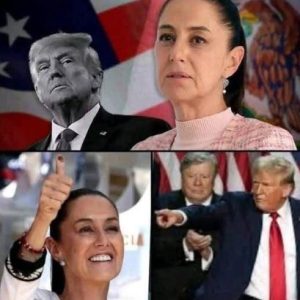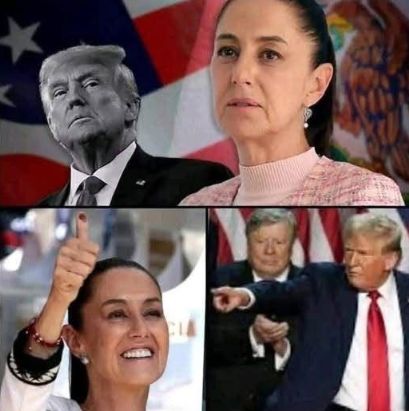
**Mexican President Claudia Sheinbaum has made several statements pushing back against aspects of U.S. President Donald Trump’s policies while maintaining a tone of pragmatic cooperation on shared issues like security, trade, and migration.**
As of mid-2026, relations between Mexico and the United States under Presidents Sheinbaum and Trump remain a careful balancing act. Sheinbaum, Mexico’s first female president and a scientist by training, has repeatedly asserted Mexican sovereignty while avoiding outright confrontation. Her approach contrasts with more fiery rhetoric from previous eras, focusing instead on dialogue, constitutional principles, and mutual interests.
Key Recent Statements
One notable theme is Sheinbaum’s firm rejection of U.S. military intervention against drug cartels on Mexican soil. In early 2026, following Trump’s comments about potential strikes or troop deployments, Sheinbaum stated that such actions were “not necessary” and “not on the table.” After a phone conversation with Trump, she described it as “very good” but emphasized ongoing collaboration within the framework of Mexican sovereignty and without foreign intervention.
She referenced Mexico’s constitution, which prohibits foreign interventions, and noted that bilateral security agreements already guide cooperation—such as intelligence sharing, joint operations requested by Mexico, and addressing root causes like U.S.-sourced firearms flowing to cartels (with U.S. Justice Department data cited by Mexico showing a high percentage of cartel weapons originating north of the border).
On the Gulf of Mexico naming dispute, Sheinbaum pushed back against any suggestion of renaming it the “Gulf of America.” In a speech, she reminded audiences of historical and geographical facts, framing it as a matter of national identity rather than a direct personal attack on Trump.
Regarding migration and border issues, Sheinbaum has defended Mexican citizens’ rights while criticizing conditions in U.S. immigration custody. She has vowed to “defend Mexicans at every level” amid reports of deaths in ICE facilities and protested U.S. policies she views as overly punitive. At the same time, Mexico has continued cooperation on managing migration flows.
She has also declined certain invitations, such as joining a proposed U.S.-led “Board of Peace” on Gaza, citing the need for balanced participation including Palestinian representation, while offering observer status.
In broader economic contexts, Sheinbaum has downplayed some threats (like tariffs) and highlighted the interdependence of the two economies under frameworks like the USMCA. She has positioned Mexico as a reliable partner open to dialogue but unwilling to subordinate its interests.
### Context and Broader Relationship
Claudia Sheinbaum assumed office in late 2024 as a successor to Andrés Manuel López Obrador (AMLO), inheriting a complex U.S. relationship marked by Trump’s return to the White House. Her background as a climate scientist and former Mexico City mayor gives her a data-driven, measured style. Polls have shown her enjoying high approval ratings domestically, partly for her handling of Trump-era pressures.
Key flashpoints include:
– **Cartels and Security**: Trump has repeatedly floated military options against cartels. Sheinbaum has countered that unilateral U.S. action violates sovereignty and that collaboration (e.g., increased Mexican seizures and arrests) is more effective. She has referenced past agreements and stressed that Mexico handles its internal security while expecting the U.S. to curb demand and arms trafficking.
– **Trade and Tariffs**: Threats of tariffs have been met with reminders of integrated supply chains in autos, agriculture, and manufacturing. Mexico has explored diversification but maintains strong economic ties.
– **Migration**: Mexico has stepped up enforcement on its southern border while criticizing humanitarian conditions in the U.S. system.
– **Other Issues**: Disputes over Cuba policy, where Mexico has provided humanitarian aid despite U.S. pressure, and symbolic matters like geographic naming.
Sheinbaum’s rhetoric often frames issues around “respect,” “dialogue,” and “non-intervention.” In one reported exchange, she told Trump directly that military deployment “is not on the table.” She has accused the U.S. of “meddling” in cases like U.S. indictments of Mexican officials allegedly linked to cartels, insisting Mexican institutions will investigate independently.
Critics in Mexico and the U.S. accuse her of being too conciliatory or too rigid, depending on the audience. Supporters praise her for avoiding escalation while protecting national dignity. Trump, for his part, has at times called her a “fine woman” or praised aspects of cooperation, while continuing to apply pressure publicly.
### Analysis: Pragmatism Over Polemics
Sheinbaum’s approach reflects Mexico’s structural realities: deep economic integration with the U.S. (the top trading partner), shared 2,000-mile border challenges, and domestic political constraints. As a member of the Morena party, she balances left-leaning sovereignty principles with the need for stability.
Her statements often serve dual purposes—signaling resolve to Mexican voters while keeping channels open for negotiation. For instance, rejecting intervention does not mean rejecting all cooperation; Mexico has increased efforts against fentanyl precursors and human smuggling.
This dynamic echoes historical U.S.-Mexico tensions (e.g., during previous Trump terms or the Bracero Program era) but operates in a more interconnected 21st-century context of supply chains, remittances, and transnational crime.
Potential future flashpoints include USMCA reviews, water rights in shared rivers, energy policy, and responses to U.S. domestic politics. Sheinbaum has emphasized that Mexico is not Venezuela or another country where interventionist precedents apply.
### Public and Social Media Echoes
Social media often amplifies fragments of these exchanges. Posts like “Mexican president states that Trump is not…” frequently circulate as clickbait or partial quotes, sometimes misattributing stronger language. One viral example involved fabricated or exaggerated speeches about consumer boycotts and cultural superiority, which fact-checks note do not match Sheinbaum’s actual words. Real statements are more diplomatic.
In summary, President Sheinbaum has consistently messaged that Trump (and the U.S.) is a necessary partner but “not” an authority over Mexican territory, laws, or decisions. Cooperation yes; subordination no. This stance has allowed her administration to navigate a high-stakes relationship without major ruptures so far, though risks remain high amid ongoing cartel violence, migration pressures, and political posturing on both sides.