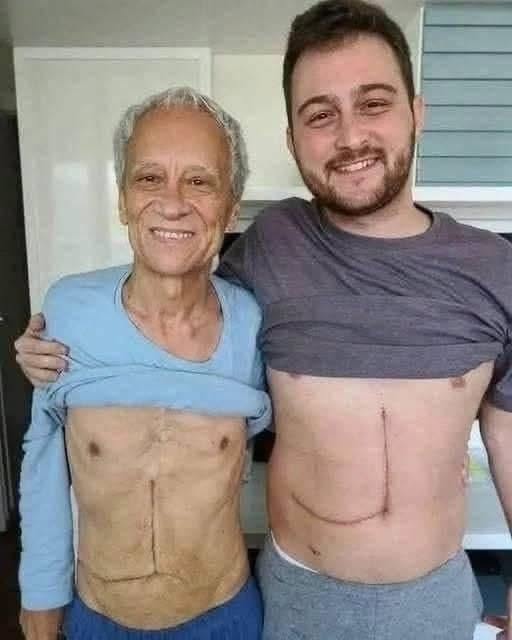
The Son Who Donated Part of His Liver to His Father
When 27-year-old Daniel received the phone call, he knew his life was about to change forever.
His father, Michael, had been battling severe liver disease for years. What had started as occasional fatigue and routine doctor visits gradually turned into hospital stays, medications, and endless uncertainty. By the time doctors delivered the latest update, the family understood the gravity of the situation.
Michael needed a liver transplant.
Without one, his chances of survival were rapidly diminishing.
The news hit the family hard. Michael had always been the strong one—the father who worked long hours to provide for his family, coached Daniel’s youth soccer team, and never missed a birthday or school event. Seeing him weakened by illness was heartbreaking.
Doctors explained that while Michael could be placed on the transplant waiting list, there was no guarantee a suitable donor organ would become available in time.
That’s when Daniel made a decision.
“I’ll do it,” he said.
The room fell silent.
His mother stared at him.
“What do you mean?” she asked.
“I’ll donate part of my liver.”
Living liver donation is possible because the liver has a unique ability to regenerate. A healthy donor can give a portion of their liver to a recipient, and over time both livers can grow back to near-normal size.
The medical team began extensive testing.
Blood work.
Scans.
Psychological evaluations.
Weeks of examinations followed.
Daniel passed every test.
He was healthy.
Compatible.
And determined.
Despite concerns from family members and friends, he never wavered.
“He’s my dad,” Daniel said repeatedly. “He spent his whole life taking care of me. This is the least I can do.”
As surgery day approached, emotions ran high.
Michael struggled with guilt.
The idea of his son undergoing major surgery on his behalf weighed heavily on him.
“What if something happens to you?” Michael asked one evening.
Daniel smiled.
“We’ll both be fine.”
The operation was scheduled for early spring.
Two surgical teams worked simultaneously.
One prepared Michael to receive the donated liver segment.
The other carefully removed a portion of Daniel’s liver.
The procedure lasted many hours.
Family members waited anxiously in the hospital.
Every passing minute felt like an hour.
Finally, a surgeon emerged.
The operation had been successful.
Relief swept through the waiting room.
Tears flowed.
Hugs were exchanged.
For the first time in months, hope replaced fear.
Michael’s recovery was challenging but promising.
Doctors were encouraged by his progress.
The donated liver segment appeared to be functioning well.
Daniel also faced a difficult recovery period. Although healthy, living donors undergo major surgery and require weeks or months to fully regain their strength.
At first, everything seemed to be moving in the right direction.
Michael grew stronger.
His skin color improved.
His appetite returned.
The family celebrated small victories every day.
Yet several weeks later, unexpected complications emerged.
Daniel began experiencing unusual symptoms.
At first, he dismissed them as normal post-surgical discomfort.
Fatigue.
Pain.
Occasional nausea.
Doctors initially believed these issues were part of the recovery process.
However, additional testing revealed a serious complication.
Though rare, living liver donation carries risks.
Daniel developed a significant postoperative infection that required immediate treatment.
The news devastated the family.
Michael felt crushed.
His son had risked everything to save him, and now he was facing a difficult medical battle of his own.
“I should have been the one suffering,” Michael said through tears.
Doctors worked tirelessly to stabilize Daniel.
He underwent additional procedures.
Specialists monitored him around the clock.
Days turned into weeks.
The hospital became a second home for the family.
Friends, neighbors, and even strangers began offering support.
Messages poured in from people inspired by Daniel’s sacrifice.
Many called him a hero.
But Daniel never saw himself that way.
Whenever someone praised him, he would simply shrug.
“I just helped my dad.”
His humility touched everyone around him.
Fortunately, after weeks of intensive treatment, Daniel’s condition gradually improved.
The infection came under control.
His strength slowly returned.
Though recovery remained difficult, doctors became increasingly optimistic.
Meanwhile, Michael continued to regain his health.
For the first time in years, he could take walks without becoming exhausted.
He could enjoy meals.
He could spend time with family without constant medical limitations.
Every improvement came with mixed emotions.
He was grateful for his second chance at life, but he couldn’t stop thinking about the price his son had paid.
One afternoon, several months after the surgeries, father and son sat together on a hospital garden bench.
The spring sun warmed the air.
For a few moments neither spoke.
Finally, Michael broke the silence.
“I don’t know how I’ll ever repay you.”
Daniel laughed softly.
“You already did.”
“What do you mean?”
“You raised me.”
Michael looked confused.
Daniel continued.
“You taught me kindness. Responsibility. Loyalty. Everything good about me came from you.”
Tears filled Michael’s eyes.
“You gave me life once,” Daniel said. “I just helped return the favor.”
Neither man spoke for several moments.
Words weren’t necessary.
The bond between them was already understood.
Over the following year, both continued to heal.
Daniel eventually returned to work.
Michael embraced a healthier lifestyle and remained under regular medical supervision.
The experience changed their family forever.
It deepened relationships.
It strengthened appreciation for ordinary moments.
Family dinners felt more meaningful.
Holiday gatherings became treasured events.
Simple conversations carried greater value.
Their story also inspired others to learn about organ donation.
Many people were surprised to discover that living liver donation is possible and has saved countless lives around the world.
Medical experts emphasize that potential donors undergo rigorous screening to maximize safety, but like any major surgery, donation carries risks and requires careful consideration.
For Daniel, however, the decision remained simple.
Asked years later whether he would make the same choice again, he didn’t hesitate.
“Absolutely.”
The journey had been painful.
There had been fear, uncertainty, and unexpected complications.
Yet his father was alive.
That fact outweighed everything else.
Today, when people hear their story, they often focus on the surgery itself.
But Daniel believes the real lesson lies elsewhere.
It’s about family.
Sacrifice.
Love.
The willingness to stand beside someone during their darkest moments.
Life often presents challenges that cannot be solved with money, influence, or luck.
Sometimes the only answer is courage.
The courage to help another person despite the risks.
The courage to put someone else’s needs before your own.
And the courage to face uncertainty with hope.
Daniel’s gift was more than a medical procedure.
It was a powerful reminder that some of the greatest acts of love are not measured by words but by actions.
For one father and son, that act of love became a second chance at life—one they would never take for granted.