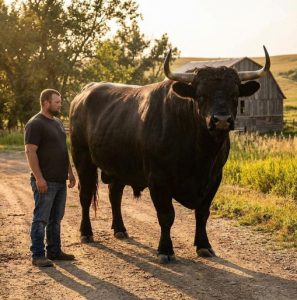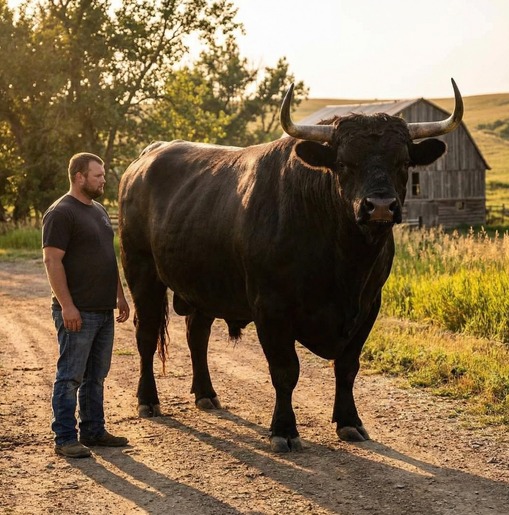
I recently spent $6,500 on a registered Black Angus bull, the kind with papers so thick they might as well come with a briefcase. Perfect confirmation, broad chest, calm eyes—looked like he stepped straight out of a catalog. I hauled him home feeling equal parts proud and nauseous, because $6,500 isn’t pocket change where I come from. That’s real money. That’s “this bull better earn his keep” money.
I turned him out with the herd the very next morning.
And that’s when things got… strange.
Instead of doing what a bull is supposed to do—what bulls have been doing successfully for thousands of years—he just grazed. Calmly. Politely. Methodically. Head down, tail swishing, chewing grass like he was auditioning for a yogurt commercial. He didn’t sniff. Didn’t posture. Didn’t even glance sideways at a cow.
At first, I thought maybe he was just settling in.
Day one? Fine. New place. New smells. Give him time.
Day two? Same thing. Grass. More grass. Premium grass, apparently, because he was really enjoying himself.
Day three? Still nothing. The cows could’ve been invisible. One of them practically walked into him and he just stepped aside like a gentleman holding a door open.
By day four, I was pacing the fence line, arms crossed, calculating how many years of calves it would take to justify this purchase—assuming he ever figured out what his job was.
By day five, my confidence was gone.
I started replaying the sale in my head. The handshake. The compliments. The way the seller said, “You’ll be happy with him.” I began to suspect I had just bought the most expensive lawn ornament in three counties.
Neighbors, of course, noticed.
“Bull settling in?” one asked.
“Yeah,” I said. “Settled in real good. Might retire here.”
Someone else joked, “Maybe he’s shy.”
Shy or not, I didn’t spend $6,500 for a bull to develop a deep personal relationship with fescue.
So I did what any reasonable, increasingly anxious cattle owner would do.
I called the vet.
The vet showed up mid-morning, leaned against the fence, and watched the bull chew grass for a solid minute without saying a word. Finally, he scratched his chin and said, “Huh.”
That’s never what you want to hear from a professional.
He walked out into the pasture, did a basic exam, checked him over, nodded a few times, and then asked me a question that caught me off guard.
“How old is he?”
I told him.
“And you said he’s never been turned out with cows before?”
That’s when the lightbulb flickered.
The vet chuckled—not unkindly, but the kind of chuckle that means this happens more than you think.
“Well,” he said, “there’s nothing wrong with him physically. Heart’s good. Legs are sound. He’s healthy as can be.”
I exhaled in relief.
Then he added, “He’s just… inexperienced.”
I blinked. “Inexperienced?”
The vet nodded. “He doesn’t really know what he’s supposed to do yet.”
I stared at the bull, who was still chewing grass with the calm confidence of someone who had no idea he was the center of a crisis.
“So,” I said slowly, “you’re telling me I bought a bull who doesn’t know he’s a bull.”
“Pretty much,” the vet said. “Think of it like this: you dropped him into a room full of strangers and expected him to be smooth about it.”
That did not make me feel better.
The vet went on. “He was raised around other bulls, wasn’t he?”
“Yes.”
“And probably handled a lot by people?”
“Yes.”
“Well,” he said, “to him, cows are just… large, unfamiliar furniture right now.”
I didn’t know whether to laugh or cry.
“So what do I do?” I asked. “Give him a pamphlet?”
The vet smiled. “No. You give him an example.”
He explained that young or inexperienced bulls sometimes need to see what’s expected. The solution, apparently, was to bring in an older, experienced bull—or at least a cow in standing heat—to jump-start the situation.
Before I could even ask how much this lesson would cost me, the vet finished with, “Oh—and one more thing.”
I braced myself.
“I’ll give him a shot of vitamins,” he said, “just to be safe. Sometimes a little boost helps with confidence.”
Confidence. I had just spent $6,500 on confidence issues.
The vet gave the shot, packed up his gear, and left me alone with my thoughts—and my grass-loving bull.
I’ll be honest: I stood there for a while, wondering how I was going to explain this to anyone without sounding ridiculous.
But here’s the thing.
Two days later, something changed.
I noticed the bull lifting his head more. Sniffing the air. Paying attention. One afternoon, I caught him following a cow—not aggressively, not awkwardly, but with purpose.
By the end of the week?
Let’s just say he figured it out.
Suddenly, he was everywhere. Busy. Focused. Determined. The grass was still there, but it was no longer the highlight of his day.
I leaned on the fence, watched him work, and laughed out loud.
That $6,500 bull wasn’t broken. He wasn’t lazy. He wasn’t defective.
He was just new.
And that experience taught me something that stuck—about animals, about people, and about expectations.
Sometimes what looks like failure is just unfamiliarity.
Sometimes what feels like a bad investment is just a slow start.
And sometimes, even the most expensive, well-bred, officially registered bull just needs a little time—and maybe a confidence boost—to remember who he is.
In the end, he earned every penny.
And I learned never to judge a bull by his grazing habits.