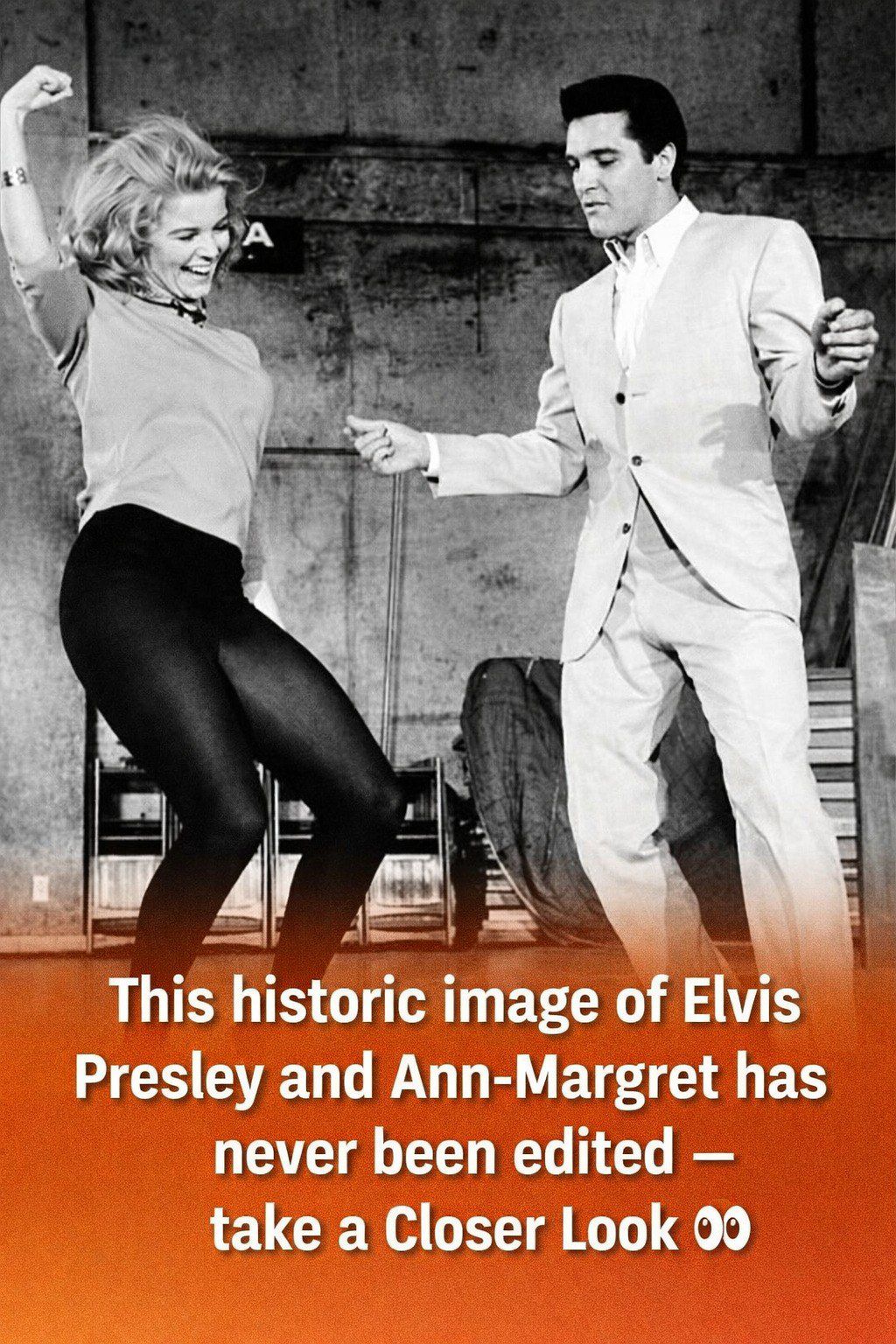
This historic image of Elvis Presley and Ann-Margret has circulated for decades, often accompanied by disbelief, romantic speculation, and the modern reflex to ask, “Is it edited?” In an era saturated with filters, Photoshop, and AI-generated visuals, the idea that a photograph could be so vivid, so emotionally charged, and yet entirely authentic feels almost radical. But this image—captured during the height of both stars’ magnetism—has never been edited. Its power lies precisely in its honesty.
To understand why this photograph resonates so deeply, one must first understand who these two people were at the moment the shutter clicked. Elvis Presley was not just a singer or a movie star. He was a cultural earthquake. By the early 1960s, he had already transformed music, scandalized polite society, survived the draft, and emerged as Hollywood’s most bankable musical leading man. He carried with him a strange duality: rebellious sensuality paired with deep Southern politeness, raw charisma mixed with boyish vulnerability.
Ann-Margret, meanwhile, was not merely a rising actress. She was electricity incarnate. Bursting onto the scene with a fearless blend of sexuality, humor, and talent, she represented a new kind of female star—one who didn’t apologize for desire or ambition. Where many actresses of the time were carefully molded into safe archetypes, Ann-Margret felt unpredictable, alive, and utterly modern.
When these two forces collided during the filming of Viva Las Vegas, Hollywood witnessed something rare: chemistry so intense it could not be manufactured, staged, or toned down. The image in question—often shared without context—captures that collision. Their bodies lean toward one another not as performers hitting marks, but as human beings responding instinctively. The closeness is real. The smiles are unguarded. The tension is palpable.
What makes the image particularly compelling is what it doesn’t do. There is no exaggerated glamour lighting, no artificial polish that distances the viewer. Instead, the photograph feels intimate, almost intrusive, as if we are witnessing a private moment that just happened to be documented. This is why so many people assume it must be altered—because modern visual culture has trained us to distrust authenticity when it feels too perfect.
But the perfection here is not technical; it is emotional.
Elvis and Ann-Margret shared something that went beyond scripted romance. Numerous accounts from the set describe a genuine bond—one rooted in mutual respect, shared insecurity, and an intuitive understanding of fame’s isolating weight. Elvis, often surrounded by handlers and expectations, found in Ann-Margret someone who did not idolize him, but saw him. Ann-Margret, navigating an industry eager to exploit her image, recognized in Elvis a man both empowered and trapped by his legend.
The photograph reflects that balance. Elvis does not dominate the frame. Ann-Margret is not positioned as an accessory. They appear as equals—two stars momentarily free from the machinery surrounding them. That equality is part of what makes the image feel so contemporary, even decades later.
It is also why the photo unsettles modern viewers. Today, we expect celebrity images to be curated narratives—carefully managed brands rather than spontaneous truths. This photograph resists that framework. It refuses to be ironic, distant, or controlled. It simply is.
There is another layer of fascination: the unfulfilled story it represents. Despite their connection, Elvis and Ann-Margret did not end up together. Elvis returned to a life shaped by obligation, contracts, and a relationship path that felt increasingly predetermined. Ann-Margret continued her ascent, forging a career defined by resilience and reinvention. The image, therefore, becomes a kind of emotional fossil—a preserved moment of possibility before reality intervened.
That sense of “what might have been” is powerful. It invites viewers not just to admire the photograph, but to project their own longings onto it. We see in their expressions the universal experience of connection that cannot be sustained—not because it lacks depth, but because life moves in unforgiving directions.
Importantly, the image has survived without alteration precisely because it does not need enhancement. Its grain, its lighting, even its imperfections contribute to its credibility. Each detail anchors it in a specific time and place, reminding us that authenticity has a texture modern images often lack. You can almost feel the warmth of the studio lights, hear the low murmur of the crew, sense the pause before motion resumes.
In a world where images are endlessly manipulated to provoke reaction, this photograph endures by doing the opposite. It invites stillness. It asks us to look longer. To consider that once—just once—two people stood close enough, honest enough, for truth to slip through the lens.
That is why the image of Elvis Presley and Ann-Margret continues to circulate, debate-proof and edit-proof. Not because it’s shocking, but because it’s sincere. Not because it’s dramatic, but because it’s human.
And perhaps that is the most unsettling realization of all: that sometimes the most unbelievable images are the ones that are completely real.