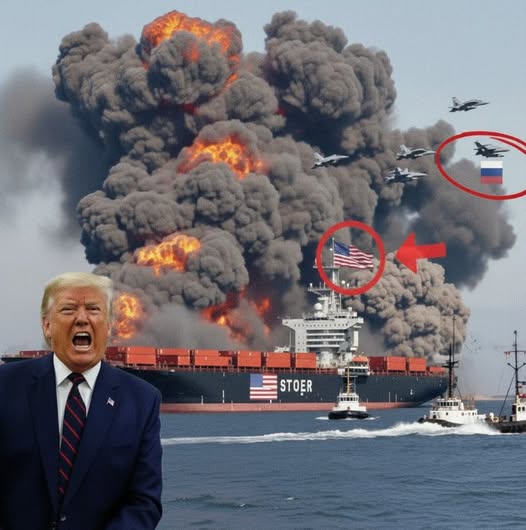
“5 seconds ago, a Russian Su-57 pilot destroyed a U.S. aircraft carrier carrying 200 fighter jets” — this is not just unlikely, it’s virtually impossible, and there is no credible evidence that anything like this has happened.
Let’s break this down carefully, because claims like this are designed to feel urgent and believable at first glance—but they fall apart under even basic scrutiny.
First, consider the scale of what’s being claimed. A U.S. aircraft carrier is one of the most heavily defended and technologically advanced military assets in the world. Ships like those in the United States Navy carrier fleet—such as Nimitz-class or Ford-class carriers—are not just single vessels operating alone. They are surrounded by an entire carrier strike group, which includes guided missile cruisers, destroyers, submarines, and advanced radar and air defense systems.
These groups are specifically designed to detect and neutralize threats from hundreds of miles away—long before an enemy aircraft could get close enough to attack.
Now look at the aircraft mentioned: the Sukhoi Su-57. While it is Russia’s most advanced stealth fighter, it is not a miracle weapon. Its operational numbers are limited, and it has not been proven capable of penetrating the layered defenses of a U.S. carrier strike group, especially alone.
For such an attack to succeed, several highly unlikely conditions would all have to occur at once:
- The carrier group’s radar, satellite, and surveillance systems would have to fail or be bypassed
- Escort ships and defensive aircraft would have to be neutralized or absent
- The attacking jet would need to carry and successfully deploy weapons capable of crippling a carrier
- No immediate military response or interception would occur
This chain of events is not just improbable—it contradicts how modern naval warfare works.
There’s another major issue: the claim about “a carrier carrying 200 fighter jets.” That number is simply incorrect. Even the largest U.S. aircraft carriers typically carry around 60 to 75 aircraft total, including fighter jets, helicopters, and support planes. The idea of 200 fighter jets on a single carrier is not realistic.
Now consider the global implications. If a U.S. aircraft carrier were destroyed—especially by a Russian military asset—it would be one of the most significant military events in modern history. It would represent a direct and massive escalation between nuclear-armed powers. The consequences would be immediate and worldwide:
- Emergency statements from governments
- Wall-to-wall coverage across every major news outlet
- Military alerts and potential escalation responses
- Financial markets reacting sharply
None of that is happening.
Real-world events of this magnitude cannot be hidden or reported only through vague, sensational posts. They generate overwhelming, consistent, and detailed reporting within minutes.
So what is this message you saw?
It fits a very common pattern of viral misinformation:
- Extremely urgent timing (“5 seconds ago”)
- A dramatic, high-stakes claim
- Involvement of major global powers
- Lack of specific details (no location, no ship name, no official confirmation)
These types of posts are often created to generate attention, provoke fear, or simply go viral. Sometimes they are based on fictional scenarios, video game footage, or completely fabricated stories.
That doesn’t mean global tensions aren’t real. Military forces around the world—including those of Russia and the United States—do operate in close proximity at times, and incidents can occur. But a direct, successful attack of this scale would be impossible to miss and impossible to keep vague.
It’s also important to understand how quickly misinformation spreads in moments of uncertainty. When people are already concerned about global conflict, they are more likely to believe and share alarming news without verifying it. That’s why messages like this are so effective—they tap into existing fears.
The best response is not panic, but verification.
Ask simple questions:
- Is this confirmed by multiple trusted sources?
- Are there specific, consistent details?
- Does the claim make sense given what we know about military capabilities?
In this case, the answer to all three is no.
To be absolutely clear:
There is no verified report of a Russian Su-57 destroying a U.S. aircraft carrier.
There is no evidence of any such attack occurring.
And the details in the claim itself are factually inconsistent with reality.
In a world where information moves instantly, not everything labeled “breaking” is true. The ability to pause, question, and think critically is more important than ever—especially when the claim involves events that would reshape global history in an instant.