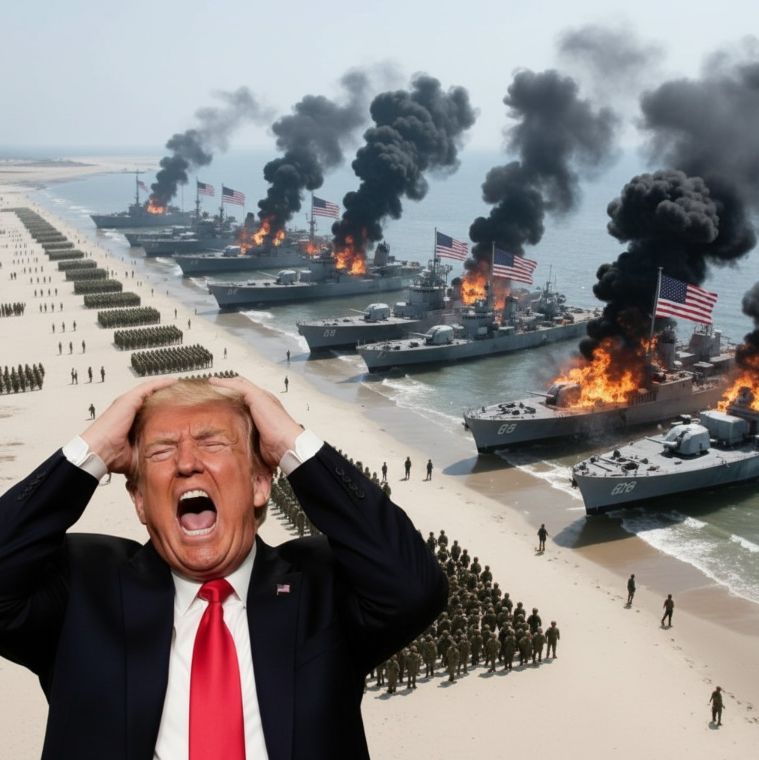
“Today, March 19th! Dozens of US warships in the Strait of Hormuz were destroyed by Russia – ARMA 3” is a perfect example of how real-world tensions, military imagery, and gaming footage can be blended into a story that feels urgent and believable—but isn’t real.
Let’s start with the most important point: there is no credible evidence that dozens of U.S. warships were destroyed in the Strait of Hormuz today—or at any recent time—by Russia or anyone else. An event of that magnitude would instantly dominate global headlines, trigger emergency government responses, and likely mark the beginning of a large-scale international conflict. None of that has happened.
So what’s really going on?
The key clue is right there at the end: ARMA 3. Arma 3 is a highly realistic military simulation game known for its detailed graphics, large-scale battles, and modding community. Players can create scenarios that look strikingly similar to real combat footage—complete with naval fleets, airstrikes, explosions, and coordinated attacks.
Because of this realism, clips from the game are often taken out of context and presented as real-world events. Someone might record a large naval battle in ARMA 3, add dramatic captions like “breaking news” or “today,” and post it online. Without context, viewers may assume they are watching actual combat footage.
This isn’t a new phenomenon. In recent years, there have been multiple instances where video game footage—especially from ARMA 3—was misrepresented as real military action. The combination of realistic visuals and fast-moving social media makes it easy for these clips to spread before they are questioned.
Now, consider the location mentioned: the Strait of Hormuz, one of the most strategically important waterways in the world. It’s a narrow passage connecting the Persian Gulf to the open ocean, and a significant portion of the world’s oil supply passes through it. Because of its importance, it is heavily monitored by multiple countries, including the United States.
The United States Navy maintains a strong presence in and around this region, often coordinating with allied forces to ensure safe passage for commercial shipping. While tensions can exist, especially involving regional powers, the destruction of “dozens” of U.S. warships in this area would be an unprecedented event.
Such an attack would have immediate and far-reaching consequences:
- Global oil prices would spike dramatically within minutes
- International shipping would halt or be rerouted
- Governments worldwide would issue emergency statements
- Military forces would be placed on high alert
- News coverage would be continuous and unavoidable
There would be no ambiguity, no vague captions, and certainly no reliance on “see more” posts or short clips without context.
There’s also a logistical issue with the claim. The idea of “dozens” of U.S. warships being destroyed in a single location is highly unrealistic. Naval forces are typically dispersed, coordinated, and protected by layered defense systems. Even in a high-conflict scenario, losses on that scale in a single moment would be extraordinarily unlikely.
So why do these posts keep appearing?
Part of the answer lies in how people consume content today. Short videos, dramatic headlines, and emotionally charged messages are more likely to be shared. When a post combines a real-world hotspot like the Strait of Hormuz with believable visuals—even if they come from a video game—it can quickly gain traction.
Another factor is the current global climate. With ongoing geopolitical tensions, people are already on edge. That makes it easier for misleading content to feel plausible. A fictional scenario suddenly seems like it could be real, especially when presented as “breaking news.”
But there’s an important distinction to keep in mind: real events come with verification, context, and consistency. They are reported by multiple independent sources, confirmed by officials, and updated as new information becomes available. Misinformation, on the other hand, often remains vague, exaggerated, or tied to unrelated visuals.
In this case, the presence of ARMA 3 in the claim is essentially an admission that the footage or scenario is not real-world. It’s a simulation—one that can look convincing, but ultimately exists within a game environment.
That doesn’t mean the Strait of Hormuz is free from tension. It remains a sensitive and strategically vital region, and military forces from various countries operate there. But there is a vast difference between ongoing geopolitical complexity and the sudden destruction of dozens of warships.
Understanding that difference is crucial.
When you encounter content like this, it helps to pause and ask:
- Is this confirmed by reliable sources?
- Are the visuals traceable to a known game or simulation?
- Does the scale of the claim match what’s realistically possible?
In this case, the answer is clear: the story is not real. It’s either based on a video game scenario or a fabricated narrative built around one.
In a world where digital content can blur the line between reality and simulation, the ability to recognize that line is more important than ever.