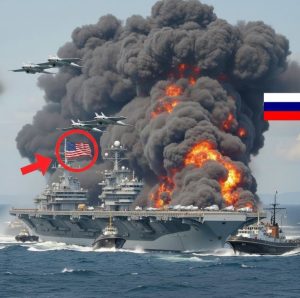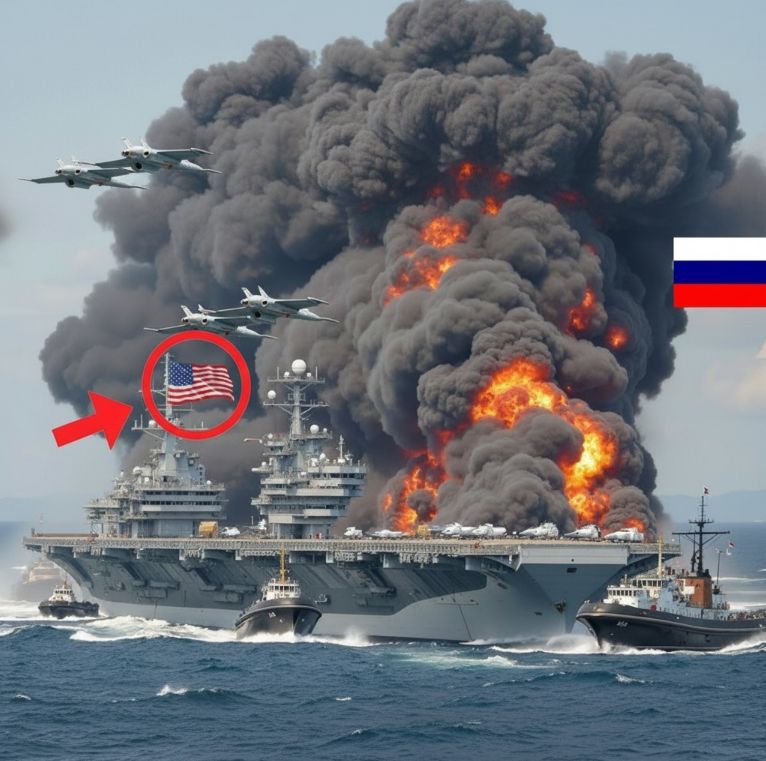
“13 minutes ago: Russian Su-57 pilot destroys U.S. aircraft carrier carrying 500 tanks — ARMA 3”
At first glance, a headline like this sounds urgent, dramatic, and alarming. It combines real-world military hardware, a high-stakes geopolitical scenario, and a sense of immediacy. But once you examine it closely, it becomes clear that this is not a real-world event—it is either a fictional scenario or gameplay footage from a military simulation, specifically Arma 3.
Let’s break down why this claim doesn’t reflect reality.
🎮 The “ARMA 3” clue
The most important detail is actually at the end: ARMA 3. This is a highly realistic military simulation game known for its large-scale battles, modding capabilities, and lifelike environments. Players can create complex combat scenarios involving aircraft, naval fleets, tanks, and coordinated strikes that can look almost indistinguishable from real footage to the untrained eye.
Because of its realism, ARMA 3 has frequently been misused online. Clips from the game are often taken out of context and reposted with captions suggesting they show real-world combat. These videos spread quickly, especially during times of global tension, when audiences are more likely to believe dramatic military developments.
So right away, the presence of “ARMA 3” strongly suggests that what you’re seeing is not real combat, but a simulation or staged scenario inside a game engine.
✈️ The aircraft: Sukhoi Su-57
The Su-57 is Russia’s most advanced stealth fighter, designed for air superiority and precision strike missions. While it is a sophisticated piece of technology, it is not capable of single-handedly destroying a U.S. aircraft carrier—especially not in the dramatic, one-pilot scenario described.
Modern military operations rely on coordination between multiple systems: aircraft, satellites, ships, electronic warfare platforms, and intelligence networks. No single jet operates in isolation to carry out massive strategic attacks against heavily defended targets.
🚢 The target: U.S. aircraft carriers
Aircraft carriers operated by the United States Navy are among the most protected military assets in existence. They function as floating airbases and are always surrounded by a carrier strike group, which includes:
- Guided missile destroyers and cruisers
- Submarines operating below the surface
- Air defense systems capable of intercepting threats at long range
- Fighter jets conducting continuous patrols
For an enemy aircraft to reach a carrier, it would have to evade detection across multiple layers of radar, avoid interception by defensive aircraft, and survive missile defenses—all before even attempting an attack. The idea of a single Su-57 accomplishing this alone is not consistent with how modern naval warfare works.
🛑 The biggest flaw: “500 tanks”
This is where the claim becomes completely unrealistic.
Aircraft carriers do not carry tanks. Their purpose is to launch and recover aircraft. Tanks are transported by entirely different types of vessels, such as amphibious assault ships or dedicated cargo ships.
Even those ships do not carry anything close to 500 tanks. The logistics alone make that impossible:
- Tanks are extremely heavy and require specialized storage
- Transporting hundreds would require multiple large vessels
- Aircraft carriers are not designed for that role at all
So the phrase “carrier carrying 500 tanks” is a clear indicator that the scenario is fictional.
🌍 What would happen if it were real?
If a U.S. aircraft carrier were destroyed—especially by a Russian military asset—it would be one of the most significant global events in decades. The consequences would be immediate and unmistakable:
- Emergency statements from governments worldwide
- Continuous coverage across every major news outlet
- Military forces placed on high alert
- Potential escalation between nuclear-armed powers
- Major disruptions to global markets
There would be no ambiguity, no vague captions, and no reliance on short clips labeled “13 minutes ago.” The entire world would know.
⚠️ Why these posts spread
Content like this spreads because it combines:
- Real military names (Su-57, U.S. Navy)
- High-stakes conflict scenarios
- Visual realism from simulation games
- Urgent language designed to trigger emotional reactions
In times of geopolitical tension, people are more likely to believe and share such content without verifying it.
🧠 Reality vs. simulation
What you’re seeing is most likely:
- A gameplay scenario from ARMA 3
- A fabricated headline built around that footage
- Or a combination of both
It is not a real military event.
✅ Final takeaway
To be absolutely clear:
- There is no verified report of a U.S. aircraft carrier being destroyed
- The claim about “500 tanks” is physically impossible
- The mention of ARMA 3 indicates a simulation, not reality
- The entire scenario is fictional or misleading
In today’s digital world, simulations can look incredibly real—but the difference lies in the details. When those details don’t match reality, the story doesn’t hold up.
If you want, I can show you how to spot ARMA 3 footage instantly so you don’t get fooled again.