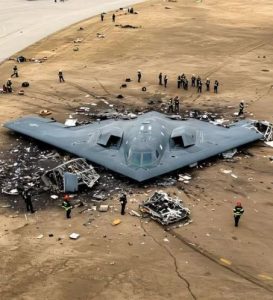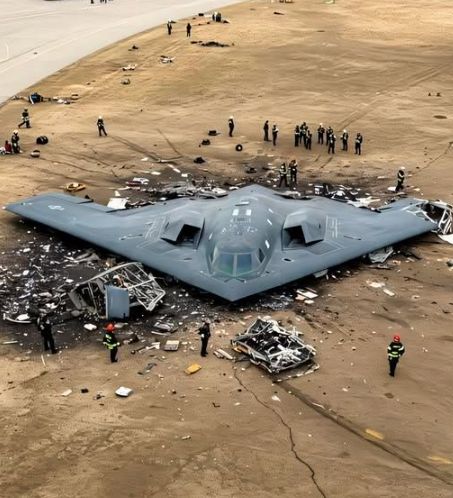
FICTIONAL THRILLER STORY — The B-2 Spirit Was Shot Down…
The following story is fictional and written purely for entertainment purposes.
The sky above the northern ocean was silent.
At 38,000 feet, invisible to the naked eye and nearly undetectable by conventional radar, a B-2 Spirit moved through the darkness like a shadow carved from the night itself.
Known as one of the most advanced aircraft ever built by Northrop Grumman, the stealth bomber had long symbolized technological dominance. Its flying-wing design absorbed radar waves, its engines whispered rather than roared, and its missions were often so secret that even allied governments never learned where it had flown.
But on this night, something went wrong.
The Mission Nobody Knew About
The aircraft, call sign Ghost One, had departed hours earlier from a remote base operated by the United States Air Force.
Officially, no mission existed.
Unofficially, intelligence reports had warned of a newly developed air-defense system rumored to detect stealth aircraft — something long considered nearly impossible.
Ghost One’s assignment was simple: test the threat.
Fly close enough to trigger detection.
Leave before anyone knew it had arrived.
At least, that was the plan.
An Unusual Signal
Inside the cockpit, Commander Daniel Reyes monitored instruments glowing softly in the dim light.
Everything appeared normal.
Radar silent.
No missile locks.
No electronic interference.
Then a faint tone sounded.
Ping.
Reyes frowned.
“Did you hear that?” he asked his co-pilot.
Another tone followed — sharper this time.
Warning indicators flickered briefly, then vanished.
The onboard defense system showed no threats, yet something invisible was tracking them.
For the first time in his career, Reyes felt uneasy inside a machine designed never to be seen.
The Invisible Enemy
Hundreds of miles away, inside a hardened underground facility, operators stared at a massive digital display.
A faint outline glowed on their screen.
Not a clear radar return.
Not a traditional signal.
But a distortion — a gap in atmospheric readings.
They weren’t detecting the aircraft itself.
They were detecting what the aircraft displaced.
Air pressure shifts.
Thermal traces.
Gravity-wave anomalies.
Years of research had produced a revolutionary sensor capable of seeing what stealth technology tried to hide.
And tonight, it worked.
Missile Launch
Back in the cockpit, alarms exploded to life.
MISSILE WARNING.
Reyes’ heart slammed against his ribs.
“That’s impossible,” he said. “We’re stealth.”
Yet the system confirmed it.
A missile had launched.
No radar lock.
No infrared tracking.
Something new.
Something unknown.
Reyes pushed the bomber into an evasive maneuver rarely attempted by such a massive aircraft. The B-2 banked sharply, deploying countermeasures designed to confuse incoming threats.
But the missile didn’t chase heat.
It didn’t chase radar reflection.
It chased prediction.
Artificial intelligence guided it, calculating where the bomber would be seconds into the future.
The Moment of Impact
The crew never saw the missile.
A sudden flash erupted beneath the wing.
The aircraft shuddered violently as shockwaves rippled through the airframe.
Warning lights turned crimson.
Hydraulic pressure dropped.
One engine failed instantly.
Smoke filled sections of the aircraft.
Reyes fought the controls as the bomber began losing altitude.
The impossible had happened.
A stealth bomber had been hit.
The Fight to Survive
Training took over.
Reyes transmitted an encrypted emergency signal while attempting stabilization.
The B-2’s advanced flight systems compensated automatically, redistributing control surfaces to maintain flight.
For several tense seconds, it worked.
Then structural alarms triggered.
Damage spread faster than onboard systems could correct.
“Prepare to eject,” Reyes ordered.
The aircraft shook again, descending toward a cold expanse of ocean far below.
Ejection
At 25,000 feet, the crew activated escape procedures.
Explosive bolts fired.
Canopies separated.
Two ejection seats launched into the night sky.
Moments later, parachutes blossomed open against the darkness.
Below them, the damaged bomber continued forward briefly — a wounded giant refusing to fall — before disappearing into clouds and vanishing from radar forever.
The world’s most advanced stealth aircraft was gone.
Global Shockwaves
Within hours, military command centers across multiple nations detected unusual communications traffic.
Satellite imagery showed rescue operations moving rapidly into a restricted maritime zone.
Rumors spread instantly:
Had stealth technology been defeated?
Defense analysts debated whether a new era of aerial warfare had begun.
If stealth could be tracked, decades of military strategy would change overnight.
The Search Operation
Rescue helicopters located the pilots before dawn.
Cold but alive, they were recovered and flown to safety under heavy escort.
Recovery teams searched relentlessly for wreckage, aware that pieces of the aircraft contained some of the most guarded technological secrets ever created.
The race wasn’t just about finding debris.
It was about preventing anyone else from finding it first.
The Strategic Implications
Experts later concluded that the attack represented a shift in warfare philosophy.
Instead of trying to see stealth aircraft directly, adversaries had learned to observe environmental disturbances created by them.
Stealth had not failed.
But invisibility was no longer absolute.
Military planners began discussing new countermeasures:
- Adaptive flight paths
- Atmospheric masking technology
- Next-generation electronic deception systems
The age of unseen aircraft had entered a dangerous new phase.
The Legacy of Ghost One
Official reports never confirmed the incident publicly.
No headlines announced the loss.
No images appeared online.
Yet within classified briefings, the mission of Ghost One became legendary.
Not as a failure.
But as a warning.
Technology evolves.
Every advantage eventually meets a countermeasure.
And in the silent contest between detection and invisibility, the skies remain a battlefield of innovation.
Epilogue
Months later, engineers studied data recovered from the pilots’ flight recorders.
What they learned reshaped future aircraft design.
The next generation of stealth would not rely solely on hiding.
It would rely on adaptability — aircraft capable of changing signatures in real time.
The fallen bomber became a turning point.
Because sometimes progress is written not in victory…
…but in the lessons learned when the impossible finally happens.