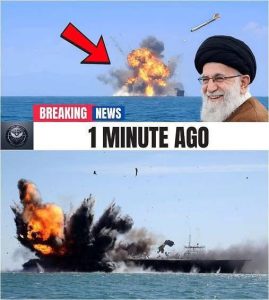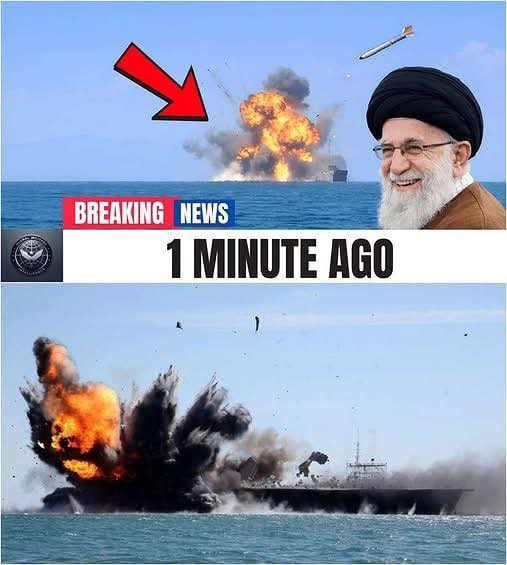
1. No Verified Incident of Iran Sinking a U.S. Aircraft Carrier
Despite viral headlines and dramatic online claims, there is no credible evidence that Iran has successfully attacked — let alone sunk — a U.S. aircraft carrier. What has been confirmed are heightened tensions in the Middle East, U.S. and Iranian military posturing, and incidents involving drones or missile threats near U.S. naval forces — but nothing resembling a carrier strike or sinking event.
Aircraft carriers are among the most heavily defended warships in the world. Modern U.S. carriers like the USS Abraham Lincoln and the USS Gerald R. Ford are accompanied by layered defenses — escort destroyers and cruisers, airborne combat air patrols, advanced radar systems, and point-defense missiles — making them extremely difficult targets for any adversary.
Analysts note that while Iran may have weapons capable of threatening naval assets under specific conditions, the physical destruction of an aircraft carrier is highly unlikely without massive escalation and direct war conditions.
2. What Incident Did Really Happen?
The U.S. military publicly reported an incident earlier this year where an Iranian drone approached a U.S. aircraft carrier and was shot down by U.S. forces. In that engagement:
-
An Iranian drone approached within proximity of the USS Abraham Lincoln carrier strike group in the Arabian Sea.
-
U.S. fighter aircraft shot it down to protect the carrier and nearby assets.
-
There were no casualties and no damage reported to U.S. forces.
This encounter illustrates how tensions can rapidly escalate but also how military engagement does not equate to a successful attack by Iran on a major U.S. warship.
3. Why These Rumors Spread: Misleading Videos and Simulations
One reason misleading narratives like “Iran sank a U.S. aircraft carrier in 32 minutes” spread so fast is because of simulation videos and dramatized content on platforms like YouTube. One such video depicts Iranian warships launching a coordinated attack on the USS Abraham Lincoln and then shows a swift U.S. counterstrike destroying all Iranian ships and bases in under half an hour — but that video is purely fictional. It is a hypothetical military scenario created for entertainment and does not describe a real event.
These simulations mix real military hardware, plausible tactics, and dramatic timelines for effect — which is fine in the context of war-gaming or historical reenactment, but not a source of factual reporting.
4. Context: Real Escalation Between the U.S., Israel, and Iran
Although no carrier has been attacked or sunk, there has been a genuine and dangerous escalation in hostilities this month. Independent reporting confirms:
-
The United States and Israel launched coordinated strikes on Iranian territory, targeting military infrastructure in several cities.
-
Iran responded with missile and drone attacks on U.S. military bases in the region.
-
Multiple countries in the Gulf, including Bahrain, Qatar, and the UAE, were affected by Iranian retaliation against U.S. installations.
-
Saudi Arabia condemned Iran’s actions as violations of international law.
This exchange has dramatically raised tensions and led to the largest U.S. military buildup in the Middle East in decades — including two aircraft carrier strike groups and over 150 aircraft deployed to the region.
5. Why Aircraft Carriers Are Strategic — and Hard to Destroy
Aircraft carriers are not just big ships; they are:
-
Mobile airbases capable of launching dozens of aircraft.
-
Surrounded by destroyers and cruisers with anti-air and anti-missile defenses.
-
Covered by airborne early-warning and combat patrols.
-
Designed with internal compartmentation that limits flooding and damage spread.
Experts note that modern anti-ship missiles alone are typically not sufficient to sink a carrier unless they hit extremely vulnerable systems — and even then, failure is more likely than success due to defensive countermeasures.
6. What Would It Take for Iran to Actually Threaten a Carrier?
Iran has repeatedly talked about developing or acquiring long-range anti-ship missiles — sometimes referred to, in broad terms, as “carrier killers” — and has reportedly explored deals for supersonic anti-ship missiles with China.
But even if Iran were to field such missiles, several factors limit their effectiveness:
-
They would need to evade multi-layered defenses.
-
Modern carriers operate far from coastal waters where such missiles might be more effective.
-
Other naval and air assets would respond before a decisive hit could occur.
In short, the difficulty isn’t just hitting a carrier — it’s hurting it badly enough to sink it. That remains outside verified Iranian capability.
7. So What Does “Everything Was Gone” Refer To?
The dramatic tagline — “32 Minutes Later, Everything Was Gone” — appears to come from fictionalized content or hypothetical military analysis video posts rather than real world events.
There is no authoritative news reporting from credible outlets stating that Iran attacked and destroyed U.S. military assets in such a manner, let alone sank a carrier. The current real conflict involves proxy strikes, missiles fired at bases, and heightened military readiness — not a naval showdown with a sunken warship.
8. What’s Really Happening Right Now?
Right now, verified reporting paints this picture:
-
The U.S. and Israel carried out substantial strikes inside Iran.
-
Iran has retaliated against U.S. bases across the Middle East, prompting condemnation from Gulf states.
-
Military assets, including carriers, jets, and missiles, are in place on both sides, and tensions are high.
-
Civilian airspace in multiple Middle Eastern countries has been restricted due to conflict risk.
None of this means a naval showdown with ship sinkings has occurred — but it does indicate how precarious the current situation is.
9. The Bottom Line
No aircraft carrier has been attacked or sunk by Iran.
There is a very real military escalation involving the United States, Israel, and Iran — including deployed carriers and offensive action — but the dramatic “32-minute” scorecard comes from fictional simulations and internet speculation, not verified events.
The real story is a dangerous clash with global implications — but one grounded in ongoing military and diplomatic tensions, not instant naval destruction.