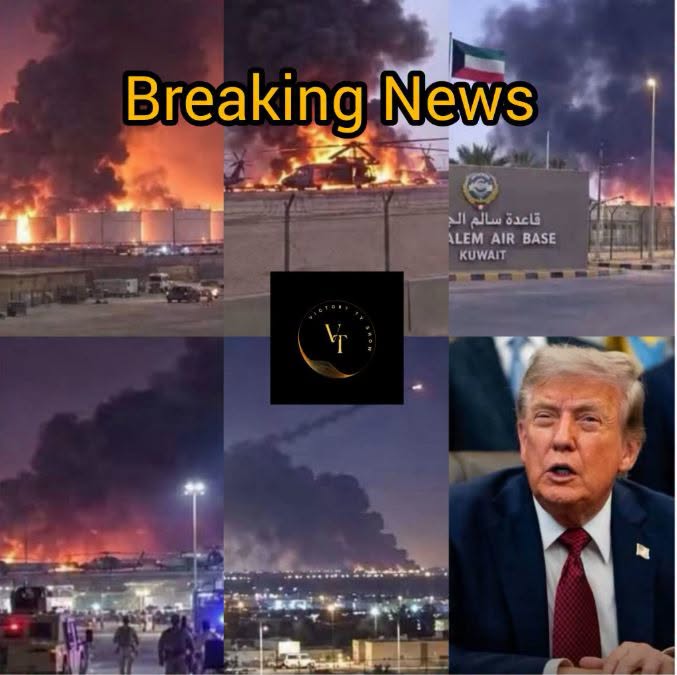
BREAKING: Iran Claims New Drone Strike on U.S. Facilities in Kuwait as Regional War Intensifies
Tensions across the Middle East have entered another dangerous phase after Iran announced that its military had launched a new drone operation targeting U.S. military facilities in Kuwait.
Iranian military officials said the operation targeted American positions at Kuwait’s Ahmed Al Jaber Air Base. Iranian reports described the attack as a retaliatory operation following recent U.S. strikes against targets inside Iran. The development has immediately raised concerns that the conflict could expand even further across the Persian Gulf.
The announcement comes at a particularly tense moment. The United States and Iran have exchanged increasingly serious attacks, while American forces remain deployed at multiple locations throughout the region. Kuwait, Bahrain, Qatar, Iraq and other countries have become increasingly important to U.S. military operations in the Middle East..
For Kuwait, the situation presents an especially difficult challenge. The country hosts American forces but has repeatedly emphasized that its territory should not become a battlefield in the confrontation between Washington and Tehran.
Iran Says the Attack Was Retaliation
According to Iranian military statements, the latest drone operation was intended as retaliation for U.S. attacks against Iranian targets.
Iranian officials have presented the strikes as part of a broader campaign against American military infrastructure in the region. Reports from Iranian sources said drones were used against facilities associated with U.S. forces at the Kuwaiti air base.
Iran has repeatedly warned that American military installations throughout the region could become targets if the United States continues striking Iran.
That threat is significant because the United States maintains a large military presence across the Gulf. American troops, aircraft, logistics facilities and command infrastructure operate from several partner countries.
Kuwait is one of the most important locations.
Why Kuwait Is So Important
Kuwait has long been a major U.S. military logistics hub in the Middle East.
American forces have used facilities in Kuwait to support operations throughout the region, including the movement of troops, equipment, fuel and supplies.
That makes U.S. bases in Kuwait strategically valuable—but it also makes them potential targets during a major conflict with Iran.
The latest Iranian claim follows earlier attacks against American positions in Kuwait. Those incidents have included drone and missile strikes against military facilities and other locations associated with U.S. forces. A congressional report previously described Iranian attacks against U.S. installations in Kuwait, including Camp Buehring and other American-linked facilities.
The repeated attacks demonstrate how difficult it has become to separate the conflict from the countries surrounding Iran.
Drones Change the Battlefield
One of the most important features of the conflict has been the extensive use of drones.
Compared with conventional aircraft or large missile systems, one-way attack drones can be relatively inexpensive and can be launched in significant numbers.
Their use creates a serious challenge for military planners because defending a large military installation requires multiple layers of protection.
Air-defense systems must detect incoming objects, determine whether they represent a genuine threat and then attempt to intercept them before they reach sensitive infrastructure.
Even when defensive systems successfully destroy incoming drones, repeated attacks can force military personnel to remain on constant alert.
The psychological effect can also be significant.
Personnel stationed at military bases know that an attack can arrive with little warning. Sirens, emergency procedures and defensive operations can become part of everyday life.
What Was Damaged?
Iranian sources have claimed that specific military infrastructure was hit or destroyed during recent attacks, including facilities connected with drones and fuel storage.
However, details surrounding the latest operation remain subject to verification.
Independent confirmation of the precise damage, number of drones involved and whether any U.S. personnel were killed or injured may take time.
This is particularly important during an active war because both sides have powerful incentives to present military operations in ways that support their strategic narratives.
Iran may emphasize successful strikes against American facilities.
The United States may emphasize the effectiveness of its defenses.
Neither side’s initial battlefield statement should automatically be treated as the complete picture.
The U.S. Response Will Matter
One of the biggest questions now is how Washington will respond.
The United States has already carried out major strikes against Iranian military targets. Those operations were presented by American officials as attempts to reduce threats to U.S. forces and prevent further attacks.
The Pentagon has also emphasized that American forces remain prepared to defend themselves and U.S. interests throughout the region.
A new attack against American personnel or facilities could therefore produce another U.S. military response.
That creates a dangerous cycle.
Iran attacks U.S. forces.
The United States retaliates against Iran.
Iran responds again.
Each round risks becoming larger than the previous one.
The greatest fear among regional governments is that this cycle eventually becomes impossible to control.
Kuwait Caught in the Middle
Kuwait faces an especially difficult position.
The country is a close U.S. security partner, but it also shares a maritime region with Iran and has strong economic and diplomatic interests in maintaining regional stability.
Kuwaiti territory has already been affected by previous Iranian attacks.
The country’s airport, military facilities and energy infrastructure have faced security threats during the wider conflict.
Kuwaiti officials have repeatedly faced the challenge of protecting their population while avoiding becoming a direct participant in the war.
That balance becomes increasingly difficult when foreign forces operating inside Kuwait are targeted.
Regional Air Defenses Under Pressure
The latest attack also highlights the importance of air-defense systems throughout the Gulf.
Countries including Kuwait, Bahrain, Qatar and the United Arab Emirates have invested heavily in missile and drone defenses, often working closely with the United States.
But defending against repeated attacks is extremely difficult.
A military base can be enormous, containing aircraft, fuel storage, communications equipment, warehouses, radar systems and personnel facilities spread across a large area.
An attacker does not necessarily need to destroy everything.
Even limited damage to a critical piece of infrastructure can disrupt operations.
That is why military officials take drone attacks seriously even when casualties are avoided.
The Risk to Civilians
Although the primary targets may be military facilities, conflicts involving drones and missiles inevitably create risks for civilians.
Kuwait is home to millions of people, and its major population centers are located relatively close to important military and energy infrastructure.
A missile or drone that misses its intended target could fall into a civilian area.
There is also the danger posed by falling debris from intercepted weapons.
Previous incidents across the Gulf have demonstrated that even successful interceptions can leave fragments falling onto roads, buildings or other populated areas.
This is one reason governments throughout the region have urged residents to follow official security instructions and avoid spreading unverified information during attacks.
A Wider War Is Becoming More Likely
The most concerning aspect of the latest development is not necessarily the individual drone attack.
It is what the attack represents.
The battlefield is becoming increasingly regional.
Iran is not only confronting American forces inside Iran. American bases and interests across the Gulf have become part of the confrontation.
At the same time, U.S. forces are operating from several countries that do not necessarily want to become direct participants in the war.
That creates a complicated strategic environment.
Every strike against a U.S. facility can place additional pressure on the government hosting that facility.
Every American response against Iran can increase pressure on neighboring countries.
And every new attack raises the possibility of casualties that could force leaders into even more aggressive decisions.
What Comes Next?
For now, attention will focus on three major questions.
First, how much damage did the latest drone operation actually cause?
Second, were any American or Kuwaiti personnel killed or wounded?
Third, will the United States respond with another major strike against Iran?
Those answers could determine whether the latest incident remains a limited exchange or becomes another step toward a much larger regional confrontation.
The situation is also being watched closely by governments across Europe and Asia because the Persian Gulf is critical to global energy supplies and international shipping.
A prolonged conflict could disrupt oil and gas transportation, increase energy prices and place additional pressure on already fragile global supply chains.
A Dangerous Moment
The Iranian announcement of a new drone operation against U.S. facilities in Kuwait is therefore much more than another battlefield headline.
It is a warning that the conflict is continuing to expand geographically and that American military facilities across the region remain vulnerable to attack.
At the same time, the precise results of the latest operation still require independent confirmation.
What is undeniable is that the stakes are rising.
Kuwait wants to protect its territory.
The United States wants to protect its forces.
Iran wants to demonstrate that American attacks will carry a price.
And every side is attempting to convince its opponents that it will not back down.
That combination makes the current situation exceptionally dangerous.
The coming hours and days could reveal whether this latest drone attack becomes another isolated exchange—or another escalation in a conflict that is already reshaping security across the Middle East.