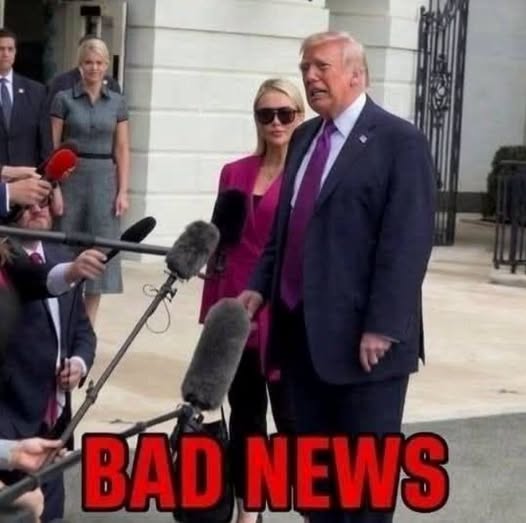
BREAKING: Donald Trump Faces More Bad News as Pressure Builds on Several Fronts
Washington is once again at the center of intense political attention as President Donald Trump faces a fresh wave of challenges and uncertainty. Headlines circulating online have claimed that Trump received “more bad news” just minutes ago, sending supporters, critics, and political observers scrambling for details.
While sensational posts can spread rapidly on social media, the real story is more complicated. Several significant developments are putting pressure on the Trump administration, particularly surrounding foreign policy, the economy, and the continuing political battles in Washington.
One of the biggest issues currently demanding Trump’s attention is the situation involving Iran and the Strait of Hormuz. Recent reports indicate that the United States and Iran remain involved in a tense diplomatic situation, with negotiations surrounding the strategically important waterway. Iran has said that an agreement involving Oman is approaching a final stage, while Trump has continued to speak publicly about the possibility of progress.
For the White House, the situation represents a difficult balancing act.
Trump has repeatedly presented himself as a leader capable of negotiating from a position of strength. But diplomacy in the Middle East can change quickly, and every statement from Washington or Tehran has the potential to affect markets, allies, military planning, and public opinion.
The Strait of Hormuz is particularly important because of its role in global energy transportation. Any prolonged disruption could have consequences far beyond the Middle East, potentially affecting fuel prices, transportation costs, businesses, and household budgets.
That means the administration is under pressure to achieve a diplomatic breakthrough while simultaneously demonstrating that the United States is prepared to respond if negotiations fail.
And that is only one part of the political storm.
Trump is also dealing with continuing legal and political challenges surrounding his administration’s policies. One recent example involves his tariff strategy. Reports indicate that 25 states have challenged the administration’s latest tariffs in court, arguing that the president’s authority to impose them has been restricted by a recent Supreme Court ruling.
A legal battle involving multiple states could become a major test of presidential authority.
For Trump, tariffs have been an important part of his economic and political strategy. He has repeatedly argued that tariffs can protect American industries, encourage domestic production, and force trading partners to make concessions.
Critics, however, argue that tariffs can increase costs for American companies and consumers.
The legal fight therefore has consequences beyond the courtroom. It could determine how much power a future president has to impose broad trade measures without congressional approval.
Meanwhile, political tensions in Washington remain high as lawmakers confront major fiscal and legislative questions. The Senate has been working to avoid a potential government shutdown, adding another challenge for an administration already dealing with international and domestic controversies.
For Trump, congressional cooperation is crucial.
Even with Republicans holding significant influence, disagreements within the party can make major legislation difficult to pass. Conservative lawmakers do not always agree on spending, foreign policy, immigration, trade, or government programs.
That means some of Trump’s most difficult political battles may come not from Democrats but from members of his own political coalition.
The president’s relationship with the economy is another area receiving close attention.
Financial markets have remained sensitive to developments involving tariffs, international conflicts, energy prices, and interest rates. Recent weakness in Asian markets has also highlighted continuing concerns about the global economic environment.
Trump has consistently emphasized economic strength as one of the central achievements of his administration. But maintaining that message becomes more difficult when Americans are worried about prices, gasoline, employment, and the broader cost of living.
This is why even seemingly distant international events can quickly become domestic political problems.
If energy prices rise, consumers notice it at the gas station. If tariffs raise the cost of imported materials, businesses may pass those costs on to customers. If financial markets become nervous, retirement accounts and investments can be affected.
Every economic development therefore carries political consequences.
At the same time, Trump’s communication strategy continues to attract enormous attention. His statements frequently dominate news cycles, sometimes generating immediate reactions from supporters and opponents.
That can be an advantage because it keeps Trump at the center of the political conversation. But it can also create problems when different statements appear to conflict or when negotiations are still developing.
The Iran situation illustrates this perfectly. Trump has expressed optimism about talks while simultaneously warning of serious consequences if an agreement cannot be reached.
That combination of optimism and pressure is characteristic of Trump’s negotiating style.
Supporters see it as evidence that he is using leverage.
Critics see it as dangerous unpredictability.
Either way, the strategy ensures that every presidential statement becomes part of the international conversation.
So, is there really a confirmed piece of “bad news” that arrived exactly 20 minutes ago?
At the time of writing, there is no reliable evidence establishing a single dramatic event matching that exact social-media headline. Instead, several genuine developments are occurring simultaneously, giving political commentators plenty to analyze.
That distinction matters.
In the modern news environment, a headline can travel around the internet within seconds. A dramatic phrase such as “Trump gets more bad news” can attract millions of clicks before anyone has confirmed precisely what happened.
Readers should therefore be cautious about posts that do not identify a specific event, source, date, or official statement.
The larger story is still significant.
Trump is operating in an unusually complicated political environment involving international negotiations, economic uncertainty, court battles, congressional disputes, and intense public scrutiny.
Each individual challenge may be manageable.
The difficulty comes from facing several at the same time.
For now, the White House will likely continue emphasizing negotiations, economic strength, and presidential authority. Trump and his allies will argue that pressure is part of the strategy and that difficult negotiations require toughness.
Opponents will continue questioning whether the administration’s approach is producing the promised results.
And the public will be watching closely.
The next major development could come from Washington, the courts, financial markets, or the Middle East. Until officials confirm a specific breaking event, however, claims that Trump received catastrophic “bad news” just 20 minutes ago should be treated as unverified.
One thing is certain: the political spotlight remains firmly on Donald Trump, and the next headline could change the conversation once again.