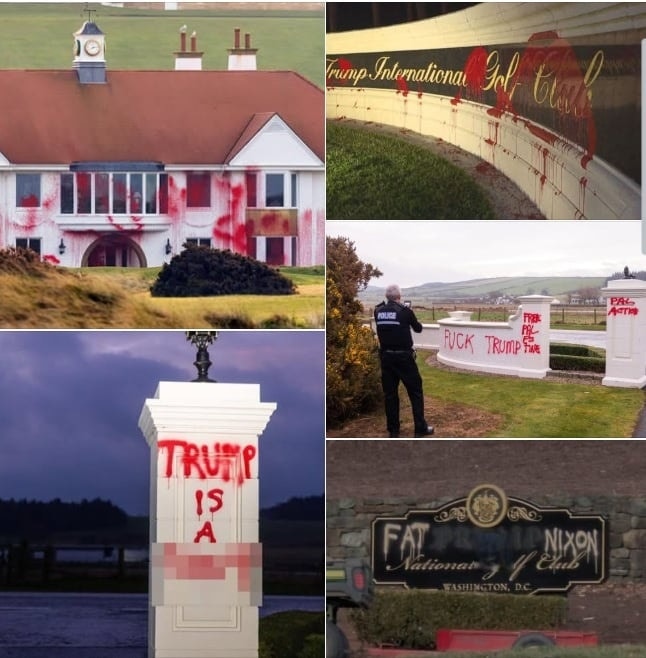
Reports that Donald Trump’s Turnberry property in Scotland was vandalized have drawn renewed attention to the intersection of politics, protest, and private property. The estate in question — widely known as Trump Turnberry — is one of the former president’s most high-profile international holdings and a frequent focal point for demonstrations tied to his political career.
According to local Scottish media accounts in similar past incidents, vandalism at the Turnberry resort has typically involved graffiti, property damage to the golf course grounds, or damage to signage. Police Scotland has historically treated such cases as criminal damage investigations, reviewing CCTV footage and appealing for witnesses. While high-profile political properties often attract protest activity, vandalism remains a criminal offense under Scottish law, regardless of motive.
Turnberry itself is not merely a private residence but a luxury golf resort and hotel located along the Ayrshire coast. It includes championship courses, event spaces, and accommodation that draw international guests. Trump purchased the property in 2014 through the Trump Organization and invested heavily in renovations. Over time, the resort has become both a commercial enterprise and a symbolic political landmark — particularly during Trump’s presidency and subsequent political campaigns.
When incidents of vandalism occur at politically associated properties, reactions tend to divide along familiar lines. Supporters often describe such acts as politically motivated attacks meant to intimidate or silence. Critics may frame them as protest expressions — though even many critics of Trump condemn property destruction as counterproductive or unlawful.
Law enforcement authorities typically emphasize that peaceful protest is protected in democratic societies, but destruction of property crosses a legal boundary. In Scotland, as in much of the United Kingdom, vandalism can result in criminal charges, fines, or imprisonment depending on the severity of the damage.
The broader context is important. Trump’s business interests have long been entwined with his political brand. During his presidency, ethics watchdogs debated whether foreign government officials staying at Trump-owned properties created conflicts of interest. Turnberry occasionally surfaced in political controversies, particularly when U.S. military expenditures at nearby airports were linked indirectly to overnight stays in the region — claims that generated congressional scrutiny at the time.
In Scotland specifically, Trump’s developments have sometimes faced local opposition related to environmental concerns and land use disputes. Protests over coastal erosion, construction projects, and broader political disagreements have occurred intermittently over the years. While most demonstrations were peaceful, the estate has been a lightning rod for activism.
When vandalism happens, it tends to generate headlines far beyond Scotland. That’s because Trump remains a polarizing global figure. For supporters, damage to his property reinforces narratives of political hostility and perceived double standards in media coverage. For opponents, it becomes another flashpoint in the ongoing debate over protest tactics and political expression.
Security experts note that high-profile properties associated with political leaders often require enhanced protection. Even after leaving office, former heads of state may retain security details depending on circumstances. Resorts like Turnberry also maintain private security and surveillance systems to deter trespassing or property damage.
Economically, incidents like this can have ripple effects. Luxury hospitality brands rely heavily on reputation and stability. Even isolated vandalism, if widely reported, can raise questions among international guests. On the other hand, controversy can sometimes increase attention — a paradox common in politically charged branding.
If the vandalism involved graffiti, it’s worth noting that protest graffiti has historically been used as a form of political messaging. From slogans sprayed on walls to symbolic imagery painted on gates, such acts aim to create a visual statement that circulates through photographs and social media. In today’s digital environment, a single image can reach millions within hours.
At the same time, many civil society groups emphasize that destructive protest often undermines broader causes. Peaceful demonstrations, organized rallies, and public debate tend to carry more legitimacy in democratic systems. Property damage can shift focus away from the underlying issue and toward law enforcement response.
In situations like this, authorities typically release limited initial details while investigations are ongoing. Confirmed information may include the time of the incident, type of damage, and estimated cost. Speculation about motives often circulates online before police verify anything.
What remains consistent is that Turnberry, as both a luxury resort and a politically symbolic site, will likely continue to attract attention. Trump’s global profile ensures that events tied to his properties receive international coverage. Whether incidents are minor acts of vandalism or larger organized protests, they become part of the ongoing narrative surrounding his public life.
Ultimately, the story reflects a larger theme in modern politics: the blending of private business, public identity, and political activism. When a property is closely associated with a political figure, it can become a stand-in for that individual in the eyes of critics and supporters alike. That dynamic can intensify reactions far beyond what would occur at an ordinary hotel or golf course.
If you’d like, I can:
- Provide background on the history of Trump Turnberry and its controversies
- Break down how Scottish law handles vandalism cases
- Or write this as a dramatic, narrative-style news feature with eyewitness detail