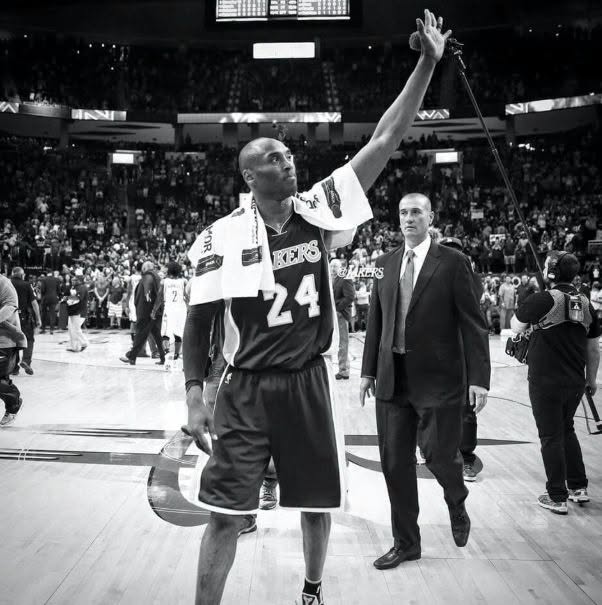
Farewell to a Legend: Kobe Bryant… See More
There are some athletes whose names become larger than the sport they played.
Their careers are remembered through statistics, championships, awards, and unforgettable moments. But every once in a while, an athlete becomes something more. Their determination, personality, discipline, and influence reach far beyond the basketball court.
Kobe Bryant was one of those rare people.
For millions of basketball fans around the world, Kobe was not simply a player. He was an inspiration, a competitor, a storyteller, a father, and a symbol of relentless determination.
His sudden death on January 26, 2020, shocked people across the globe. Kobe was 41 years old. His daughter Gianna and seven others also lost their lives in the helicopter crash in California.
The news was devastating.
For many fans, it felt impossible to believe that someone who had appeared so powerful and determined on the basketball court could suddenly be gone.
Almost immediately, tributes began appearing from athletes, entertainers, coaches, teammates, fans, and ordinary people who had grown up watching him play.
The sadness was enormous because Kobe’s influence had been enormous.
He spent his entire 20-year NBA career with the Los Angeles Lakers, becoming one of the most recognizable players in the history of the franchise.
From his early years as a teenager entering the NBA to his final game, Kobe built a career based on an extraordinary willingness to work.
He became famous for his intense approach to preparation.
He believed that talent alone was never enough.
Practice mattered.
Discipline mattered.
Failure mattered.
Mental toughness mattered.
That philosophy eventually became associated with what many people called the “Mamba Mentality.”
For Kobe, the idea was about approaching challenges with focus, confidence, preparation, and persistence.
It was not simply about basketball.
People began applying the philosophy to school, business, fitness, careers, and personal challenges.
That may be one of Kobe’s greatest legacies.
He showed people that success is not always about being the most naturally gifted person in the room.
Sometimes it is about being willing to work when everyone else has stopped.
Kobe entered the NBA in 1996 as an 18-year-old. He was young, ambitious, and determined to prove himself.
Over the years, he transformed from a talented teenager into one of basketball’s greatest stars.
He won five NBA championships with the Lakers.
He became an 18-time NBA All-Star.
He won the NBA Most Valuable Player Award in 2008.
He earned two Olympic gold medals with Team USA.
And in one unforgettable game in 2006, Kobe scored 81 points against the Toronto Raptors, producing one of the greatest individual scoring performances in NBA history.
But statistics only tell part of the story.
Fans remember the moments.
The difficult shots.
The fourth-quarter comebacks.
The fierce defensive plays.
The celebrations after victories.
The disappointment after losses.
And the way Kobe approached every game as though there was something important at stake.
His competitiveness was legendary.
Opponents knew they were facing someone who would never willingly surrender.
Teammates knew he expected tremendous effort.
Fans knew they might witness something special whenever he stepped onto the court.
Then came the final chapter of his basketball career.
On April 13, 2016, Kobe played his final NBA game.
The Los Angeles Lakers faced the Utah Jazz.
At the age of 37, Kobe delivered one last unforgettable performance, scoring 60 points.
It was an extraordinary ending to an extraordinary career.
When the final buzzer sounded, Kobe thanked the fans and walked away from professional basketball.
But retirement did not mean the end of his ambition.
Instead, Kobe entered a new chapter.
He became increasingly involved in storytelling, creative projects, youth sports, and mentoring.
He founded Granity Studios, a multimedia original-content company designed to tell stories about sports, creativity, and imagination.
In 2018, Kobe won an Academy Award for the animated short film “Dear Basketball,” based on the poem he wrote announcing his retirement from basketball.
That achievement revealed another side of him.
He was no longer simply the athlete people had watched for decades.
He was becoming a creator.
A storyteller.
A mentor.
And a father.
His relationship with his daughters became an especially meaningful part of his later life.
Kobe often spoke proudly about his children and encouraged them to pursue their interests.
His daughter Gianna had developed a deep passion for basketball herself.
Kobe became closely involved in helping her develop as a player and supporting the next generation of young athletes.
For fans who remember Kobe primarily as a basketball superstar, seeing him in that role offered a different perspective.
He was not simply chasing another championship.
He was trying to pass knowledge forward.
He wanted young people to understand the beauty of competition, teamwork, discipline, and confidence.
Then, on January 26, 2020, tragedy struck.
Kobe and Gianna were traveling by helicopter when the aircraft crashed in Calabasas, California.
There were no survivors.
The news spread around the world.
Basketball games were played in his memory.
Players wore his numbers.
Fans gathered at arenas.
Murals appeared in cities.
People shared photographs and memories.
Some who had never watched basketball closely found themselves grieving.
That was the extraordinary reach of Kobe Bryant.
He had become part of popular culture.
His story had become part of people’s lives.
For young athletes, he represented dedication.
For competitors, he represented mental toughness.
For parents, he represented family.
For artists and entrepreneurs, he represented the possibility of building a second chapter after athletic success.
And for basketball fans, he represented the beauty of the game.
Years after his death, conversations about Kobe continue.
Young players still study his footwork.
Coaches still discuss his approach to preparation.
Fans still watch highlights of his greatest games.
People still quote lessons associated with his philosophy.
His influence continues through the people he inspired.
That is what makes a farewell to Kobe Bryant so complicated.
There is sadness because his life ended far too soon.
But there is also gratitude.
Gratitude for the performances.
Gratitude for the championships.
Gratitude for the lessons.
Gratitude for the inspiration.
And gratitude for the memories.
Kobe’s career reminds us that greatness is not created in a single moment.
It is built through thousands of ordinary moments — early mornings, difficult practices, mistakes, losses, criticism, recovery, and the decision to keep going.
His story also reminds us that life is bigger than professional achievement.
After basketball, Kobe continued searching for ways to create, teach, and inspire.
That part of his story deserves to be remembered just as strongly as his basketball accomplishments.
Today, when people say goodbye to Kobe Bryant, they are not simply saying goodbye to a basketball player.
They are remembering a competitor who pushed himself beyond ordinary limits.
They are remembering a father who loved his daughters.
They are remembering a storyteller who discovered a new creative world.
They are remembering an athlete whose influence crossed borders and generations.
And they are remembering a man whose life, although tragically short, left an extraordinary mark.
The final lesson may be the simplest one.
Work hard.
Love your family.
Respect your craft.
Learn from failure.
Help others.
And never take tomorrow for granted.
Kobe Bryant’s basketball career eventually ended, but his impact did not.
The jerseys remain.
The photographs remain.
The highlights remain.
The stories remain.
And most importantly, the inspiration remains.
Farewell, Kobe.
Thank you for the memories.
Thank you for the competition.
Thank you for showing millions of people what relentless determination can look like.
Legends leave the court.
But their influence can continue long after the final buzzer.