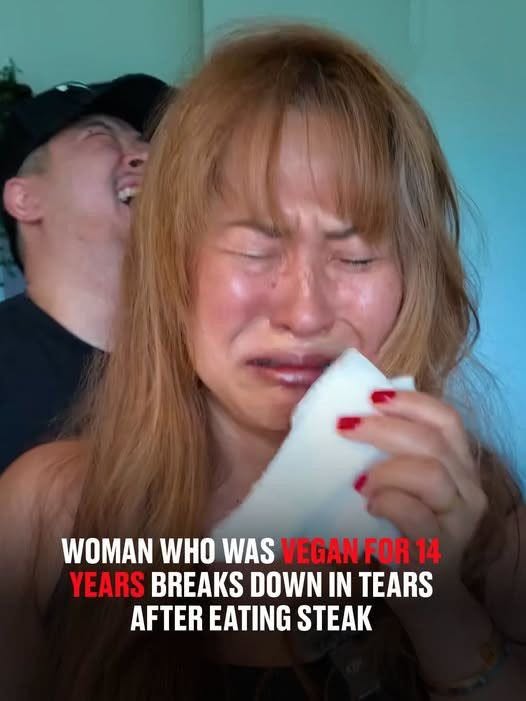
Woman Who Was Vegan for 14 Years Breaks Down in Tears After Eating Steak
For 14 years, she had made a decision that shaped almost every part of her daily life. She carefully checked ingredient labels, avoided meat and animal products, learned how to prepare plant-based meals, and built a lifestyle around the belief that going vegan was the right choice for her.
Then, one day, she ate steak.
What happened afterward was not simply about food. For her, that single meal appeared to bring years of emotions, beliefs, memories, and personal decisions rushing to the surface. She reportedly became overwhelmed and broke down in tears, creating a moment that left many people wondering what could possibly make one meal feel so emotionally powerful.
The story has since become the kind of conversation that quickly spreads online because it touches on something much bigger than whether someone should or should not eat meat.
It raises questions about identity, personal choices, changing beliefs, and the complicated emotions people can experience when they make a decision that seems to contradict a lifestyle they have followed for years.
Fourteen Years Is a Long Time
Fourteen years is enough time for a dietary decision to become part of someone’s identity.
For many people who follow a vegan lifestyle, being vegan isn’t simply about removing meat from their plate. It can involve ethical beliefs, environmental concerns, personal values, animal welfare, health considerations, or some combination of these motivations.
Over such a long period, routines become automatic.
You know which restaurants have suitable options. You know which ingredients to avoid. You learn alternative ways to prepare familiar foods. You develop favorite recipes and perhaps introduce friends and family to your lifestyle.
Eventually, checking a menu or choosing groceries may become second nature.
That’s why suddenly eating steak after 14 years could carry an emotional weight that has little to do with taste alone.
It could represent a dramatic departure from something the person has spent more than a decade practicing.
The First Bite
Imagine sitting in front of a plate containing something you haven’t eaten in 14 years.
The smell is familiar, but distant. The appearance may bring back memories from before your lifestyle changed. At the same time, you may be thinking about all the reasons you stopped eating meat in the first place.
Then you take the first bite.
For some people, the experience might simply be surprising.
For others, it could be deeply emotional.
Taste memories can be remarkably powerful. Food is closely connected with childhood, family traditions, celebrations, holidays, relationships, and personal history.
A single flavor can unexpectedly bring back memories that haven’t been experienced for years.
That emotional response can be difficult to predict.
Why Would Someone Cry?
There isn’t one universal explanation for an emotional reaction like this.
Someone might cry because they feel guilty. Someone else might cry because they are relieved. Another person could experience nostalgia, confusion, regret, happiness, or simply the shock of realizing that their relationship with food has changed.
Sometimes several emotions appear at the same time.
For someone who has been vegan for 14 years, eating steak could create an internal conflict.
One part of the person might remember why they became vegan.
Another part might remember enjoying meat before that decision.
The experience could bring those two versions of themselves into the same moment.
That doesn’t necessarily mean the person has rejected veganism or decided to abandon their principles permanently.
It may simply mean that the experience was emotionally significant.
Food Choices Can Be Personal
Dietary decisions are often discussed as if they are simple mathematical equations.
People ask:
“Is this healthy?”
“Is this unhealthy?”
“Should people eat meat?”
“Should everyone become vegan?”
But real people’s relationships with food are rarely that simple.
Food can be connected to culture, family, finances, health, religion, ethics, convenience, taste, social life, and personal beliefs.
One person’s decision doesn’t automatically have to become another person’s decision.
A person who chooses veganism deserves the freedom to make that choice.
Likewise, someone who decides to introduce animal products into their diet deserves the ability to make that decision without automatically being reduced to a stereotype.
The emotional story surrounding this woman demonstrates how complicated food choices can become when they are connected to personal identity.
The Internet Quickly Takes Sides
Whenever a story like this appears online, reactions tend to divide quickly.
Some people may respond with sympathy.
They might say that 14 years is a long time and that changing one’s diet can naturally bring complicated feelings.
Others may celebrate the decision, seeing the experience as evidence that someone can reconsider an old belief.
Still others may criticize the choice, particularly if they believe the person’s original ethical reasons for avoiding animal products remain important.
Social media can turn an intensely personal moment into a public debate within minutes.
A person may share an emotional experience expecting a small audience, only to discover that thousands or millions of strangers are discussing it.
That can be overwhelming in itself.
Changing Your Mind Doesn’t Erase Your Past
One of the most important lessons from stories like this is that changing your mind doesn’t necessarily mean your previous choices were meaningless.
People change.
Their circumstances change.
Their priorities change.
Their understanding of themselves can change.
Someone can follow a particular lifestyle sincerely for 14 years and later decide that it no longer fits them.
That doesn’t automatically mean they were dishonest during those 14 years.
Likewise, someone can experiment with a different diet without needing to immediately define their entire future.
Life is rarely a straight line.
People try things, learn, reconsider, and sometimes return to old habits.
The Emotional Side of Nostalgia
For some people, meat can be associated with powerful memories.
Maybe steak reminds them of family dinners.
Maybe it reminds them of a restaurant they visited with someone they loved.
Maybe it brings back memories from childhood.
Maybe it reminds them of a time before their life changed dramatically.
When a person hasn’t experienced a particular taste for more than a decade, encountering it again can feel strangely familiar and unfamiliar at the same time.
That contradiction can produce a strong emotional response.
It is not necessarily about the steak itself.
It can be about everything the steak represents.
Health Is a Separate Question
It is also important not to turn one emotional experience into a universal health claim.
One person enjoying steak doesn’t prove that everyone needs to eat meat.
Likewise, one person’s long-term vegan lifestyle doesn’t automatically establish that everyone should become vegan.
Dietary needs vary from person to person.
Anyone making a major dietary change should consider their individual nutritional needs and, when appropriate, speak with a qualified healthcare professional or registered dietitian.
Emotional reactions are not medical evidence.
They are personal experiences.
That distinction matters, especially when viral stories become the basis for sweeping claims about nutrition.
The Bigger Story Is About Identity
Perhaps the most fascinating part of this story isn’t the steak at all.
It’s the question of what happens when a person does something that conflicts with an identity they have carried for years.
Imagine telling people for more than a decade:
“I am vegan.”
You build routines around that statement.
You may have friends who know you as the vegan person.
You may have defended the lifestyle in conversations.
You may have made sacrifices because you believed strongly in it.
Then suddenly, you find yourself doing something you once avoided.
That can create an identity crisis, even if the action itself seems simple to someone watching from the outside.
A Single Meal Doesn’t Define a Person
Whether the woman continues eating meat, returns to veganism, adopts a vegetarian diet, or finds another approach entirely is ultimately her decision.
One meal does not have to determine the rest of her life.
That’s another important lesson.
People sometimes feel pressure to make permanent declarations after making a temporary change.
But life doesn’t always require an immediate answer.
Someone can explore their feelings.
They can ask why they reacted emotionally.
They can reconsider their values.
They can learn more about nutrition.
And they can decide what works for them.
Why This Story Resonates
The reason stories like this attract so much attention is that many people understand the experience of changing their minds.
Maybe it was a career.
Maybe it was a relationship.
Maybe it was a belief.
Maybe it was a lifestyle choice.
Most people have experienced some moment when the person they once were didn’t perfectly match the person they were becoming.
That transition can be uncomfortable.
It can also be liberating.
And sometimes, it can be emotional.
The woman who spent 14 years avoiding meat and then broke down after eating steak may have experienced one of those moments.
Whether the tears represented guilt, nostalgia, relief, conflict, or several emotions at once, they remind us that food can carry meaning far beyond nutrition.
The Takeaway
Ultimately, the story isn’t really about convincing people to eat steak or convincing people to remain vegan.
It’s about recognizing that personal choices can become deeply connected to identity.
Fourteen years is a significant portion of someone’s life. Changing something that has been part of one’s daily routine for that long can naturally produce unexpected emotions.
The most reasonable response may therefore be curiosity rather than judgment.
What was she feeling?
What memories came back?
Why did that particular moment affect her so strongly?
And what does she want to do next?
Those questions are more interesting than simply asking whether steak is “good” or “bad.”
Because behind every viral food story is a real human being trying to understand their own choices.
And sometimes, the most surprising part isn’t what is on the plate.
It’s what the experience makes us feel.