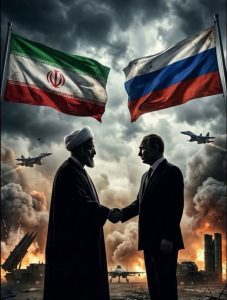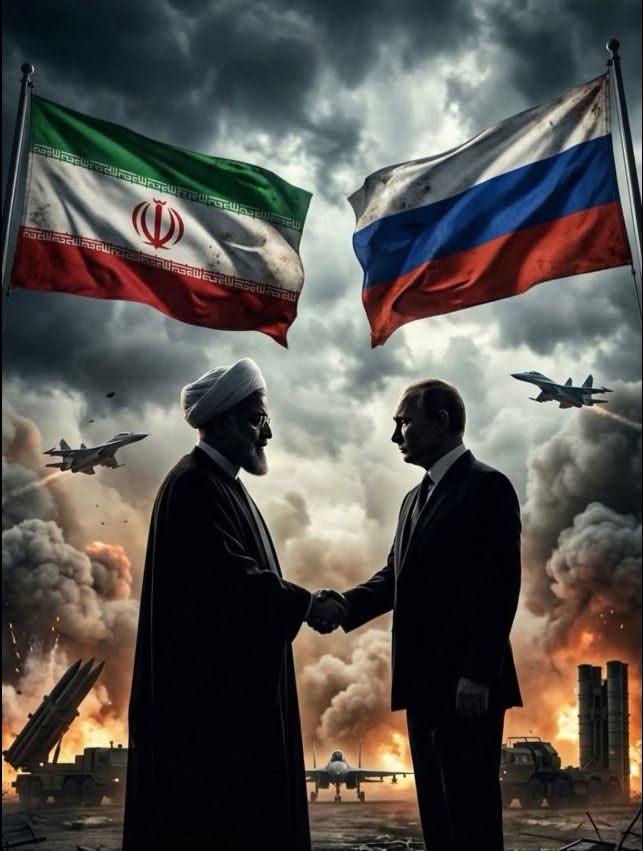
The image above presents a dramatic and highly symbolic scene: the flags of Iran and Russia dominate a dark, storm-filled sky while two powerful-looking figures stand face to face, shaking hands. Behind them, military aircraft, missile systems, smoke, fire, and destroyed-looking landscapes create an atmosphere of war and uncertainty. Although the picture appears designed to communicate a political message, it is important to recognize that such an image may be symbolic or digitally generated rather than a literal photograph of an actual event.
At first glance, the most noticeable elements are the two flags. On the left is the Iranian flag, with its green, white, and red horizontal bands and the emblem of the Islamic Republic in the center. On the right is the Russian tricolor, featuring white, blue, and red. The flags are positioned high above the two figures, almost as if they represent the governments or nations standing behind them. Their large size immediately draws attention to the relationship between the two countries.
Below the flags, the two figures are shown shaking hands. One figure is dressed in clothing associated with Iran’s political and religious leadership, while the other is portrayed in a dark formal suit and resembles a senior Russian political figure. The handshake is one of the strongest visual symbols in the composition. It suggests cooperation, diplomacy, partnership, or an agreement between two sides.
However, the background tells a very different story.
Instead of showing a peaceful diplomatic setting, the image places the handshake against a battlefield filled with smoke, fire, aircraft, missile systems, and military equipment. This contrast appears intentional. The artist is likely trying to communicate the idea that political alliances can have consequences far beyond a conference room or diplomatic meeting.
The dark clouds above the scene contribute to the feeling of danger. The sky is filled with heavy gray and black clouds, while bright light breaks through in the center. This creates a cinematic atmosphere, almost like a poster for a political thriller. The lighting makes the handshake appear especially significant, suggesting that the relationship between the two figures is occurring at a moment of serious international tension.
Military aircraft appear on both sides of the composition. Their presence reinforces the theme of military power and conflict. At the bottom of the image, missile-launching equipment and other military vehicles can also be seen. Smoke rises in the distance, while orange flames appear near the horizon. Together, these details create the impression of an active war zone.
Yet viewers should be careful about interpreting every detail literally.
Images like this are frequently created for social media because they are visually powerful and capable of generating strong emotional reactions. A dramatic image showing national flags, political leaders, aircraft, missiles, and explosions can quickly make people believe that an important event has just happened. But the appearance of an image does not prove that the scene actually occurred.
In particular, the handshake portrayed here should not automatically be treated as evidence of a real meeting. The composition looks highly stylized, with exaggerated lighting, dramatic clouds, carefully positioned military equipment, and a cinematic atmosphere. These characteristics are common in digitally created political artwork and AI-generated imagery.
The larger message of the image appears to concern the relationship between Iran and Russia. Both countries have developed significant political and strategic ties over the years, particularly in areas involving defense, energy, regional security, and international diplomacy. Their relationship has attracted considerable attention because developments involving either country can have consequences for wider international politics.
Iran occupies an important strategic position in the Middle East, while Russia is a major military and political power with influence extending far beyond its immediate region. Because of this, cooperation between the two countries is often watched closely by governments, analysts, journalists, and the public.
The image therefore uses visual symbolism to simplify a complicated geopolitical relationship. Instead of presenting lengthy explanations about diplomacy, military cooperation, economic interests, and regional politics, it communicates everything through a single handshake.
That handshake can be interpreted in several ways.
For some viewers, it may represent strategic cooperation. For others, it may symbolize a partnership that concerns Western governments and neighboring countries. Another interpretation is that the handshake represents the broader reality of international politics, where countries sometimes cooperate because their interests overlap even when their governments have different priorities or histories.
The military background adds another layer to the message. It suggests that diplomacy and military power are often connected. Nations may negotiate while simultaneously preparing for possible conflicts. They may build alliances, purchase military equipment, share intelligence, or conduct exercises while publicly emphasizing diplomatic solutions.
This does not mean that every partnership inevitably leads to war. In fact, diplomacy can sometimes reduce tensions precisely because countries have channels through which they can communicate. But the image deliberately emphasizes the darker possibility: that international alliances can become important during periods of conflict.
The fire and smoke in the background are perhaps the most emotionally powerful elements. They represent destruction, uncertainty, and the human cost associated with warfare. Even though no individual victims are visible in the picture, the destruction implied by the smoke and explosions reminds viewers that military conflicts are not merely political games.
Behind every aircraft, missile, or battlefield strategy are ordinary people whose lives can be dramatically affected.
Families can be separated. Cities can be damaged. Businesses can disappear. People can be forced from their homes. Soldiers can lose their lives, while civilians can suffer injuries, displacement, and fear. This is why political images depicting war should be viewed critically rather than simply shared because they appear dramatic.
The image also demonstrates how powerful visual storytelling can be. Without using a single sentence, it communicates several ideas at once: Iran, Russia, political cooperation, military power, conflict, danger, and uncertainty.
The composition is especially effective because the figures are placed in the center. The flags are above them, while the battlefield is behind them. This creates three visual levels. At the top are the nations and their symbols. In the middle are the political figures and their relationship. At the bottom and in the background are the military consequences.
The viewer’s eyes naturally move between these three levels, creating a story without words.
Still, the most responsible way to understand such an image is to separate symbolism from verified information. A dramatic photograph or graphic should not be treated as proof of a political event unless reliable reporting confirms what it depicts. Social media posts can easily combine real people, fictional backgrounds, old photographs, AI-generated imagery, and sensational captions.
This is particularly important when the subject involves war or international conflict. False claims can spread extremely quickly when people are frightened or angry. A striking picture can receive thousands of shares before anyone checks whether it represents a genuine event.
The image therefore works best as a visual representation of geopolitical tension rather than as standalone evidence of a specific military or diplomatic development.
Ultimately, the picture raises a broader question about the relationship between diplomacy and conflict. The handshake suggests cooperation, while the battlefield suggests confrontation. The flags represent national interests, while the smoke represents the consequences that can follow when political tensions escalate.
That contradiction is what makes the image so striking.
It reminds viewers that international relations are rarely simple. Countries can cooperate in one area while disagreeing in another. They can negotiate peace while preparing for security threats. They can form partnerships based on shared interests without necessarily sharing the same worldview.
The most important lesson is therefore not simply to look at the handshake and assume that it tells the whole story. Look at the entire picture, consider what is symbolic, and then seek reliable information before accepting any claim associated with it.
In an age when realistic-looking digital images can be created and distributed within minutes, visual literacy has become increasingly important. A powerful picture can start a conversation, but evidence is what should determine whether the story behind it is true.
This image succeeds at creating a sense of drama, uncertainty, and geopolitical tension. Its flags, handshake, aircraft, missiles, smoke, and dark sky combine to produce a powerful visual narrative. But its real value may be in encouraging viewers to think critically about how political stories are presented—and to remember that the most dramatic image is not always the most accurate account of reality.