**A Positive Attitude Brings Much Gratitude: Making Positivity a Daily Habit**
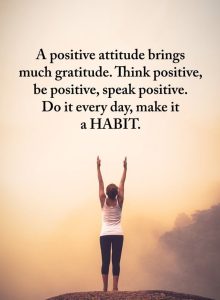
A positive attitude is not merely a pleasant mood that comes and goes with the weather. It is a deliberate choice, a quiet decision made in the early hours of the morning and carried through every interaction, setback, and small victory of the day. The image of a woman standing on a rocky outcrop, arms stretched wide toward a soft golden sky, captures this truth perfectly. She is not celebrating a finished race or a sudden miracle. She is simply open—open to the light, open to possibility, open to the quiet power that comes from choosing how to see the world. The words above her declare: “A positive attitude brings much gratitude. Think positive, be positive, speak positive. Do it every day, make it a HABIT.” These sentences are not decorative. They are a practical map.
Gratitude is the first and most immediate gift of a positive attitude. When the mind is trained to notice what is working rather than what is missing, the world changes shape. A cup of coffee becomes more than caffeine; it becomes a moment of warmth. A delayed train becomes a chance to breathe. A difficult conversation becomes an opportunity to practice patience. This is not denial. It is selective attention with purpose. The brain, left to its own devices, is wired for threat detection. It scans for danger, for lack, for the next problem. A positive attitude does not silence that alarm system; it simply refuses to let the alarm be the only sound in the room. Over time, the nervous system learns a new pattern: look first for what can be appreciated. The result is a steady accumulation of gratitude that feels less like forced optimism and more like a natural state.
Thinking positive is the quiet work done before the day begins. It is the decision, made while still in bed or standing at the kitchen counter, to interpret events through a lens of possibility rather than catastrophe. This does not mean pretending everything is fine when it is not. It means asking better questions. Instead of “Why does this always happen to me?” the question becomes “What is still within my control?” or “What can I learn from this?” The difference is subtle but cumulative. One set of questions keeps the mind circling the same drain of frustration. The other set opens small doors. Over weeks and months those doors add up to a different life.
Being positive is the next layer. It is the way the body and face and voice carry the decision that was made in private. Posture softens. The voice loses its edge. Eye contact becomes warmer. People notice. They may not be able to name what has changed, but they feel safer in the presence of someone who has decided not to add to the ambient anxiety of the world. Being positive is not performance. It is congruence. The internal choice and the external expression begin to match, and that matching produces a quiet confidence that others find steadying.
Speaking positive is the most visible and therefore the most powerful of the three practices. Words are not neutral. They shape the emotional climate of every room they enter. A complaint spoken lightly can still lower the temperature. A word of encouragement, even when it feels awkward, raises it. Speaking positive does not require constant cheerfulness. It requires honesty without unnecessary harshness. It means choosing language that leaves the other person with more energy rather than less. It means refusing to rehearse grievances in conversation simply because the grievance feels justified. Over time, the people around a positive speaker begin to mirror the tone. Families change. Workplaces change. The speaker changes most of all, because the brain believes what the mouth repeatedly says.
The final instruction in the quote is the most important: do it every day and make it a habit. Motivation is unreliable. It arrives like a guest and leaves without notice. Habit is the architecture that remains when the guest is gone. The woman on the rock did not arrive there by accident. Somewhere in her past she decided that raising her arms toward the light was more useful than folding them against the cold. She practiced that decision until it became automatic. The same is true for any of us.
Building the habit begins with small, almost invisible actions. One sentence of gratitude written before sleep. One deliberate choice to interpret a setback as data rather than doom. One conversation in which a complaint is replaced with a constructive observation. These actions feel insignificant on the day they are performed. Their power appears only in aggregate. After thirty days the mind begins to expect the positive frame. After ninety days it starts to prefer it. After a year the old patterns of complaint and resignation feel foreign, like clothes that no longer fit.
There will be days when the habit feels impossible. Grief arrives. Exhaustion settles in. The news is relentless. On those days the practice shrinks to its smallest viable form: one breath taken with awareness, one sentence spoken without bitterness, one moment of noticing that the sky is still beautiful even when the heart is heavy. The habit is not broken by imperfect days. It is strengthened by the decision to return.
The gratitude that follows a sustained positive attitude is not the shallow kind that ignores suffering. It is the deeper kind that can hold both the beauty and the pain without collapsing into either. It is the gratitude that says, “This is hard, and I am still here, and the light is still reaching me.” That kind of gratitude is resilient. It does not depend on perfect circumstances. It grows in the middle of imperfect ones.
The image of the woman with arms raised is not a fantasy of endless success. It is a portrait of orientation. She is facing the light on purpose. The mist and the distant trees and the soft glow are not the point. The point is the posture. Anyone can adopt that posture in their own life—not on a mountaintop necessarily, but in the ordinary rooms where most of life actually happens. The kitchen at dawn. The desk at midday. The quiet of evening when the day is being reviewed.
A positive attitude, practiced daily until it becomes habit, does not guarantee an easy life. It guarantees a life that is more fully inhabited. It turns ordinary days into material for gratitude. It turns setbacks into teachers. It turns the simple act of speaking into an act of quiet creation. The woman on the rock already knows this. The rest of us are still learning. The learning is available every morning, with every thought, every action, and every word. The only requirement is to begin again, and then again, until the beginning itself becomes the habit.