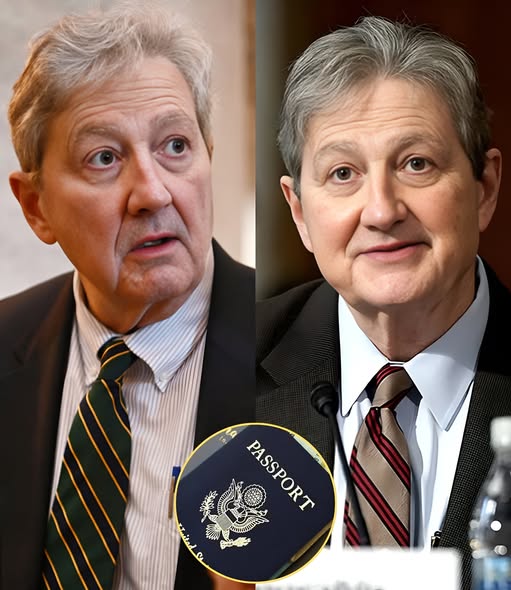
In a move that has already ignited fierce constitutional debate, John Neely Kennedy unveiled what he described as a “groundbreaking and clarifying” bill aimed at redefining eligibility standards for America’s highest offices. The proposal would limit both the presidency and seats in Congress to individuals born on American soil — a sweeping change that, if enacted, would alter long-standing interpretations of citizenship and constitutional law.
Standing before reporters on Capitol Hill, Kennedy framed the measure as a matter of national sovereignty and public trust.
“This country was founded on the principle that its leaders answer to the American people,” he said. “If you’re going to write our laws or serve as commander-in-chief, you should have been born here — raised here — shaped by this country from day one.”
The proposal immediately set off a storm of commentary from legal scholars, civil rights advocates, and lawmakers across the political spectrum.
A Constitutional Earthquake
Under the current framework established by the United States Constitution, eligibility rules differ depending on the office. Article II requires that a president be a “natural-born citizen,” at least 35 years old, and a resident of the United States for 14 years. However, for Congress, Article I requires only that a member be a citizen for a certain number of years — seven for the House and nine for the Senate — along with age and residency requirements.
Kennedy’s proposal would fundamentally change that balance by adding a birthplace requirement not only to the presidency but also to both chambers of Congress.
Constitutional experts point out that such a change would require a constitutional amendment — a process demanding approval by two-thirds of both the House and Senate and ratification by three-fourths of the states. It is one of the most difficult legislative paths in American governance.
Supporters argue that difficulty does not mean impossibility.
“This isn’t about shutting people out,” one of Kennedy’s senior aides said. “It’s about reinforcing clarity. The Constitution was written in a different era. We need to modernize its language to remove ambiguity and protect national loyalty.”
The “Natural-Born” Debate Revisited
The phrase “natural-born citizen” has sparked political controversy for decades. During the 2008 presidential race, questions arose regarding Barack Obama and conspiracy theories about his birthplace. In 2016, similar scrutiny was directed at Ted Cruz, who was born in Canada to an American mother. Legal scholars widely agreed that Cruz met constitutional requirements because he was a U.S. citizen at birth.
Kennedy’s proposal appears to eliminate that interpretive space entirely by requiring physical birth on U.S. soil — regardless of parental citizenship status abroad.
Critics argue that such a standard would exclude not only immigrants but also Americans born overseas to military families, diplomats, and aid workers.
“It would mean a child born to two American soldiers stationed abroad couldn’t grow up to be president or serve in Congress,” said one constitutional law professor at Georgetown University. “That raises profound fairness concerns.”
Supporters Call It a Matter of Loyalty
Kennedy, however, frames the bill as a patriotic safeguard rather than an exclusionary measure. He frequently references America’s founding ideals and the importance of shared civic experience.
“Our founders worried deeply about foreign influence,” he said during his announcement. “They debated it extensively. This proposal simply ensures that the people who lead this nation have no divided birthplace loyalties.”
Some supporters argue that in an era of globalized citizenship and dual allegiances, stricter eligibility rules could prevent foreign interference in domestic politics. They point to growing tensions with global rivals and increased concerns about cybersecurity, espionage, and political infiltration.
“There’s nothing radical about saying the president should be born here,” one advocacy group leader stated. “In fact, most Americans assume that’s already the case.”
Critics Warn of Dangerous Precedent
Opponents see the proposal as symbolic politics that risks undermining America’s immigrant identity. They note that the United States has long prided itself on being a nation defined by ideals rather than birthplace.
“Birth location does not determine loyalty,” said a House member responding to the bill. “Naturalized citizens serve honorably in our armed forces, run businesses, and contribute in every conceivable way.”
Historically, immigrant leadership has shaped the nation at every level. While the presidency remains restricted to natural-born citizens, Congress has included many naturalized members who played critical roles in shaping policy.
Civil liberties groups warn that rewriting eligibility requirements could send a message that naturalized citizens are somehow less American.
Political Reality Check
Even many Republicans privately acknowledge that the bill faces steep odds. Constitutional amendments rarely succeed without overwhelming bipartisan support. The last ratified amendment — the 27th — took more than 200 years to achieve approval.
Some analysts interpret Kennedy’s move less as a legislative strategy and more as a statement of values aimed at energizing voters who prioritize national identity and sovereignty.
“It’s a message bill,” said a political strategist. “It’s about drawing a philosophical line.”
A Broader Cultural Debate
At its core, the proposal taps into a broader national conversation: What defines American identity in the 21st century? Is it birthplace? Citizenship status? Shared belief in democratic principles?
The founders themselves debated foreign influence extensively during the Constitutional Convention. While they ultimately imposed a natural-born requirement for the presidency, they allowed more flexibility for Congress.
Kennedy’s proposal reopens that historical question in a modern context shaped by global mobility, dual citizenship, and complex family histories.
For some Americans, the bill represents a reaffirmation of national boundaries in an era of blurred lines. For others, it signals retreat from a long tradition of immigrant inclusion.
What Happens Next?
The bill will likely be referred to committee, where hearings could explore constitutional scholarship, historical precedent, and comparative international standards. Other countries have varying eligibility rules, but few democracies impose as strict a birthplace requirement as Kennedy proposes.
Whether the measure advances or stalls, it has already accomplished one thing: it has forced a renewed examination of constitutional language many Americans rarely consider.
As the debate unfolds, the nation may once again confront a defining tension in its history — balancing security and sovereignty with openness and opportunity.
In the end, Kennedy’s proposal may not become law. Constitutional amendments are notoriously difficult. But by introducing it, he has placed a fundamental question before the American public:
Should leadership be defined by birthplace — or by allegiance to the principles that define the United States?
The answer, as always in a democracy, will ultimately rest not with one senator, but with the people and the constitutional process they choose to uphold.