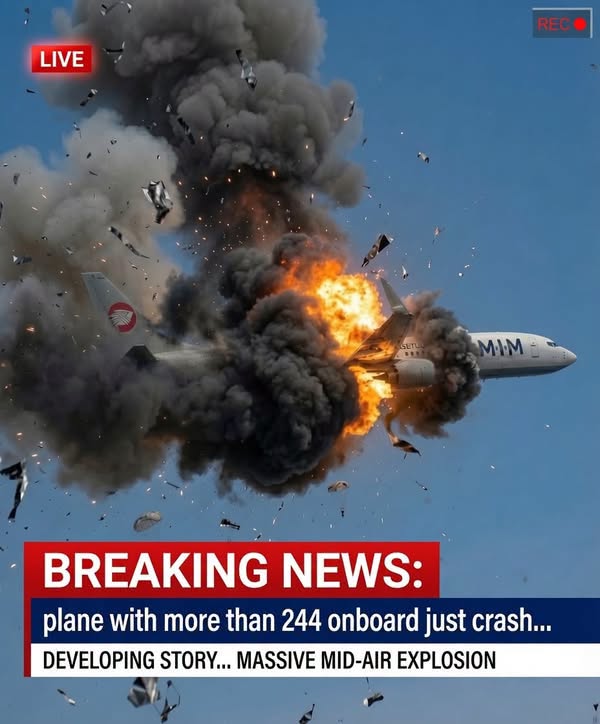
Breaking News: Plane Carrying More Than 240 People Crashes Shortly After Takeoff
A devastating aviation tragedy unfolded in Ahmedabad, India, when an Air India passenger aircraft carrying more than 240 people crashed just minutes after taking off, sending shock waves through communities in India and around the world.
The aircraft, Air India Flight AI171, was traveling from Ahmedabad toward London Gatwick when it went down shortly after departure. According to reports from the time, the Boeing 787-8 aircraft had 242 passengers and crew members listed by the airline, while an Indian aviation official initially gave a figure of 244 people aboard.
The flight departed Ahmedabad at approximately 1:38 p.m. local time. Only a few minutes later, the aircraft crashed into an area near the airport, striking buildings in the Meghani Nagar neighborhood. Witnesses described seeing a massive cloud of smoke rising above the city as emergency crews rushed toward the scene.
The aircraft was a Boeing 787-8 Dreamliner, a modern wide-body passenger jet used by airlines around the world for long-distance flights. The crash was especially shocking because the 787 had become one of the most recognizable long-haul aircraft in commercial aviation.
As news of the disaster spread, firefighters, police officers, medical teams, and other emergency responders were sent to the crash site. The aircraft had been carrying a significant amount of fuel because it was preparing for an international flight, creating a major fire and rescue challenge.
Television footage showed thick smoke rising from the crash area while firefighters worked to extinguish flames and search through the wreckage. Nearby buildings were also affected because the aircraft came down in a populated part of the city.
The human cost was enormous. Initial reports indicated that people aboard the aircraft were among those killed, while people on the ground were also affected because the aircraft crashed into a building. Later reporting confirmed that the disaster resulted in hundreds of deaths when both those aboard the plane and people on the ground were counted.
One passenger, Vishwaskumar Ramesh, was reported to have survived the crash and was taken to a hospital for treatment. His survival was remarkable given the scale of the destruction around him.
The identities of passengers and victims became an important priority for authorities and families. Air India reported that those aboard included Indian, British, Portuguese, and Canadian nationals. The airline said there were 169 Indian nationals, 53 British nationals, seven Portuguese nationals, and one Canadian national among the passengers and crew.
For families waiting in London, India, and elsewhere, the hours following the crash were filled with fear and uncertainty. Airports and authorities worked to provide information as officials attempted to establish exactly what had happened.
British officials expressed sympathy for those affected because many British nationals were aboard the aircraft. The tragedy also drew international attention because the flight was traveling between India and the United Kingdom, connecting two countries with strong personal, business, and cultural ties.
India’s government immediately treated the incident as a major national emergency. Civil aviation authorities and rescue teams were mobilized while officials traveled to the crash site. Authorities emphasized the need to provide medical assistance, identify victims, support survivors, and assist grieving families.
One of the biggest questions surrounding any aviation disaster is what caused the aircraft to crash.
In the immediate aftermath, investigators generally cannot determine the cause simply by looking at the wreckage. Investigators must examine flight-data recordings, cockpit information, air-traffic-control communications, maintenance records, weather conditions, aircraft systems, engine components, and eyewitness accounts.
That process can take months or even longer.
Early speculation can be dangerous because an aircraft accident may involve several contributing factors. Mechanical problems, flight-control issues, weather, human factors, operational circumstances, or other possibilities must be examined carefully before investigators can reach conclusions.
The crash also attracted worldwide attention because it involved a Boeing 787-8 Dreamliner. Reports noted that this was the first crash involving a Boeing 787 aircraft since the type entered commercial service.
That fact immediately raised questions throughout the aviation industry. However, the involvement of a particular aircraft model does not by itself establish that the model caused an accident. Investigators must determine whether any aircraft component, operational factor, maintenance issue, or other circumstance played a role.
Boeing said it was aware of the reports and was working to gather information. Air India also established support arrangements for families seeking information about passengers aboard the flight.
For the people of Ahmedabad, however, the tragedy was not simply an aviation story. It was a disaster that happened in their own neighborhood.
Residents witnessed smoke, flames, emergency vehicles, and rescue workers rushing through streets that had been ordinary just moments earlier. Hospitals prepared to receive injured people, while emergency workers faced the difficult task of searching through a severely damaged site.
Behind every number was a person with a family, friends, memories, plans, and a destination waiting for them.
Some passengers were traveling for work. Others were returning home. Some were beginning a new journey. Families were waiting at airports expecting to see loved ones walk through arrival gates. Instead, many received heartbreaking news.
The tragedy serves as a painful reminder of how quickly an ordinary journey can change.
Air travel is one of the safest forms of transportation, but when a major aviation disaster occurs, the consequences can be devastating because large numbers of people can be affected within seconds.
The investigation into Flight AI171 therefore became important not only for determining what happened to one aircraft, but also for helping aviation authorities understand how similar tragedies might be prevented in the future.
Investigators will examine every available piece of evidence. The aircraft’s flight recorders, maintenance history, communications, and physical wreckage can help reconstruct the final moments of the flight.
Until investigators reach verified conclusions, it is important to avoid spreading rumors or unconfirmed claims about the cause of the crash.
For the families who lost loved ones, however, no investigation can erase the pain.
The most important response is compassion.
People around the world expressed condolences to the victims, survivors, families, emergency workers, and everyone affected by the disaster. The crash brought together people from different countries who shared the same grief and concern.
The tragedy also highlighted the courage of first responders. Firefighters, police officers, medical professionals, rescue workers, and volunteers entered a dangerous and chaotic environment to search for victims and help survivors.
Their work continued while families waited desperately for information.
The story of Flight AI171 is therefore more than a headline about an airplane crash. It is a story about lives suddenly interrupted, families changed forever, emergency workers confronting unimaginable conditions, and investigators searching for answers.
When aviation disasters happen, the world naturally asks one question: Why?
Finding that answer requires patience, evidence, and careful investigation.
Until every fact is established, the victims and their families deserve accurate information rather than speculation.
What remains undeniable is the scale of the tragedy and the suffering it caused.
The people aboard Flight AI171 had lives beyond the passenger list. They had parents, children, spouses, siblings, friends, colleagues, and communities waiting for them.
Their stories deserve to be remembered with dignity.
As investigators work to understand the circumstances surrounding the crash, the aviation industry will also look closely at the lessons that emerge. Every major accident has the potential to teach investigators, airlines, pilots, engineers, and regulators something that can improve aviation safety.
For now, the focus remains on the victims, the survivors, the families, and the communities affected.
This tragedy reminds us that behind every breaking-news headline are real human beings.
And behind every passenger number is a life that mattered.