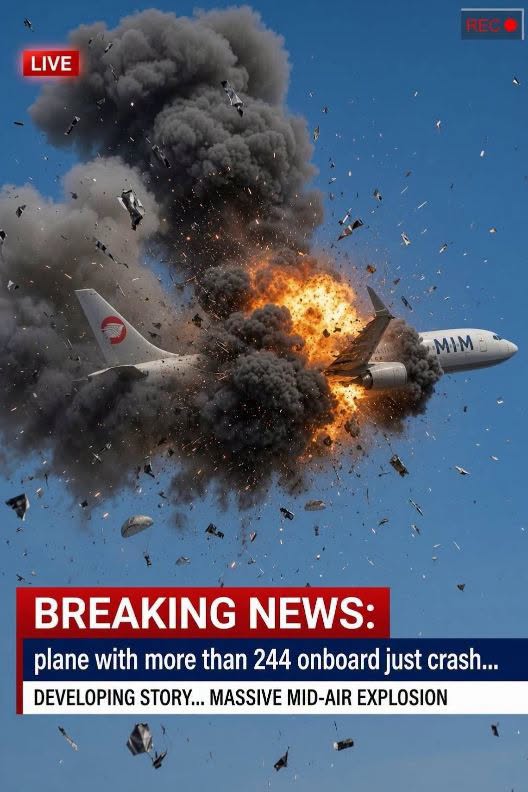
BREAKING NEWS: Passenger Plane Carrying More Than 244 People Crashes Shortly After Takeoff — A Tragedy That Shocked the World
A devastating aviation tragedy can unfold in only a matter of seconds. One moment, passengers are beginning a journey, looking forward to reaching their destination, speaking with loved ones, checking their phones, or simply settling into their seats. The next moment, everything can change.
That is what happened in one of the most heartbreaking aviation disasters in recent years, when an Air India passenger aircraft bound for London crashed shortly after taking off from Ahmedabad, India, in June 2025. Early reports indicated that more than 240 people were aboard the aircraft, with figures reported as 242 or 244 depending on the source and stage of reporting.
The tragedy immediately sent shockwaves through India and around the world.
A Flight That Never Reached Its Destination
The aircraft had departed from Sardar Vallabhbhai Patel International Airport in Ahmedabad and was headed toward London. Instead of continuing its scheduled journey across continents, the aircraft crashed shortly after takeoff.
Witnesses in the area reported seeing a massive column of smoke rising into the sky. Television footage showed emergency responders rushing toward the crash site as authorities began one of the most difficult operations imaginable: searching the wreckage, helping survivors, accounting for passengers and crew, and informing families.
The location of the crash made the situation particularly distressing. Ahmedabad is a major city with millions of residents, and the aircraft came down in a populated area near the airport.
For families waiting at airports in India and the United Kingdom, the hours that followed were filled with fear and uncertainty.
Many relatives had expected a routine flight. They may have said goodbye to their loved ones only hours earlier, believing they would soon receive a message saying the plane had landed safely.
Instead, they were confronted with devastating news.
Emergency Crews Race to the Scene
Following an aviation disaster, the first priority is always saving lives.
Emergency workers, firefighters, police officers, medical teams, airport personnel, and other responders rushed to the area. Their work was made more difficult by the scale of the wreckage and the conditions surrounding the crash.
Every minute mattered.
Rescue teams had to search through debris while trying to identify people who might need urgent medical attention. Hospitals in the surrounding area prepared to receive casualties.
For the responders, this was not simply another emergency call. They were dealing with hundreds of lives potentially affected by a single catastrophic event.
Scenes from the crash site showed thick smoke and widespread destruction, creating a picture that was difficult for many people around the world to comprehend.
Families Waiting for Answers
Perhaps the most painful part of any aviation disaster comes after the initial impact.
It is the waiting.
Families want to know whether their loved ones are alive. They want confirmed information. They want names, answers, and certainty.
But immediately after a major crash, authorities often cannot provide complete information.
Passenger lists must be verified. Identification procedures must be completed. Investigators must secure the crash site. Officials must communicate information carefully so that families do not learn about the fate of loved ones through rumors or social media.
That period can feel unbearable.
Behind every passenger number is a human being.
There may have been parents traveling to visit their children, couples returning home, business travelers heading to meetings, students beginning new chapters, tourists returning from trips, and people simply traveling from one place to another.
A passenger manifest is a list of names, but each name represents an entire network of family members, friends, coworkers, and communities.
What Caused the Crash?
One of the first questions people naturally ask after an aircraft disaster is: What went wrong?
However, determining the cause of an aviation accident is rarely immediate.
Investigators typically examine many possibilities, including aircraft systems, engines, flight controls, weather, maintenance records, crew actions, airport conditions, air traffic communications, and other technical or operational factors.
It is important not to declare a cause before investigators have completed their work.
Social media can quickly become filled with theories after a crash. Some posts may claim mechanical failure. Others may blame weather, pilot error, fuel problems, birds, or technical malfunctions.
But speculation is not evidence.
Aviation accident investigators must reconstruct what happened using flight data, cockpit recordings, physical evidence, maintenance records, witness accounts, and other information.
The goal is not simply to determine who was responsible. One of the most important purposes of an accident investigation is to discover what happened so that future tragedies can potentially be prevented.
A Global Aviation Community in Mourning
When a major commercial aircraft crashes, the impact extends far beyond the country where the accident occurs.
Passengers may come from different cities and countries. Their relatives may live thousands of miles away. The airline may operate internationally. The destination may be on another continent.
That is why aviation tragedies often produce an international response.
People who never knew the passengers personally may still feel grief.
There is something uniquely emotional about a plane crash because air travel has become such an ordinary part of modern life. Millions of people board aircraft every day expecting to reach their destinations safely.
A tragedy like this reminds the world that behind every flight number are real people with families, dreams, responsibilities, and stories.
The Importance of Accurate Information
In the immediate aftermath of a disaster, accurate reporting becomes extremely important.
False information can cause additional pain.
Imagine a family member seeing an unconfirmed social media post claiming that a particular passenger survived, only to discover later that the information was incorrect. Or imagine relatives learning about a confirmed death from a social-media account before authorities have had an opportunity to notify them.
That is why responsible reporting requires patience.
Numbers can change as authorities verify passenger manifests. Details about injuries and fatalities can change as rescue and identification operations continue.
The safest approach is to rely on official authorities and reputable news organizations rather than viral posts or anonymous accounts.
Remembering the People, Not Just the Numbers
When discussing an aviation tragedy, it is easy to focus on statistics.
More than 240 people.
One aircraft.
One airport.
One destination.
One crash.
But numbers can never fully describe the human cost.
Every person aboard the aircraft had a life beyond the flight.
Someone may have been waiting for them at home.
Someone may have been expecting a phone call.
Someone may have been planning a celebration.
Someone may have had a dream they had not yet fulfilled.
That is why remembrance matters.
The people involved should not be reduced to a headline or a number. They were individuals whose lives mattered to families and communities.
Lessons for the Future
The aviation industry has developed an extraordinary safety culture over many decades, partly because previous accidents have provided painful lessons.
Investigations into disasters can lead to changes in aircraft design, pilot training, maintenance procedures, airport operations, emergency response, and regulations.
According to International Air Transport Association data, commercial aviation accidents remain rare relative to the enormous number of flights operating worldwide. Its 2024 safety reporting recorded 40.6 million flights and seven fatal accidents, although those accidents resulted in 244 onboard fatalities.
That statistic does not make any individual tragedy less painful.
Instead, it highlights why every accident must be investigated carefully.
The goal should always be to learn.
A Moment to Remember
The crash of an aircraft carrying more than 240 people is not merely an aviation story. It is a human story.
It is about families waiting for answers.
It is about emergency workers running toward danger while others are running away.
It is about investigators searching for truth.
It is about communities coming together during unimaginable grief.
And it is about remembering the preciousness of life.
For those who lost loved ones, no headline can fully express their pain. No statistic can explain their loss. And no investigation can undo what happened.
But careful investigation, honest reporting, compassion, and remembrance can help ensure that the lives affected are never forgotten.
As the aviation community continues learning from tragedies such as this, the hope remains that future passengers will board aircraft, fasten their seat belts, look out the window, and arrive safely at their destinations.
For now, the most important message is one of compassion.
Remember the victims. Support the families. Respect the facts. And never turn tragedy into speculation.
Aviation disasters remind us how fragile life can be—but they also remind us how important it is to value every journey, every goodbye, every reunion, and every person waiting for us at the other end.